
The Next Layer of Intelligence: How 11/AI Can Strengthen National Security Missions

Introduction
Modern intelligence agencies operate in an environment defined by speed, ambiguity, and massive data volume. Organizations like the Central Intelligence Agency focus on collecting foreign intelligence, producing objective analysis, and supporting national security decisions .
Meanwhile, the National Security Agency specializes in signals intelligence, cryptography, and securing communications infrastructure .
These missions are evolving rapidly.
The next challenge is no longer just collecting intelligence it is controlling how intelligence-driven systems execute decisions.
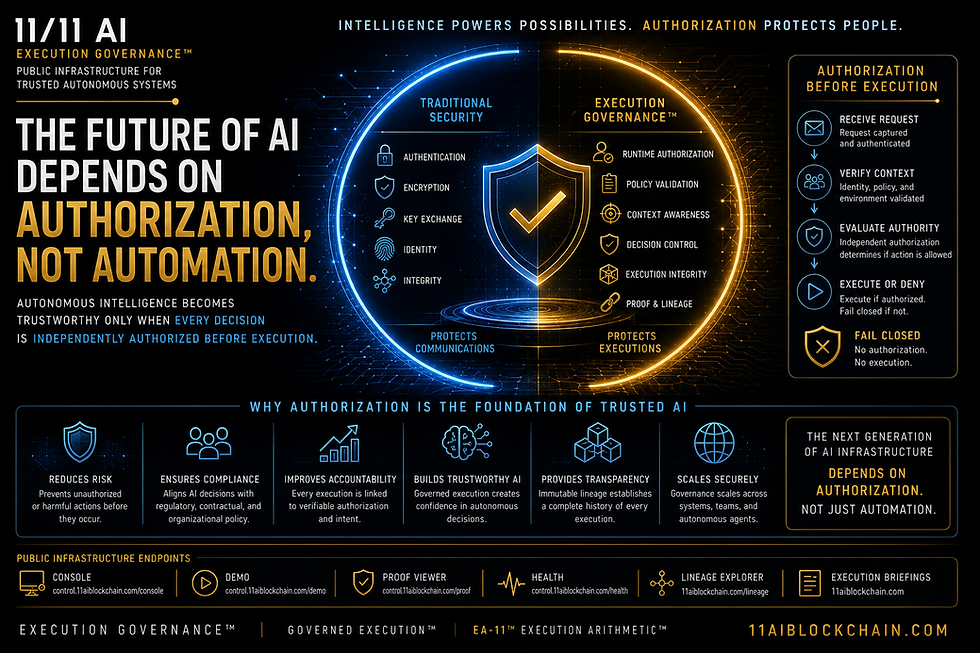
This is where 11/AI introduces a new category: execution governance for intelligence systems.

The Current Intelligence Model
Today’s intelligence workflow generally follows a familiar pattern:
Data is collected (signals, human intelligence, open source)
Analysis is performed
Decisions are made
Actions are executed
This model has worked for decades. But with AI systems now embedded across analysis and operations, a new risk has emerged:
Execution happens before full validation.
Even the most advanced agencies are now accelerating adoption of private-sector technology and AI to keep pace with threats . Speed is increasing but so is complexity.
The Gap: Execution Without Control
AI-enabled intelligence introduces a fundamental problem:
Models can recommend or trigger actions
Systems can operate autonomously
Decisions can propagate faster than human oversight
This creates a critical gap:
There is no universal control layer that enforces what AI is allowed to do before it executes.
For national security environments, this gap is not theoretical it is operational risk.
What 11/AI Introduces
11/AI is not another model.
It is a control plane for execution authority.
Instead of improving prediction, it enforces:
What actions are allowed
Under what conditions
With cryptographic proof of compliance
Core Principle
Request → Verify → Allow or Deny → Execute → Proof
This transforms intelligence systems from:
Observed after execution
to
Controlled before execution
Why This Matters for NSA and CIA Missions
1. Intelligence Integrity
The Central Intelligence Agency is responsible for delivering objective intelligence to decision-makers .
11/AI adds:
Verified execution pathways
Tamper-proof audit trails
Deterministic system behavior
Result: Intelligence that can be trusted not just in analysis but in action.
2. Signals Intelligence and Cyber Operations
The National Security Agency operates at the core of global communications intelligence and cybersecurity .
11/AI enhances:
Cryptographic enforcement of system behavior
Pre-execution policy validation for cyber actions
Controlled automation in network operations
Result: Secure execution in high-speed cyber environments.
3. AI Adoption at Mission Speed
The CIA has already moved to accelerate integration of private-sector technology and AI capabilities .
11/AI enables:
Safe deployment of AI in classified environments
Policy-bound execution across models and systems
Fail-closed enforcement if conditions are not met
Result: Speed without loss of control.
4. Counterintelligence and Risk Reduction
Modern threats include:
Adversarial AI
Data poisoning
Unauthorized system actions
11/AI provides:
Execution-level enforcement boundaries
Identity-bound system behavior
Immutable logs for forensic validation
Result: Reduced risk of silent failure or unauthorized execution.
The Strategic Shift
The intelligence community is entering a new phase:
From data advantage
to
execution control advantage
Historically, power came from:
Better intelligence collection
Better analysis
Now, advantage will come from:
Controlling how intelligence systems act before they act.
Why This Is a National Security Question
In defense and intelligence environments, the key questions are no longer:
“Is the model accurate?”
“Is the data correct?”
The real question is:
Who controls execution authority in AI-driven systems?
Without that control:
Systems can act outside intent
Errors can propagate instantly
Attribution becomes difficult
With control:
Actions are deterministic
Policies are enforced at runtime
Every execution is provable
Positioning 11/AI
11/AI is not a replacement for existing intelligence systems.
It is the layer that sits above them.
Think of it as:
Not the model
Not the data
Not the network
But the authority layer that governs execution across all of them
Conclusion
Agencies like the National Security Agency and Central Intelligence Agency are already evolving toward faster, AI-driven operations.
But as speed increases, so does risk.
The next strategic platform will not be defined by better AI models.
It will be defined by:
Who controls what those models are allowed to do before they do it.
11/AI represents that shift.
From intelligence collection to intelligence control From analysisto execution authority
And ultimately:
From observing systems… to governing them.


Comments