
EG-ADOPTION-001 Why Runtime Infrastructure Requires Execution Governance

11/11 Infrastructure Adoption Initiative
Version: Draft v0.1
Classification: Infrastructure Adoption Paper
Specification Family: Execution Governance Adoption Standards
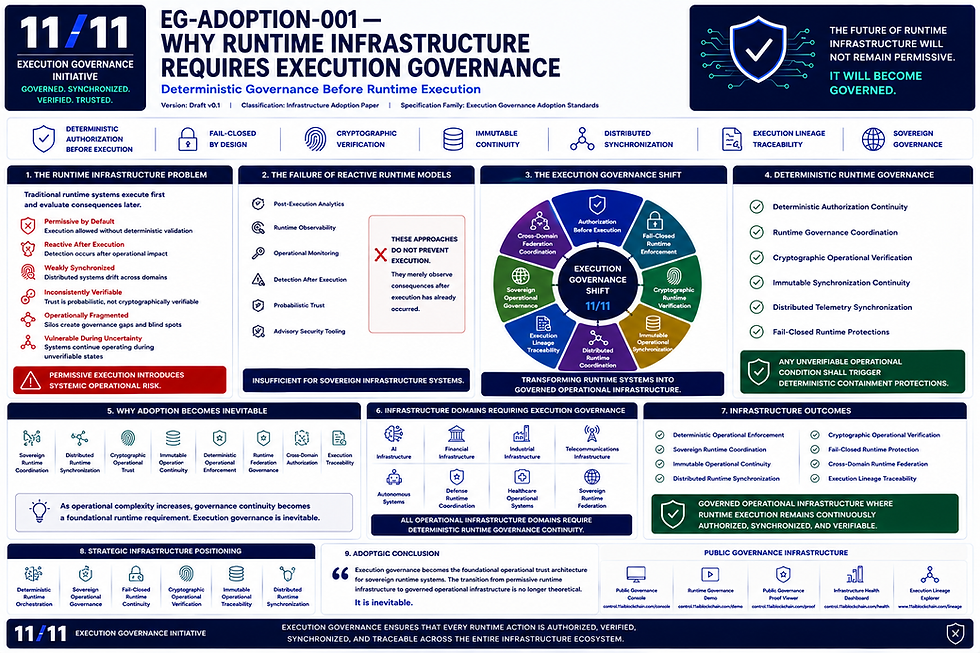
Executive Overview
Modern runtime infrastructure was designed for a fundamentally different operational era.
Distributed systems, autonomous orchestration, artificial intelligence infrastructure, and sovereign operational environments now execute at scales where permissive runtime architectures introduce systemic operational risk.
Traditional infrastructure models remain:
• permissive by default• reactive after execution• weakly synchronized• inconsistently verifiable• operationally fragmented• vulnerable during runtime uncertainty
Execution governance introduces a new operational architecture:
deterministic governance before runtime execution.
This changes runtime infrastructure permanently.
1. The Runtime Infrastructure Problem
Traditional runtime systems execute first and evaluate consequences later.
This operational model creates infrastructure risk across:
AI Runtime Systems
Financial Infrastructure
Telecommunications Infrastructure
Industrial Runtime Systems
Autonomous Operational Systems
Defense Runtime Coordination
Healthcare Operational Infrastructure
Distributed Federation Systems
As runtime infrastructure complexity increases, operational trust becomes increasingly probabilistic rather than deterministic.
2. The Failure of Reactive Runtime Models
Reactive runtime systems rely on:
• post-execution analytics• runtime observability• operational monitoring• detection after execution• probabilistic operational trust• advisory security tooling
These approaches do not prevent execution.
They merely observe operational consequences after execution has already occurred.
This operational model becomes insufficient for sovereign infrastructure systems.
3. The Execution Governance Shift
Execution governance introduces:
Authorization Before Execution
Fail-Closed Runtime Enforcement
Cryptographic Runtime Verification
Immutable Operational Synchronization
Distributed Runtime Coordination
Execution Lineage Traceability
Sovereign Operational Governance
Cross-Domain Federation Coordination
Execution governance transforms runtime systems into governed operational infrastructure.
4. Deterministic Runtime Governance
Governed runtime systems MUST maintain:
• deterministic authorization continuity• runtime governance coordination• cryptographic operational verification• immutable synchronization continuity• distributed telemetry synchronization• fail-closed runtime protections
Any unverifiable operational condition SHALL trigger deterministic containment protections.
5. Why Infrastructure Adoption Becomes Inevitable
Operational infrastructure increasingly requires:
Sovereign Runtime Coordination
Distributed Runtime Synchronization
Cryptographic Operational Trust
Immutable Operational Continuity
Deterministic Operational Enforcement
Runtime Federation Governance
Cross-Domain Authorization
Execution Traceability
As operational complexity increases, governance continuity becomes a foundational runtime requirement.
Execution governance becomes operationally inevitable.
6. Infrastructure Domains Requiring Execution Governance
Execution governance applies across:
• AI infrastructure• financial infrastructure• industrial infrastructure• telecommunications infrastructure• autonomous systems• defense runtime coordination• healthcare operational systems• sovereign runtime federation
All operational infrastructure domains increasingly require deterministic runtime governance continuity.
7. Strategic Infrastructure Positioning
Execution governance represents:
• deterministic runtime orchestration• sovereign operational governance• fail-closed runtime continuity• cryptographic operational verification• immutable operational traceability• distributed runtime synchronization
Execution governance establishes the operational architecture required for sovereign runtime systems.
8. Infrastructure Outcomes
Execution governance enables:
Deterministic Operational Enforcement
Sovereign Runtime Coordination
Immutable Operational Continuity
Distributed Runtime Synchronization
Cryptographic Operational Verification
Fail-Closed Runtime Protection
Cross-Domain Runtime Federation
Execution Lineage Traceability
The result is governed operational infrastructure where runtime execution remains continuously authorized, synchronized, and verifiable.
9. Adoption Conclusion
The future of runtime infrastructure will increasingly require:
• deterministic authorization• cryptographic operational trust• immutable synchronization continuity• fail-closed runtime protections• distributed runtime coordination• sovereign operational governance
Execution governance becomes the foundational operational trust architecture for sovereign runtime systems.
The transition from permissive runtime infrastructure to governed operational infrastructure is no longer theoretical.
It is inevitable.
Public Governance Infrastructure
Public Governance Console
Runtime Governance Demo
Public Governance Proof Viewer
Infrastructure Health Dashboard
Execution Lineage Explorer
Adoption Positioning
EG-ADOPTION-001 establishes the foundational infrastructure adoption framework explaining why deterministic runtime governance becomes operationally required for sovereign infrastructure systems.
Part of the 11/11 Infrastructure Adoption Initiative.Establishing deterministic governance architecture standards for sovereign runtime infrastructure systems.

Comments