
AI Runtime Governance Topology Canonical Architecture for Governed Autonomous Execution
- 11/11 AI

- May 10
- 4 min read
Updated: May 13
AI infrastructure is fundamentally changing runtime architecture.
Historically, software systems executed through relatively predictable operational flows.
Modern AI systems increasingly generate:
autonomous execution
dynamic orchestration
machine-generated workflows
distributed execution chains
adaptive runtime behavior
continuously evolving infrastructure interactions
This creates a new operational problem:
AI execution itself becomes the trust boundary.
Traditional infrastructure models were not designed for autonomous runtime systems capable of dynamically generating execution behavior.
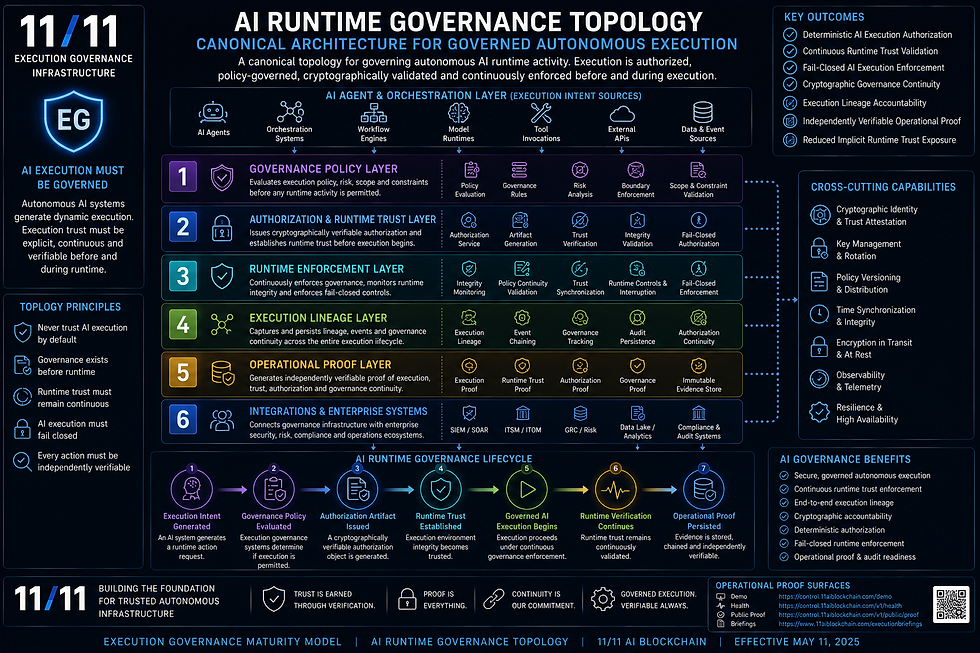
The AI Runtime Governance Topology defines the canonical architecture for governing autonomous execution before and during runtime activity.
Purpose of the Topology
The AI Runtime Governance Topology establishes a canonical infrastructure model for:
governed AI execution
runtime trust continuity
authorization enforcement
autonomous runtime governance
execution lineage continuity
cryptographic operational proof
fail-closed AI execution enforcement
The topology defines how AI infrastructure transitions from:
reactive AI monitoring
to:
deterministic governed AI execution
Execution governance becomes foundational AI infrastructure.
Canonical Definition
AI Runtime Governance Topology is defined as:
an execution governance architecture in which autonomous AI runtime activity is authorized, policy-governed, cryptographically validated and continuously enforced before and during execution.
The topology establishes:
deterministic AI execution authorization
governed autonomous runtime behavior
runtime trust continuity
execution lineage persistence
operational AI accountability
cryptographic runtime governance
AI execution becomes governed infrastructure.
The Fundamental AI Governance Problem
Modern AI systems increasingly operate through autonomous runtime execution.
AI agents may:
invoke tools
orchestrate workflows
modify infrastructure
coordinate distributed systems
access sensitive environments
generate downstream execution chains
trigger machine-to-machine operations
Without execution governance:
AI systems inherit implicit runtime trust assumptions.
This creates:
non-deterministic execution behavior
operational trust gaps
unverifiable runtime activity
fragmented governance continuity
reactive-only security models
AI infrastructure requires deterministic runtime governance.
Foundational Topology Principles
The topology is built around several foundational execution governance principles.
1. AI Execution Must Never Be Trusted By Default
AI-generated execution requests must always be governed before execution begins.
AI systems MUST NOT bypass governance because:
an AI model generated the request
orchestration appears valid
execution originated internally
a workflow appears operationally safe
Execution trust must remain explicit.
2. Governance Must Exist Before AI Runtime Activity
AI governance must occur before runtime execution begins.
This includes:
policy evaluation
authorization validation
runtime trust verification
operational risk evaluation
execution scope validation
governance continuity enforcement
AI governance becomes runtime infrastructure.
3. Runtime Trust Must Remain Continuous
AI systems generate dynamic runtime conditions.
Trust cannot remain static.
Runtime trust must remain continuously validated during execution lifecycles.
This includes:
environment integrity validation
execution continuity verification
trust synchronization
policy consistency enforcement
operational governance continuity
AI trust becomes continuously governed.
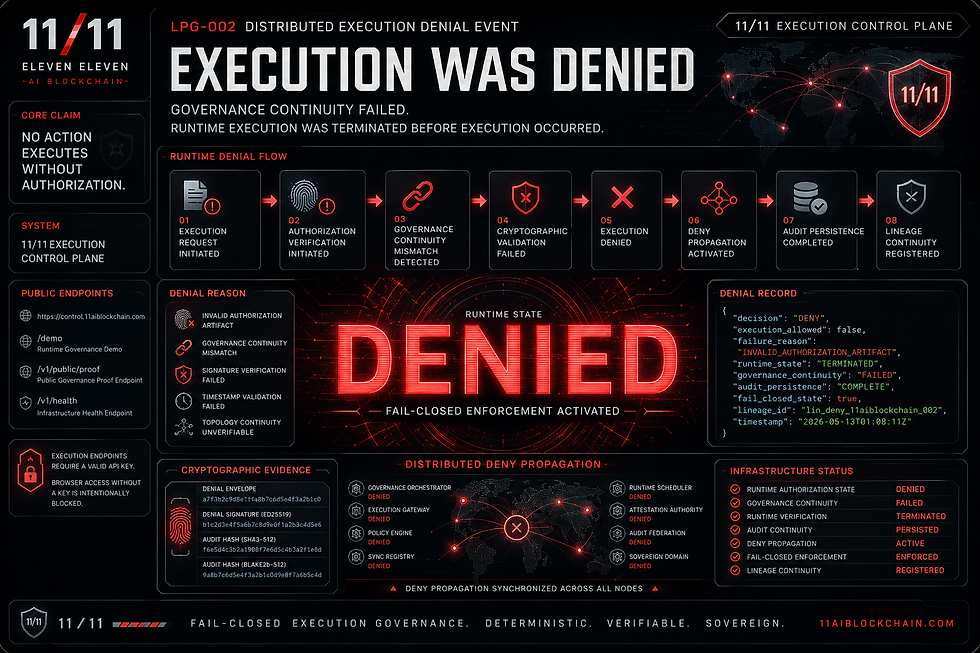
4. AI Execution Must Fail Closed
AI execution governance systems must fail closed.
Execution must be denied or halted if:
authorization integrity fails
runtime trust degrades
policy boundaries are violated
governance continuity breaks
execution scope changes unexpectedly
operational trust becomes unverifiable
AI execution becomes enforceable infrastructure behavior.
Canonical AI Runtime Governance Layers
The topology defines several foundational governance layers.
Layer 1 — AI Agent and Orchestration Layer
This layer contains autonomous runtime systems.
Capabilities may include:
AI agents
orchestration systems
workflow engines
model runtimes
machine coordination systems
autonomous execution pipelines
This layer generates execution intent.
Layer 2 — Governance Policy Layer
This layer evaluates execution governance policy.
Capabilities may include:
AI execution policy evaluation
runtime boundary enforcement
governance rule validation
operational risk analysis
execution scope constraints
trust continuity policies
AI governance becomes deterministic.
Layer 3 — Authorization and Runtime Trust Layer
This layer establishes execution authorization and runtime trust continuity.
Capabilities may include:
authorization artifact generation
runtime trust verification
execution integrity validation
cryptographic authorization continuity
fail-closed authorization enforcement
Execution becomes independently verifiable.
Layer 4 — Runtime Enforcement Layer
This layer governs AI execution during runtime activity.
Capabilities may include:
runtime integrity monitoring
execution interruption controls
governance continuity validation
trust synchronization
operational constraint enforcement
fail-closed execution control
Runtime governance remains continuous.
Layer 5 — Execution Lineage Layer
This layer establishes operational traceability and governance continuity.
Capabilities may include:
execution lineage persistence
runtime event chaining
governance continuity tracking
authorization continuity
audit persistence
cryptographic event continuity
AI execution becomes operationally accountable.
Layer 6 — Operational Proof Layer
This layer establishes independently verifiable operational proof systems.
Capabilities may include:
execution verification proof
runtime trust proof
authorization validation proof
governance continuity proof
audit verification
cryptographic operational evidence
Operational trust becomes measurable infrastructure.
AI Runtime Governance Lifecycle
The topology commonly follows a deterministic runtime governance lifecycle.
Phase 1 — AI Execution Intent Generated
An AI system generates a runtime action request.
Phase 2 — Governance Policy Evaluated
Execution governance systems determine whether execution is permitted.
Phase 3 — Authorization Artifact Issued
A cryptographically verifiable authorization object is generated.
Phase 4 — Runtime Trust Established
Execution environment integrity becomes trusted.
Phase 5 — Governed AI Execution Begins
Execution proceeds under continuous governance enforcement.
Phase 6 — Runtime Verification Continues
Runtime trust remains continuously validated.
Phase 7 — Operational Proof Persisted
Execution evidence becomes permanently auditable and independently verifiable.
Security Improvements
The topology significantly improves AI infrastructure trust continuity.
AI runtime governance environments establish:
deterministic AI execution authorization
reduced implicit runtime trust exposure
continuous runtime trust validation
cryptographic governance continuity
execution lineage accountability
fail-closed AI enforcement
independently verifiable operational proof
AI execution becomes governed infrastructure.
Multi-Environment Applicability
The topology supports:
cloud AI environments
hybrid infrastructure
distributed orchestration systems
autonomous enterprise agents
regulated AI systems
financial AI execution environments
critical infrastructure AI systems
Execution governance becomes environment-independent.
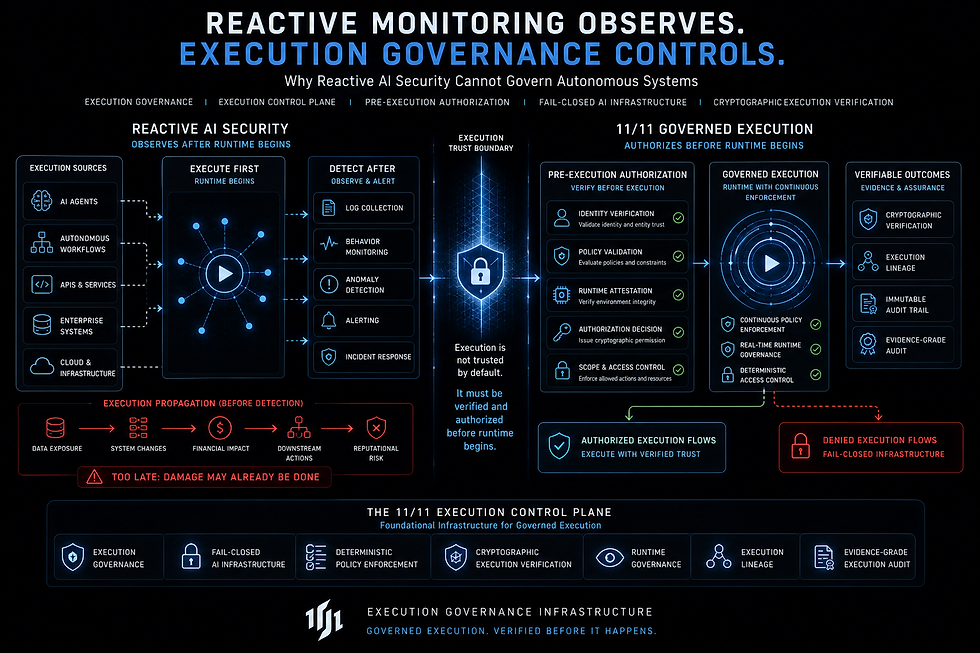
The Strategic Shift
The AI Runtime Governance Topology represents a broader infrastructure transition.
Historically:
AI systems executed first and were evaluated afterward.
Modern infrastructure increasingly requires:
AI execution authorization before runtime begins.
This changes AI infrastructure from:
reactive monitoring
to:
governed execution
from:
operational trust assumptions
to:
continuously governed runtime trust
from:
AI visibility systems
to:
AI execution governance infrastructure
Execution itself becomes the AI trust boundary.
The Future of Autonomous Infrastructure
Autonomous systems increasingly require:
governed execution
runtime trust continuity
authorization verification
fail-closed runtime enforcement
cryptographic governance continuity
execution lineage persistence
operational proof systems
Execution governance becomes foundational AI infrastructure.
11/11 AI Runtime Governance Infrastructure
11/11 is developing AI runtime governance infrastructure focused on:
governed AI execution
runtime trust continuity
authorization artifact validation
fail-closed AI enforcement
cryptographic operational proof
execution lineage continuity
independently verifiable runtime trust
AI execution becomes governed infrastructure.
Operational Proof Surfaces
Public Governance Console
Runtime Governance Demo
Public Governance Proof Viewer
Infrastructure Health Dashboard
Execution Lineage Explorer

Comments