
Artificial Intelligence: Strategic Trajectory, Systemic Risk, and the Emergence of Execution Control Infrastructure

NATIONAL SECURITY BRIEFING:

Executive Summary
Artificial intelligence has transitioned from an analytical support capability into an operational force multiplier across intelligence, cyber, and military domains. Its integration into decision systems, targeting pipelines, cyber operations, and autonomous platforms has materially altered the speed and scale at which actions can be taken.
However, current AI deployment architectures contain a structural vulnerability that is not widely addressed in existing systems:
AI systems are permitted to execute prior to deterministic validation of intent, constraint, and authorization.
This introduces a critical gap between:
Capability and control
Decision and enforcement
Execution and verification
As AI systems scale across classified environments, adversarial engagement zones, and autonomous systems, this gap creates systemic risk that can be exploited by both external adversaries and internal system failures.
This briefing outlines:
The current state of AI deployment across national security domains
The structural vulnerabilities inherent in existing AI architectures
The emerging need for execution control infrastructure
The convergence of AI and quantum systems and its implications
The projected market and strategic value of AI infrastructure control
The role of execution governance platforms in future national security systems
The central conclusion is:
The next strategic advantage in AI will not be determined by model capability, but by control over execution prior to action.
1. Current State of AI in National Security Systems
Artificial intelligence is now embedded across multiple operational layers:
1.1 Intelligence Collection and Processing
AI is used to:
Process ISR data streams
Identify patterns across large datasets
Automate signal classification
Prioritize intelligence outputs
1.2 Decision Support Systems
AI assists in:
Threat assessment
Scenario modeling
Risk scoring
Resource allocation
1.3 Cyber Operations
AI is integrated into:
Intrusion detection systems
Automated response mechanisms
Network anomaly detection
Offensive cyber tooling
1.4 Autonomous Systems
AI powers:
Drone navigation and targeting
Swarm coordination
Autonomous surveillance platforms
Semi-autonomous weapons systems
1.5 Data Fusion and Multi-Domain Operations
AI enables:
Integration across air, land, sea, cyber, and space domains
Real-time situational awareness
Cross-domain coordination
2. Structural Vulnerability in Current AI Architectures
Despite widespread deployment, AI systems share a common operational model:
Input is received
Model processes input
Output is generated
Action is taken or recommended
Logging and review occur after execution
This model contains a pre-execution vulnerability window.
2.1 The Pre-Execution Gap
There is no deterministic enforcement layer that ensures:
The AI action is authorized before execution
The output complies with mission constraints
The system is operating within verified trust boundaries
2.2 Implications
This gap introduces several risks:
Unauthorized Execution
AI systems may execute actions outside intended parameters.
Adversarial Manipulation
Inputs can be crafted to induce unintended outputs.
Escalation Risk
Autonomous or semi-autonomous systems may trigger unintended escalation.
Lack of Accountability
Post-execution logs do not prevent the initial action.
3. Adversarial Threat Landscape
AI systems are now a primary target for adversarial exploitation.
3.1 Input Manipulation
Adversaries can:
Inject malicious data into training or inference pipelines
Manipulate sensor inputs
Exploit model biases
3.2 Model Exploitation
Attacks include:
Prompt injection
Model inversion
Data poisoning
3.3 System-Level Attacks
AI systems can be targeted through:
Infrastructure compromise
API manipulation
Credential theft
3.4 Strategic Outcome
The result is the ability to:
Influence decision-making
Trigger incorrect actions
Undermine trust in AI systems
4. The Limits of Current Mitigation Approaches
Current approaches focus on:
Model alignment
Post-execution auditing
Monitoring systems
Human-in-the-loop review
These methods are insufficient because:
They operate after execution
They do not prevent unauthorized actions
They rely on probabilistic rather than deterministic enforcement
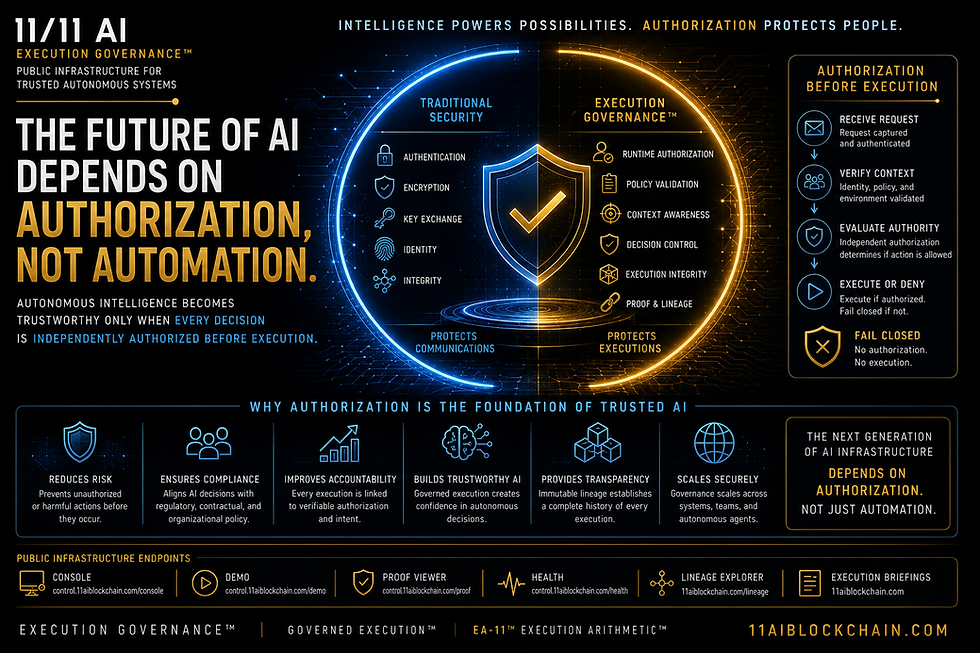
5. The Shift Toward Execution Control
A new architectural layer is emerging:
Execution Control Infrastructure
This layer introduces:
Pre-execution validation
Deterministic enforcement
Real-time authorization checks
Cryptographic verification of execution paths
5.1 Core Principle
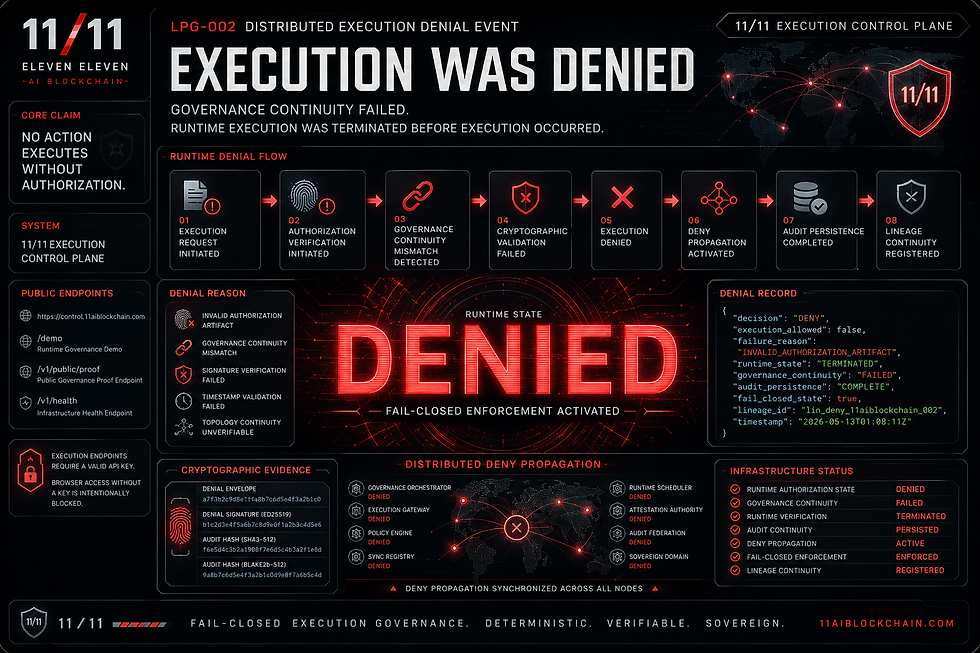
No action is executed without prior verification and authorization.
6. Execution Control Architecture Model
An effective execution control system includes:
6.1 Policy Layer
Defines:
Allowed actions
Prohibited actions
Contextual constraints
Identity requirements
6.2 Verification Layer
Performs:
Input validation
Context verification
Policy enforcement
6.3 Execution Layer
Ensures:
Execution occurs only after approval
Unauthorized actions are blocked
6.4 Proof and Audit Layer
Generates:
Cryptographic records of execution
Immutable audit trails
Verifiable decision lineage
7. Military and Intelligence Applications
7.1 Autonomous Systems
Execution control ensures:
Compliance with rules of engagement
Prevention of unintended targeting
Real-time authorization enforcement
7.2 Intelligence Pipelines
Execution control enables:
Validation of analytical outputs
Prevention of hallucinated intelligence
Verifiable decision chains
7.3 Cyber Operations
Execution control provides:
Controlled automated responses
Prevention of escalation through unauthorized actions
Forensic audit capabilities
7.4 Multi-Domain Operations
Execution control allows:
Unified policy enforcement across domains
Coordinated execution governance
Trusted interoperability
8. AI and Quantum Convergence
Quantum computing introduces:
Increased computational power
Potential to break classical encryption
New forms of system unpredictability
8.1 Implications for AI
Faster model training
Enhanced optimization
Increased system complexity
8.2 Risk Amplification
Quantum systems amplify existing risks:
Faster exploitation of vulnerabilities
Increased attack surface
Greater unpredictability in execution
9. Post-Quantum Security Requirements
Governments are already transitioning toward:
Post-quantum cryptography
Quantum-resistant infrastructure
Secure execution environments
Execution control systems must:
Integrate post-quantum cryptographic methods
Ensure long-term security of execution records
Maintain trust in future computing environments
10. Infrastructure Bottlenecks and Market Dynamics
AI growth is constrained by:
Compute limitations
Data center capacity
Energy consumption
Network bandwidth
10.1 Market Growth
AI infrastructure is projected to grow into the hundreds of billions of dollars.
10.2 Missing Category
Despite this growth, there is limited investment in:
Execution governance
Pre-runtime enforcement
Deterministic control systems
11. Strategic Importance of Execution Control
Execution control represents:
A new layer of computing infrastructure
A critical component of national security systems
A control point for all AI-driven operations
11.1 Control Plane Concept
Execution control acts as a control plane:
Governing AI behavior
Enforcing policy across systems
Providing a unified layer of authority
12. Global Strategic Implications
Nations that control execution infrastructure will:
Control AI deployment standards
Influence global security frameworks
Establish dominance in AI governance
Failure to develop this capability risks:
Loss of control over AI systems
Increased vulnerability to adversaries
Reduced strategic autonomy
13. Commercial and Civilian Expansion
Execution control will extend into:
Financial systems
Healthcare
Critical infrastructure
Cloud computing
13.1 Use Cases
Fraud prevention
Regulatory compliance
Secure AI decision-making
Infrastructure protection
14. Adoption Path
Phase 1
Pilot programs in defense and intelligence environments
Phase 2
Integration into classified systems
Phase 3
Standardization across agencies
Phase 4
Commercial deployment
15. Strategic Outlook
AI systems will continue to scale in:
Capability
Autonomy
Integration
Without execution control:
Risk scales faster than capability
Trust in AI systems degrades
Strategic advantage is compromised
16. Key Findings
AI is already operational in critical systems
Current architectures lack execution control
The pre-execution gap is a systemic vulnerability
Adversaries are actively targeting AI systems
Execution control is the missing infrastructure layer
Quantum computing will amplify both capability and risk
Control over execution will define future advantage
17. Final Assessment
The evolution of AI is entering a phase where:
Capability is no longer the limiting factor
Control becomes the defining constraint
The decisive question is not:
“How intelligent is the system?”
The decisive question is:
“Who controls what the system is allowed to do before it acts?”
Closing Statement
Artificial intelligence will continue to transform national security operations.
Quantum computing will increase the scale and speed of these transformations.
However, the determining factor in future strategic dominance will be:
The ability to enforce control over AI execution before it occurs.

Comments