
Autonomous AI Requires Execution Governance Infrastructure


Artificial intelligence is rapidly evolving beyond assistant-based systems.
The next generation of AI will not simply generate information.
It will generate actions.
Autonomous systems are now being developed to:
orchestrate infrastructure
execute transactions
modify software systems
coordinate operational workflows
manage security operations
interact with other AI systems
execute decisions without direct human intervention
This transition fundamentally changes the security and governance requirements of artificial intelligence infrastructure.
Current AI systems primarily operate inside an execution model that:
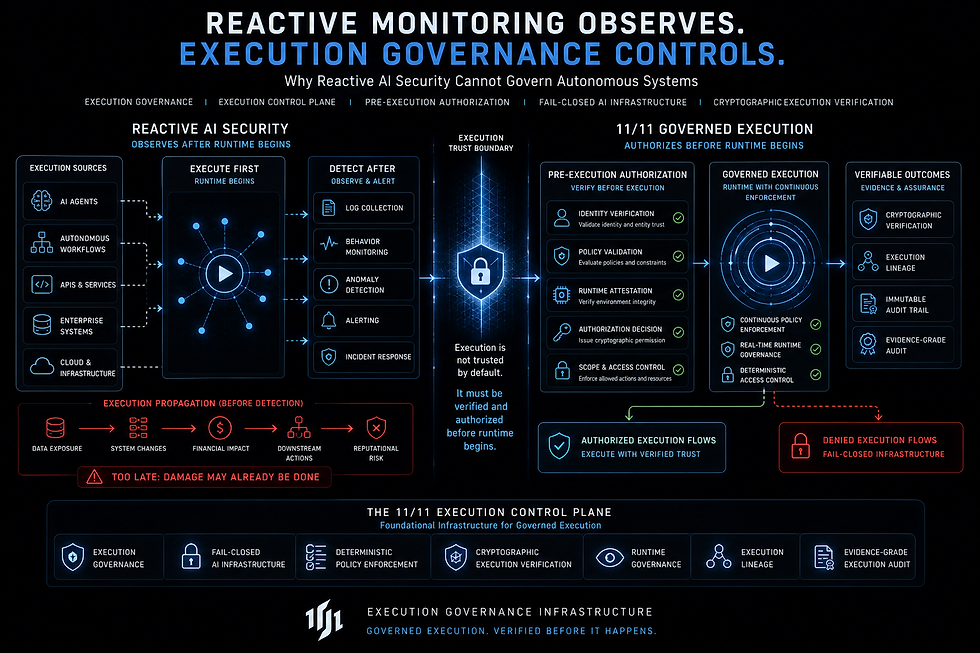
executes first
logs afterward
evaluates consequences later
That architecture may be tolerable for content generation systems.
It becomes extremely dangerous for autonomous execution systems.
As AI systems gain the ability to independently trigger operational actions, the requirement for governance before execution becomes unavoidable infrastructure.
11/11 introduces Execution Governance™ infrastructure for autonomous AI systems.
The objective is not to observe AI behavior after execution.
The objective is to determine whether execution should be permitted before execution occurs.
This introduces a fundamentally different infrastructure model.
The Transition From AI Assistants to Autonomous Systems
The global AI ecosystem is rapidly moving toward:
autonomous agents
AI orchestration frameworks
self-operating infrastructure systems
autonomous financial execution systems
AI-driven security operations
AI-to-AI operational coordination
These systems are no longer limited to generating text or recommendations.
They increasingly possess the ability to:
invoke APIs
trigger infrastructure changes
access sensitive systems
execute transactions
interact with operational environments
make independent execution decisions
This creates a new infrastructure problem.
When autonomous systems can independently execute actions, governance can no longer remain optional.
Governance becomes mandatory infrastructure.
The Core Failure of Current AI Infrastructure
Most modern AI systems still operate within an architecture model that prioritizes:
speed
execution
workflow completion
post-event monitoring
This creates an “execute first, investigate later” environment.
That model introduces severe operational risks across:
healthcare
finance
defense
government
energy
enterprise infrastructure
critical systems operations
Traditional observability systems primarily focus on:
logs
telemetry
monitoring
alerts
post-event analytics
These systems operate after execution has already occurred.
They do not determine whether execution itself should have been authorized.
This distinction becomes critically important as autonomous AI systems gain increasing operational authority.
What 11/11 Introduces
11/11 introduces a governance-first infrastructure architecture built around pre-execution authorization and deterministic runtime enforcement.
The architecture introduces:
pre-execution authorization
cryptographic authorization artifacts
runtime verification enforcement
deterministic policy validation
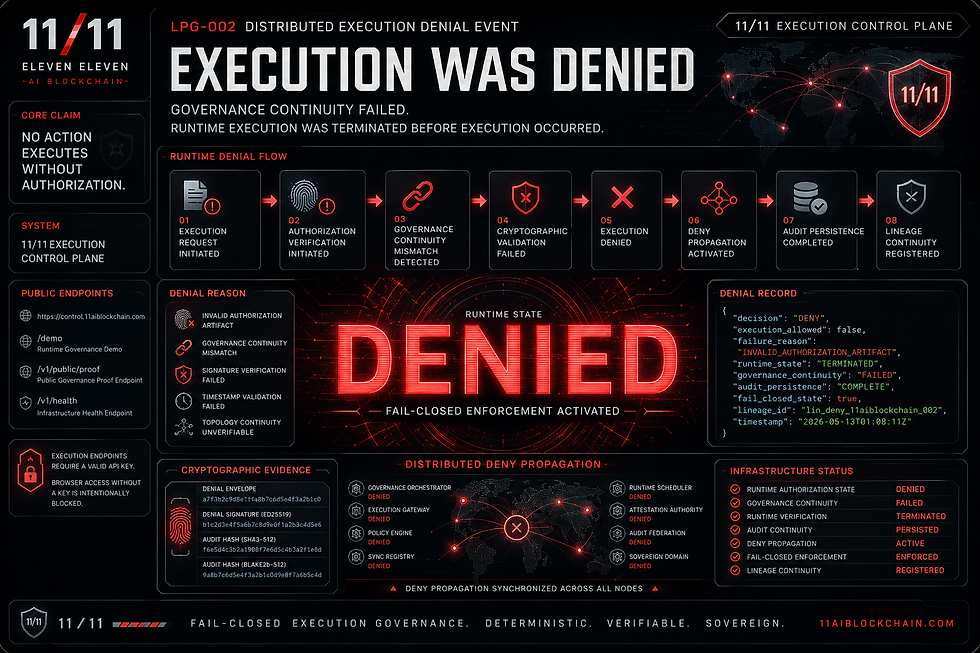
fail-closed execution models
execution lineage persistence
immutable audit chains
Under this model, execution is not treated as the default state.
Execution becomes a governed operation requiring authorization before runtime activity is permitted.
This creates a fundamentally different trust boundary for artificial intelligence systems.
Governance Before Execution
Execution Governance™ infrastructure introduces the concept that:authorization must exist before execution can occur.
This reverses the operational assumptions of many current AI architectures.
Instead of:execute → monitor → investigate
The model becomes:request → authorize → verify → execute → audit → persist lineage
This creates:
deterministic enforcement boundaries
verifiable execution trails
cryptographic governance validation
accountable runtime behavior
controlled autonomous execution
The result is a governance architecture designed for autonomous operational systems rather than passive AI observation.
Autonomous Systems Require Governance Infrastructure
Autonomous systems without execution governance become unbounded infrastructure.
As AI systems gain greater operational authority, the absence of governance creates:
unverified execution
uncontrolled decision chains
unverifiable infrastructure activity
non-deterministic operational risk
opaque autonomous behavior
Execution Governance infrastructure introduces:
enforceable execution boundaries
verifiable authorization
runtime accountability
execution lineage
deterministic operational control
This becomes increasingly necessary as AI systems expand into regulated and mission-critical environments.
The Future AI Infrastructure Stack
The next generation of AI infrastructure will likely evolve into layered governance architectures:
Application LayerAI ModelsAgent FrameworksExecution Governance LayerInfrastructure RuntimeCloud / Compute / Hardware
Execution Governance becomes the enforcement layer between intelligence generation and operational execution.
This introduces a new infrastructure category focused on governing whether execution itself should be permitted.
The Next Infrastructure Era
The next era of artificial intelligence will not be defined solely by model intelligence.
It will be defined by whether autonomous systems are permitted to execute actions without authorization.
As autonomous AI systems continue expanding into operational environments, governance before execution becomes foundational infrastructure.
Public Infrastructure Endpoints
Public Runtime Infrastructure
Public Governance Console
Runtime Governance Demo
Public Governance Proof Viewer
Infrastructure Health Dashboard
Execution Lineage Explorer
Execution endpoints intentionally require valid API authorization.
Browser access without a valid authorization key is fail-closed by design.
11/11 introduces Execution Governance™ infrastructure for the autonomous AI era.
Execution Governance™Governed Execution™Patent Pending

Comments