
Autonomous AI Without Execution Governance Creates Unbounded Operational Risk
- 11/11 AI

- May 22
- 3 min read

Artificial intelligence infrastructure is rapidly transitioning into autonomous operational infrastructure.
Modern AI systems increasingly possess the ability to:
execute workflows
orchestrate enterprise infrastructure
coordinate operational systems
interact with sensitive environments
initiate financial activity
trigger machine-speed operational decisions
As these systems gain execution authority, the operational risk model surrounding artificial intelligence fundamentally changes.
The core infrastructure question is no longer:“What information did the AI generate?”
The question becomes:“What actions was the AI allowed to execute?”
11/11 introduces Execution Governance™ infrastructure designed to establish deterministic operational control before autonomous execution occurs.
Autonomous Execution Changes the Risk Model
Traditional software systems primarily operate under direct human control.
Autonomous AI systems increasingly operate under delegated operational authority.
This creates entirely new categories of operational risk.
Autonomous systems can:
execute actions at machine speed
chain operational decisions together
interact with external systems autonomously
scale execution across environments
propagate errors rapidly
operate continuously without direct intervention
Without deterministic governance, autonomous infrastructure becomes operationally unbounded.
The Problem With Execute-First Architectures
Many current AI systems still operate inside architectures built around:
execution first
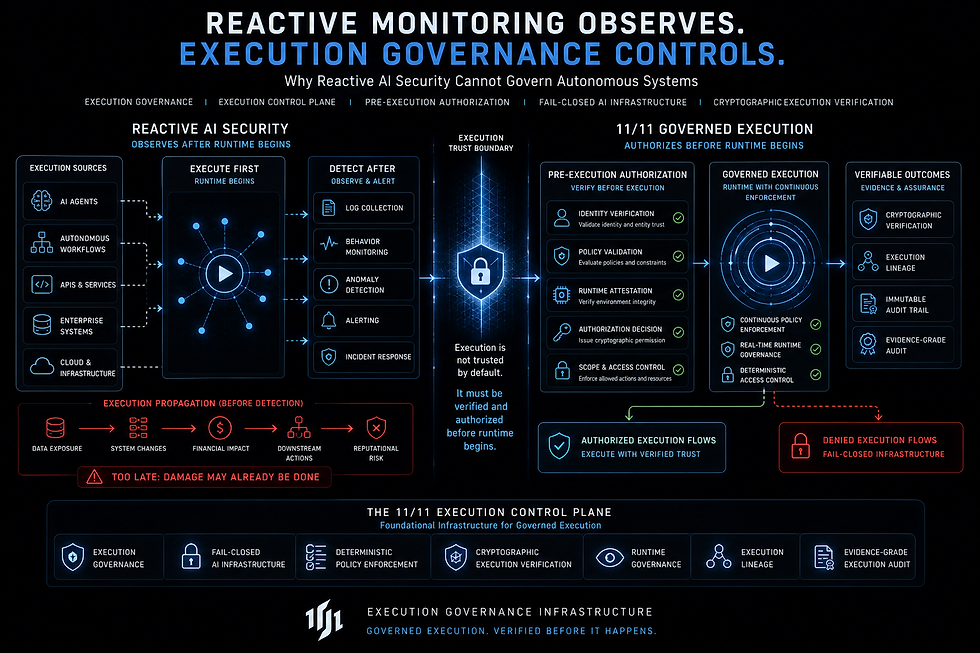
monitoring afterward
investigation after impact
reactive operational controls
These systems often assume:if execution occurred, operational trust already existed.
Autonomous AI systems invalidate that assumption.
Post-event monitoring cannot prevent:
unauthorized execution
policy bypass
operational drift
privilege escalation
out-of-bound runtime activity
machine-speed cascading failure
Governance must occur before execution begins.
Governance Before Execution
Execution Governance™ introduces a governance-first runtime architecture.
Instead of:execute → observe → investigate
The infrastructure flow becomes:request → authorize → verify → enforce → execute → audit → persist lineage
Under this model:
execution intent becomes declared
authorization occurs before runtime activity
runtime verification validates conditions continuously
deterministic enforcement governs execution boundaries
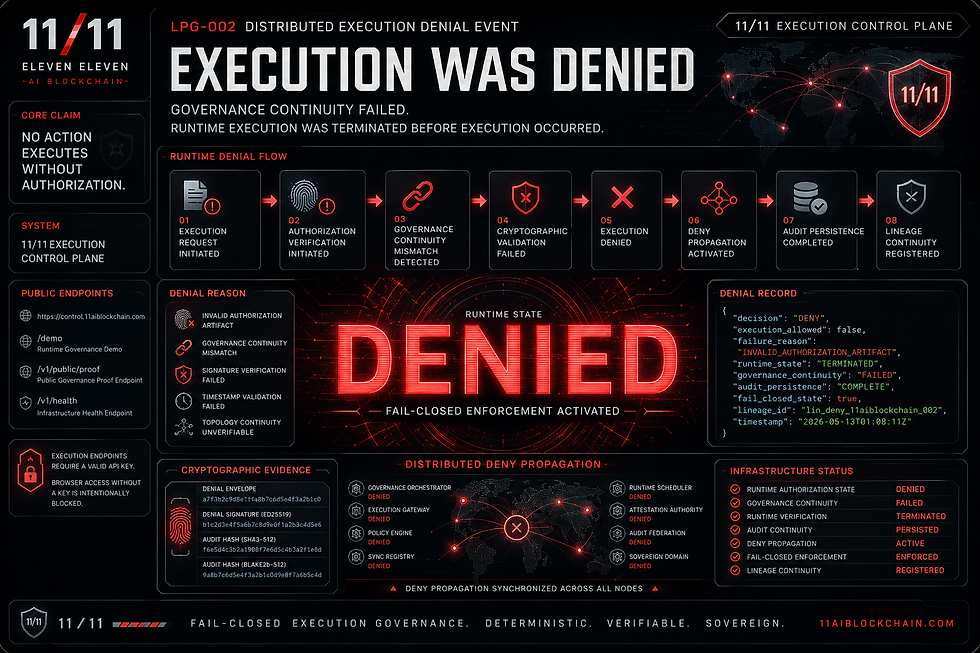
unauthorized activity fails closed
execution lineage preserves operational accountability
Execution becomes governed infrastructure rather than assumed behavior.
Unbounded AI Creates Systemic Risk
As AI systems expand into:
finance
healthcare
defense
government
enterprise infrastructure
energy
telecommunications
critical operational systems
…the absence of deterministic governance creates systemic operational risk.
Organizations increasingly require infrastructure capable of proving:
why execution occurred
who approved execution
what policies governed actions
whether runtime verification succeeded
whether governance boundaries remained intact
Without these controls, autonomous systems become difficult to trust, validate, or contain.
Governance as Operational Infrastructure
Execution Governance™ transforms governance from:
passive observation
retrospective analysis
monitoring overlays
advisory policy systems
…into enforceable runtime infrastructure.
Under this architecture:
authorization becomes mandatory
verification becomes deterministic
policy enforcement becomes operational
lineage becomes immutable
execution becomes attributable
trust becomes verifiable
This creates infrastructure designed specifically for autonomous operational systems.
The Future AI Runtime Stack
The next generation of AI infrastructure will increasingly require:
governance before execution
pre-execution authorization
runtime verification
deterministic policy enforcement
fail-closed operational control
immutable execution lineage
cryptographic operational accountability
Execution Governance becomes the operational trust layer between autonomous intelligence and runtime execution.
The Autonomous Infrastructure Era
The future of artificial intelligence infrastructure will not be defined solely by intelligence generation.
It will increasingly be defined by whether autonomous systems operate inside deterministic governance boundaries.
Autonomous AI without Execution Governance creates unbounded operational risk.
Public Infrastructure Endpoints
Public Runtime Infrastructure
Public Governance Console
Runtime Governance Demo
Public Governance Proof Viewer
Infrastructure Health Dashboard
Execution Lineage Explorer
Execution endpoints intentionally require valid API authorization.
Browser access without a valid authorization key is fail-closed by design.
11/11 introduces Execution Governance™ infrastructure for governed autonomous execution and deterministic operational trust.
Execution Governance™ Governed Execution™ Patent Pending

Comments