
Why Autonomous Infrastructure Requires Runtime Coordination


Autonomous systems do not fail only because of malicious activity.
They also fail because distributed infrastructure loses operational coordination.
As infrastructure becomes increasingly autonomous, execution is no longer isolated to a single application, server, workflow, or operator.
Execution now occurs across:
orchestration layers
cloud runtimes
AI systems
policy engines
infrastructure gateways
financial rails
operational APIs
distributed compute systems
autonomous service chains
Each component may be functioning correctly on its own.
But if operational coordination breaks down between them, governance certainty disappears.
This creates a new infrastructure challenge.
Autonomous systems require runtime coordination.
Runtime coordination means infrastructure components remain synchronized at the moment execution occurs.
Authorization state must align.
Policy state must align.
Runtime conditions must align.
Environmental context must align.
Operational trust must align.
Execution lineage must align.
Without synchronization across these layers, infrastructure begins operating on fragmented assumptions rather than deterministic governance.
That fragmentation creates operational drift.
A policy engine may approve execution while runtime conditions have already changed.
An orchestration layer may continue processing after authorization expires.
A distributed system may execute against stale operational context.
A runtime may proceed even though governance certainty no longer exists.
These failures are not theoretical.
They become increasingly probable as machine-speed infrastructure grows more autonomous, more distributed, and more interconnected.
This is why runtime coordination becomes foundational to governed execution.
Execution Governance™ treats coordination as an operational requirement, not an optimization layer.
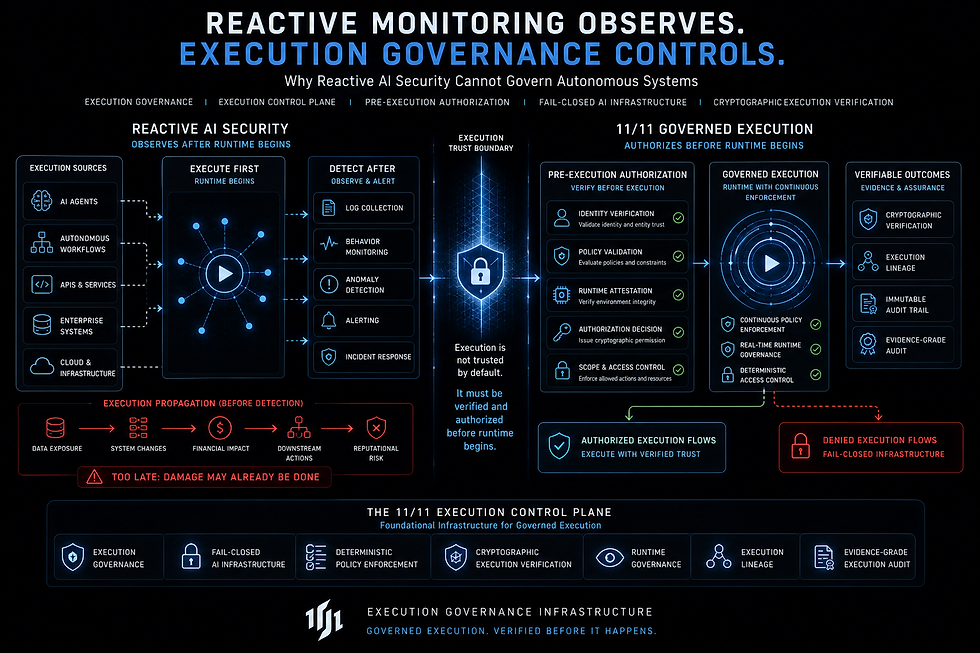
The infrastructure must continuously synchronize governance state before execution occurs.
Execution cannot rely on isolated validation.
It requires coordinated operational truth across the entire execution boundary.
This creates deterministic infrastructure behavior.
A governed system knows:
whether authorization is current
whether policy remains valid
whether runtime context changed
whether infrastructure conditions drifted
whether execution should proceed
whether proof remains trustworthy
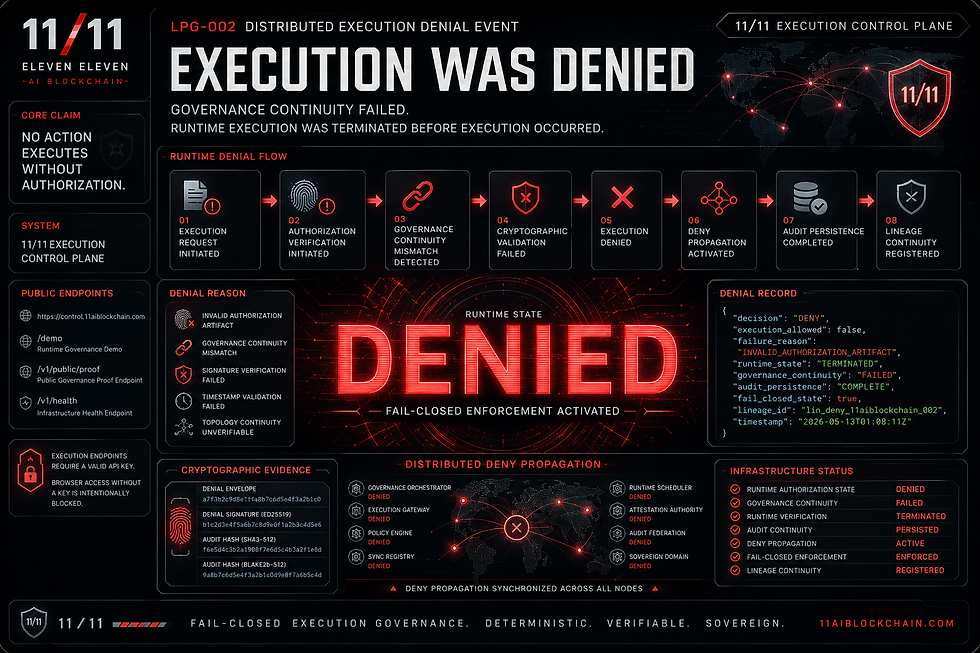
If synchronization fails, execution must fail closed.
No coordinated governance state means no trusted execution.
This principle becomes increasingly important in sovereign infrastructure environments.
Public systems, defense systems, healthcare systems, financial systems, and autonomous operational platforms cannot depend on fragmented runtime assumptions.
They require coordinated operational trust.
They require synchronized governance enforcement.
They require infrastructure capable of maintaining deterministic execution integrity at machine speed.
That capability is what runtime coordination provides.
The future of autonomous infrastructure is not simply automation.
It is governed synchronization.
Infrastructure that continuously coordinates authorization, runtime validation, policy enforcement, and operational trust before execution occurs.
That is how autonomous systems remain governable at scale.
That is how execution governance becomes operational infrastructure.
That is why runtime coordination is becoming mandatory for sovereign autonomous systems.
Public Infrastructure Endpoints
Public Runtime Infrastructure
Public Governance Console
Runtime Governance Demo
Public Governance Proof Viewer
Infrastructure Health Dashboard
Execution Lineage Explorer
Execution endpoints intentionally require valid API authorization.
Browser access without a valid authorization key is fail-closed by design.
11/11 introduces Execution Governance™ infrastructure for governed autonomous execution and deterministic operational trust.
Execution Governance™
Governed Execution™
Patent Pending

Comments