
Computational State Authority
- 11/11 AI

- May 29
- 3 min read

Computational systems are often described as collections of states.
Active.
Pending.
Approved.
Restricted.
Archived.
At first glance, these states appear equal.
Each simply represents a condition that a system may occupy.
Yet closer examination reveals something deeper.
Not all states possess equal influence.
Some states can create change.
Others can only receive change.
Some states govern behavior.
Others are governed by it.
Some states shape the future.
Others merely record the past.
This imbalance introduces a foundational concept within Computational State Theory:
Computational State Authority.
Authority is not merely a property of institutions.
It is a property of state itself.
Certain states possess greater capacity to influence computational reality than others.
Understanding this hierarchy becomes essential for understanding how modern systems actually function.
States Are Not Equal
Classical computational models frequently treat states as equivalent positions within a state machine.
A system moves from one state to another.
The transition occurs.
The model continues.
Yet operational systems rarely behave so simply.
An Approved state typically possesses greater operational influence than a Pending state.
An Administrative state possesses greater influence than a User state.
An Active policy possesses greater influence than a Historical record.
The states themselves are not equal.
Their ability to affect future system behavior differs dramatically.
Authority therefore emerges as a measurable characteristic of computational states.
Authority As Influence
The simplest definition of state authority is influence over future transitions.
A state possesses authority when it can affect what happens next.
Some states permit actions.
Some prohibit actions.
Some modify actions.
Some create entirely new pathways.
The greater a state's influence over future computational behavior, the greater its authority.
Authority is therefore not merely a label.
It is a functional capability embedded within computational reality.
The Hierarchy Of States
Most operational environments naturally develop state hierarchies.
Foundational states.
Governing states.
Operational states.
Dependent states.
Historical states.
These layers resemble institutional structures found throughout society.
Certain conditions shape the environment.
Other conditions operate within that environment.
The hierarchy emerges because systems require structure.
Without hierarchy, conflicting states would continuously compete for influence.
Authority provides resolution.
Authority determines precedence.
Authority determines which state ultimately controls behavior.
State Authority And Constraint
Authority is often misunderstood as the ability to permit action.
Its equally important function is constraint.
Many of the most influential states in a system exist primarily to limit behavior.
Restrictions.
Policies.
Controls.
Boundaries.
Requirements.
These states derive authority not from enabling activity but from constraining it.
The ability to prevent change is frequently more powerful than the ability to create it.
This principle appears throughout both computational and institutional systems.
Inherited Authority
Authority is not always created directly.
Sometimes authority is inherited.
A subordinate state may derive influence from a superior state.
A delegated permission derives influence from its originating authority.
A temporary role derives influence from a permanent role.
A federated identity derives influence from its issuing institution.
Authority therefore propagates through systems.
It flows.
It transfers.
It accumulates.
This inheritance creates complex authority networks that extend far beyond individual states.
Authority And Persistence
Persistence amplifies authority.
A temporary state may possess influence for minutes.
A persistent state may possess influence for decades.
The longer a state remains active, the greater its cumulative effect upon the system.
This relationship between persistence and authority explains why long-lived states frequently become foundational components of infrastructure.
Continuity magnifies influence.
Persistence magnifies authority.
Authority And Computational Order
Large systems require order.
Order requires structure.
Structure requires authority.
Without authority, state conflicts become impossible to resolve.
Competing permissions.
Competing identities.
Competing policies.
Competing outcomes.
Authority provides a mechanism through which systems determine precedence.
The result is stability.
Not because disagreement disappears.
But because the system possesses a mechanism for determining which state ultimately governs behavior.
The Future Of State Authority
As computational systems become increasingly autonomous, authority becomes increasingly important.
Future systems will manage enormous state spaces.
Millions of identities.
Millions of policies.
Millions of operational conditions.
The question will no longer be:
"What state exists?"
The question will increasingly become:
"Which state possesses authority?"
The answer determines behavior.
The answer determines outcomes.
The answer determines reality.
Conclusion
Computational states are not equal.
Some possess greater influence.
Some possess greater persistence.
Some possess greater control over future behavior.
These differences create authority.
Computational State Authority explains how influence emerges within state-based systems and why hierarchy becomes unavoidable as complexity increases.
States do not merely exist.
States govern.
The future of computational theory will increasingly depend upon understanding not only what states are, but which states possess authority.
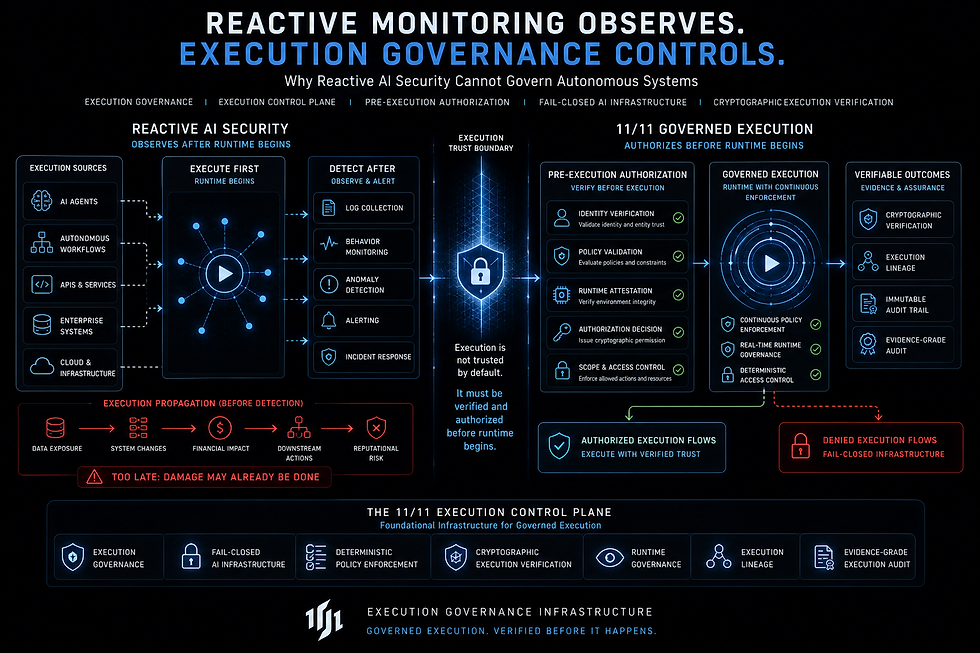
11/11 introduces Execution Governance™ infrastructure for governed autonomous execution and deterministic operational control.
Execution Governance™ Governed Execution™ EA-11™ Execution Arithmetic™
Patent Pending
Public Infrastructure Endpoints


Comments