
Computational State Failure Theory


Computational systems are often designed around success.
Valid states.
Expected transitions.
Authorized actions.
Intended outcomes.
Architecture documents frequently describe how systems should behave.
Reality is different.
Every sufficiently complex computational environment eventually encounters failure.
The question is not whether failure occurs.
The question is how failure emerges.
Traditional approaches frequently view failure as an event.
A crash.
An outage.
A corruption.
A compromise.
Yet these visible outcomes often represent the final stage of a much deeper process.
Failure is rarely an event.
Failure is usually a state evolution.
A progression.
A deterioration.
A breakdown of computational coherence occurring across time.
Computational State Failure Theory examines failure not as an isolated incident but as a transformation of state itself.
Failure Begins Before Collapse
Most computational failures remain invisible during their earliest stages.
The system appears operational.
Processes continue running.
Resources remain available.
Users remain active.
Yet beneath the surface, conditions begin changing.
Dependencies accumulate.
Relationships weaken.
Boundaries erode.
Policies drift.
Constraints become inconsistent.
The visible failure occurs later.
The underlying state failure begins much earlier.
Understanding failure therefore requires examining state conditions long before collapse becomes observable.
Failure As State Degradation
Many systems do not fail suddenly.
They degrade.
Performance declines.
Consistency declines.
Reliability declines.
Predictability declines.
The state remains operational.
Yet operational quality deteriorates.
This degradation creates an intermediate condition between success and collapse.
A mature theory of computational systems must recognize this space.
Not every state is healthy.
Not every state is failed.
Many exist somewhere in between.
State Conflict
One of the most common sources of failure is conflict.
Competing permissions.
Competing policies.
Competing authorities.
Competing identities.
Competing jurisdictions.
These conflicts create ambiguity.
Ambiguity creates instability.
Instability creates failure.
Large computational systems increasingly experience conflict not because components are malfunctioning, but because components are functioning according to incompatible assumptions.
Failure emerges from contradiction.
State Corruption
A state may persist while becoming corrupted.
Identity relationships become inaccurate.
Permissions become misaligned.
Policies become inconsistent.
Dependencies become damaged.
The state continues to exist.
Yet the state no longer accurately represents reality.
Corruption creates one of the most dangerous forms of failure because it often remains hidden.
The appearance of normal operation conceals the deterioration beneath.
Boundary Failure
Many failures originate at boundaries.
Isolation weakens.
Containment breaks.
Jurisdictions overlap.
Authority escapes intended scope.
Interaction exceeds intended limits.
Boundary failure frequently allows localized problems to become systemic problems.
What begins as a minor state anomaly spreads across the environment.
The result is cascading instability.
Inheritance Failure
Inheritance preserves continuity.
Inheritance can also preserve defects.
Flawed assumptions propagate.
Incorrect permissions propagate.
Obsolete constraints propagate.
Over time, inherited defects accumulate across generations of states.
The resulting system appears stable until those inherited weaknesses become operationally significant.
Failure may therefore originate decades before its visible manifestation.
Mutation Failure
Mutation enables adaptation.
Mutation also introduces risk.
Small modifications accumulate.
Interactions become increasingly complex.
Emergent behaviors appear.
Eventually the system may evolve beyond the assumptions upon which it was originally designed.
Failure emerges not because mutation occurred.
Failure emerges because mutation occurred without sufficient understanding.
Cascading Failure
The most severe failures are rarely isolated.
One failed state affects another.
That state affects another.
The process continues.
Failure propagates.
A local anomaly becomes a systemic disruption.
This phenomenon resembles biological, institutional, and economic systems.
Complex environments possess interconnected dependencies.
The greater the connectivity, the greater the potential for cascading effects.
Resilience As Failure Management
The objective of advanced computational systems is not eliminating failure.
That goal is impossible.
The objective is managing failure.
Detecting degradation.
Containing corruption.
Resolving conflict.
Repairing damage.
Restoring coherence.
Resilience emerges through the ability to absorb failure without systemic collapse.
Future computational infrastructures will increasingly be measured by this capability.
The Future Of Failure Theory
As computational systems become more autonomous, more persistent, and more interconnected, failure becomes increasingly complex.
The challenge will not be identifying crashes.
The challenge will be identifying deteriorating realities.
Future systems will require continuous visibility into state health, state coherence, and state stability.
Failure theory therefore becomes foundational to computational governance.
One cannot govern computational reality without understanding how computational reality fails.
Conclusion
Failure is not merely an event.
Failure is a state transformation.
States degrade.
States conflict.
States corrupt.
States collapse.
Understanding these processes reveals that computational failure begins long before visible disruption occurs.
Computational State Failure Theory provides a framework for understanding how systems deteriorate and how resilient infrastructures preserve coherence despite inevitable disruption.
The future belongs not to systems that never fail.
The future belongs to systems that understand failure before failure becomes reality.
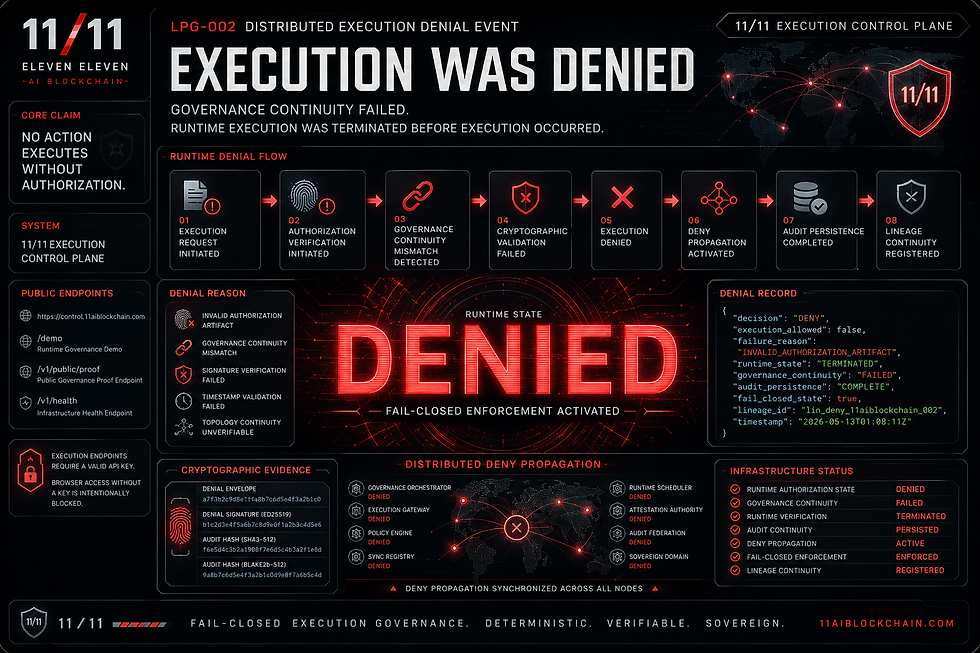
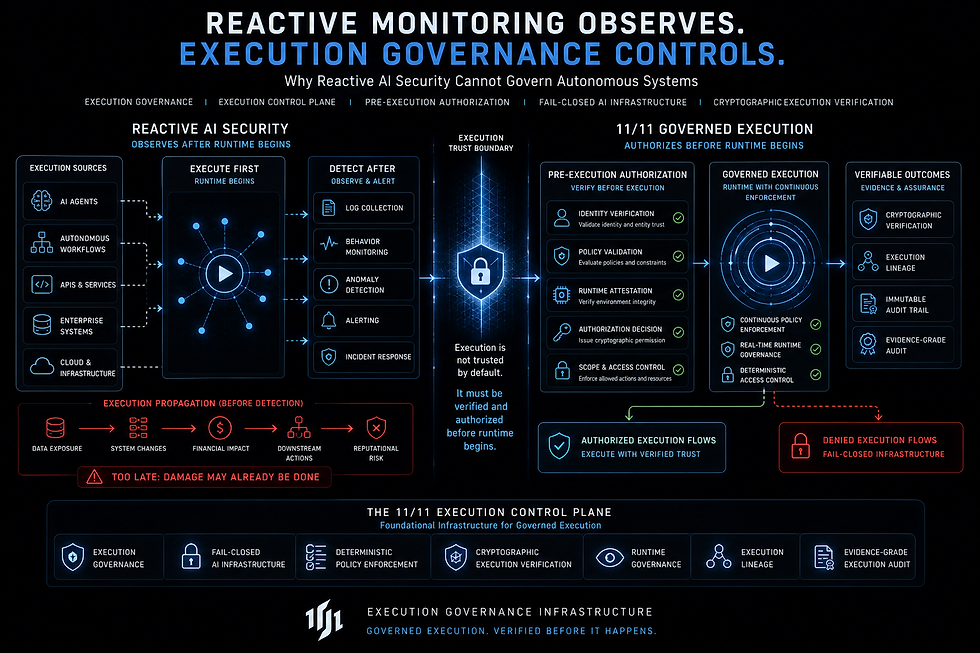
11/11 introduces Execution Governance™ infrastructure for governed autonomous execution and deterministic operational control.
Execution Governance™ Governed Execution™ EA-11™ Execution Arithmetic™
Patent Pending
Public Infrastructure Endpoints

Comments