
Computational State Governance


The existence of computational states creates a fundamental challenge.
Who decides which states may exist?
Who determines how states evolve?
Who controls state transitions?
Who resolves conflicts between competing states?
Who determines when a state should cease to exist?
These questions reveal an increasingly important reality.
Complex computational systems do not merely require state management.
They require state governance.
As computational environments become larger, more autonomous, and more persistent, governance becomes inseparable from operation itself.
Without governance, state spaces expand uncontrollably.
Without governance, transitions become unpredictable.
Without governance, persistence becomes disorder.
Computational State Governance emerges as the discipline responsible for maintaining coherence within state-based systems.
States Create Complexity
Every new state increases system complexity.
A system containing two states is relatively simple.
A system containing ten states becomes more complicated.
A system containing thousands of states becomes an ecosystem.
Modern infrastructure increasingly operates within enormous state environments.
Users.
Permissions.
Policies.
Resources.
Identities.
Workflows.
Relationships.
All exist simultaneously.
The challenge is no longer computation itself.
The challenge is governing computational reality.
Governance Determines Possibility
The most fundamental role of governance is determining possibility.
Not every state should exist.
Not every transition should occur.
Not every condition should persist.
Governance establishes the boundaries of possibility.
It defines the operational universe within which a computational system may function.
This role resembles constitutional systems found throughout society.
The purpose is not merely to direct behavior.
The purpose is to define the limits of behavior itself.
Governing State Creation
Every state begins somewhere.
Some are created automatically.
Some are created through policy.
Some are created through execution.
Some are created through human action.
Governance determines the acceptable mechanisms for state creation.
Without such controls, systems may generate states that were never intended to exist.
The result is state inflation.
Uncontrolled growth.
Operational confusion.
Governance prevents this by defining legitimate pathways through which states may emerge.
Governing State Persistence
Creation is only the beginning.
A state that exists briefly poses limited risk.
A state that persists indefinitely may fundamentally alter system behavior.
Governance therefore extends beyond creation into persistence.
Some states deserve continuity.
Others require expiration.
Others require periodic review.
The ability to determine what should endure becomes one of the most important functions of governance.
Persistence without governance eventually produces institutional accumulation.
Accumulation eventually produces complexity.
Complexity eventually produces instability.
Governing State Transitions
Transitions represent movement.
Movement creates consequences.
Every transition changes computational reality.
Governance therefore focuses heavily on transition control.
Which transitions are permitted?
Which transitions require review?
Which transitions are prohibited?
Which transitions are irreversible?
The answers determine the behavior of the system.
A state space without transition governance becomes unpredictable.
Predictability emerges when transitions are governed.
Conflict Resolution
Large systems inevitably produce conflicting states.
An identity may simultaneously appear active and restricted.
A resource may appear available and reserved.
A policy may conflict with another policy.
Governance provides mechanisms for resolving these conflicts.
Conflict resolution becomes essential because computational systems cannot remain indefinitely ambiguous.
Eventually precedence must be established.
Eventually a governing outcome must emerge.
The role of governance is to provide the framework through which that resolution occurs.
Governance As Computational Stability
Many people associate governance with control.
Its deeper purpose is stability.
Stable systems maintain coherent state environments.
Unstable systems accumulate contradictions.
Governance exists to preserve coherence across time.
The larger the system becomes, the more important this function becomes.
What appears unnecessary within a small application becomes essential within large infrastructure.
Scale transforms governance from an optional feature into a foundational requirement.
Governance And Computational Evolution
Governance is often viewed as restrictive.
Yet governance also enables evolution.
Uncontrolled systems frequently collapse under their own complexity.
Governed systems can evolve safely because change occurs within defined structures.
The result is sustainable adaptation.
Governance therefore serves a dual purpose.
It constrains.
It enables.
Both functions are necessary.
The Future Of Computational State Governance
Future computational environments will contain state spaces far larger than anything seen today.
Autonomous agents.
Persistent digital identities.
Federated infrastructures.
Institutional-scale execution environments.
Such systems cannot operate through unmanaged state expansion.
Governance becomes necessary not because systems are failing.
Governance becomes necessary because systems are succeeding at unprecedented scale.
The future challenge is not building larger systems.
The future challenge is governing larger realities.
Conclusion
States define computational reality.
Governance defines how that reality operates.
The existence of states alone does not create order.
Order emerges when state creation, persistence, transition, and resolution are governed.
Computational State Governance therefore becomes a foundational discipline for modern infrastructure.
The larger the state space becomes, the more important governance becomes.
The future of computation will increasingly depend not only upon what states exist.
It will depend upon how those states are governed.
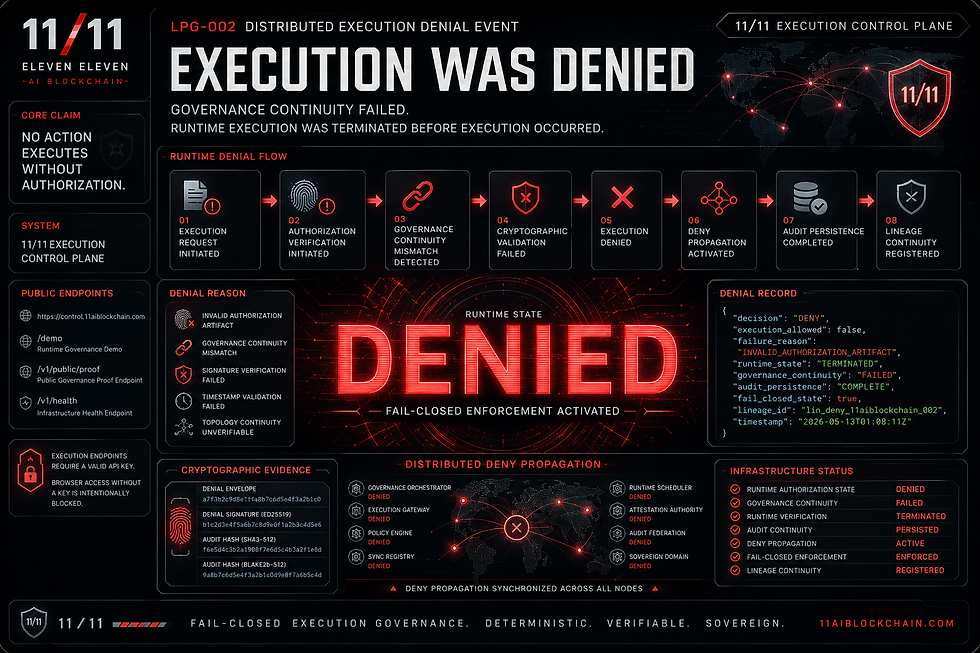
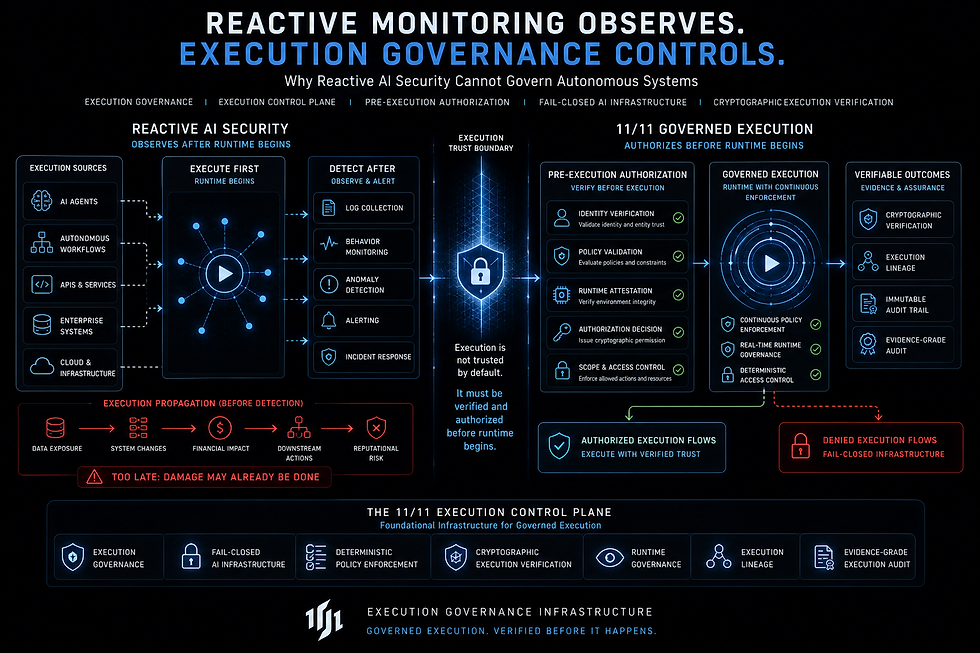
11/11 introduces Execution Governance™ infrastructure for governed autonomous execution and deterministic operational control.
Execution Governance™ Governed Execution™ EA-11™ Execution Arithmetic™
Patent Pending
Public Infrastructure Endpoints

Comments