
Computational State Jurisdiction


Every computational state exists somewhere.
It occupies a condition.
It possesses boundaries.
It exercises influence.
Yet there is a deeper question beneath every state architecture:
Where is that state valid?
The answer introduces a foundational principle of Computational State Theory:
Jurisdiction.
A state may exist.
A state may persist.
A state may possess authority.
Yet authority without jurisdiction becomes meaningless.
Jurisdiction defines the domain within which a state may exercise influence.
It establishes scope.
It establishes applicability.
It establishes control.
Without jurisdiction, computational environments become unable to distinguish between local influence and universal influence.
The result is conflict.
Computational State Jurisdiction provides the framework through which states acquire operational domains and through which computational systems determine where a state's influence begins and ends.
States Are Not Universally Valid
One of the most common assumptions in computing is that a valid state is valid everywhere.
Reality is very different.
A permission may be valid inside one system and invalid inside another.
An identity may possess authority within one environment and possess none outside it.
A policy may govern one infrastructure while remaining irrelevant to another.
States therefore derive meaning not only from their characteristics but from their jurisdiction.
Validity is contextual.
Influence is contextual.
Authority is contextual.
Jurisdiction provides that context.
Jurisdiction Creates Domains
Every computational system naturally develops domains.
Applications.
Organizations.
Networks.
Platforms.
Institutions.
Governance environments.
Each domain creates its own operational reality.
Jurisdiction determines which states belong within that reality.
This separation prevents computational chaos.
Without jurisdictional domains, states would continuously interfere with environments for which they were never intended.
The Difference Between Authority And Jurisdiction
Authority and jurisdiction are often confused.
Authority determines what a state may do.
Jurisdiction determines where it may do it.
A state may possess enormous authority within a narrow jurisdiction.
A state may possess limited authority within a broad jurisdiction.
The two concepts are related but distinct.
A complete theory of computational systems requires both.
Authority without jurisdiction creates overreach.
Jurisdiction without authority creates impotence.
Effective systems balance both dimensions.
Jurisdictional Boundaries
Every jurisdiction possesses boundaries.
These boundaries define operational limits.
Inside the boundary, the state is recognized.
Outside the boundary, recognition may disappear.
This principle appears throughout computational infrastructure.
Access control systems.
Identity systems.
Federated environments.
Policy frameworks.
Execution platforms.
Each relies upon jurisdictional boundaries to determine applicability.
The future of computational governance increasingly depends upon these mechanisms.
Overlapping Jurisdictions
Complex systems rarely contain a single jurisdiction.
More often they contain many.
A computational state may simultaneously exist within:
Organizational jurisdiction
Platform jurisdiction
Regulatory jurisdiction
Operational jurisdiction
Identity jurisdiction
These overlapping jurisdictions create layered environments.
The challenge becomes determining precedence when jurisdictions conflict.
This problem resembles federal systems, institutional systems, and international systems.
As computational environments scale, jurisdictional coordination becomes increasingly important.
Jurisdiction And State Transition
Transitions are rarely jurisdiction-neutral.
A state transition often changes jurisdiction.
An identity moves from applicant to member.
A process moves from review to approval.
A resource moves from private to shared.
Each transition may alter the domain within which the state operates.
Understanding jurisdiction therefore requires understanding movement.
Jurisdiction is not merely spatial.
It is evolutionary.
Jurisdiction And Sovereignty
Jurisdiction frequently serves as the operational mechanism through which sovereignty is expressed.
A sovereign environment defines:
What states exist.
Which states are recognized.
Which states are enforceable.
Which states are ignored.
Jurisdiction transforms sovereignty from an abstract concept into operational reality.
This relationship will become increasingly important as computational infrastructures continue expanding across organizational and institutional boundaries.
Jurisdictional Conflict
Conflict emerges when multiple jurisdictions claim influence over the same state.
Which policy prevails?
Which authority governs?
Which boundary controls?
These questions become increasingly common within large federated environments.
The future of computational architecture will require increasingly sophisticated mechanisms for jurisdictional conflict resolution.
Without such mechanisms, scale produces instability.
The Future Of Computational Jurisdiction
The next generation of computational systems will operate across multiple infrastructures simultaneously.
Autonomous agents.
Persistent digital identities.
Institutional execution environments.
Federated governance systems.
These architectures will require jurisdictional models far more sophisticated than those used today.
The future challenge will not be defining states.
The future challenge will be defining where those states are valid.
Conclusion
States define conditions.
Boundaries define limits.
Jurisdiction defines applicability.
A state without jurisdiction cannot determine where its influence matters.
Computational State Jurisdiction provides the framework through which states acquire operational domains and through which large-scale systems preserve order across complex environments.
As computational ecosystems continue expanding, jurisdiction will become one of the defining principles of computational theory.
The future belongs not merely to states.
The future belongs to governed states operating within defined jurisdictions.
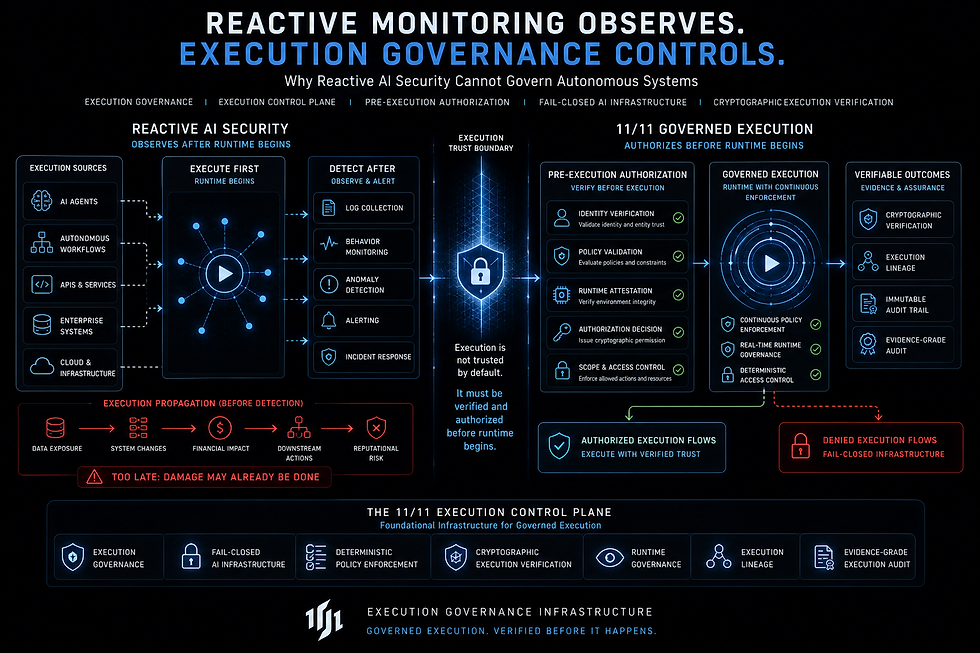
11/11 introduces Execution Governance™ infrastructure for governed autonomous execution and deterministic operational control.
Execution Governance™ Governed Execution™ EA-11™ Execution Arithmetic™
Patent Pending
Public Infrastructure Endpoints

Comments