
Computational State Persistence


Most discussions of computation focus on activity.
Instructions execute.
Processes run.
Functions complete.
Events occur.
The attention of both engineers and theorists is frequently directed toward motion.
Yet computation possesses another dimension that is often overlooked.
Persistence.
A computational state that disappears immediately carries limited significance.
A computational state that endures begins to shape reality.
This distinction becomes increasingly important as computational systems evolve from temporary calculation engines into persistent operational environments.
Modern infrastructure is not merely executing instructions.
It is maintaining continuity.
This continuity is made possible through state persistence.
Computational State Persistence examines why some states vanish while others remain, and why persistence itself may be one of the most important properties of advanced computational systems.
The Difference Between Execution And Persistence
Execution is temporary.
Persistence is enduring.
An instruction may execute in milliseconds.
The consequences of that execution may persist for decades.
A database record may outlive the system that created it.
An identity may survive countless software upgrades.
A policy may remain active long after its original authors have disappeared.
The execution event is often brief.
The resulting state may become permanent.
This asymmetry reveals a profound truth.
The significance of computation frequently resides not in execution itself, but in what remains afterward.
Persistence Creates Reality
Imagine a system in which every state disappeared immediately after creation.
Nothing would accumulate.
Nothing would endure.
Nothing would possess history.
Such a system could perform calculations but could not construct meaningful continuity.
Persistence transforms isolated events into enduring realities.
Identity persists.
Ownership persists.
Authorization persists.
Relationships persist.
History persists.
Infrastructure itself depends upon persistence.
Without persistence there can be no continuity.
Without continuity there can be no system.
Memory As State Preservation
Computational memory is often described as storage.
A deeper interpretation views memory as state preservation.
The purpose of memory is not merely to retain information.
Its purpose is to preserve state across time.
Every memory system exists to answer a fundamental question:
What remains true after execution has ended?
This question sits at the center of persistence theory.
A state that survives execution becomes part of the system's continuing reality.
A state that cannot survive execution becomes computationally insignificant.
The Persistence Hierarchy
Not all states persist equally.
Some states exist for microseconds.
Others exist for minutes.
Others survive for years.
Others may become effectively permanent.
This creates a hierarchy of persistence.
Transient states.
Temporary states.
Operational states.
Institutional states.
Foundational states.
The longer a state persists, the greater its influence over future computational activity.
Persistence therefore becomes a form of computational gravity.
Long-lived states shape future outcomes simply because they remain present.
Persistence And Computational History
A system without persistence possesses no history.
History itself is a collection of preserved states.
Every audit trail.
Every ledger.
Every database.
Every registry.
Every archive.
Exists because state persistence has occurred.
History is therefore not separate from computation.
History is computational persistence observed across time.
This observation becomes increasingly important for autonomous systems operating continuously across large time horizons.
The Economics Of Persistence
Persistence is not free.
Storage consumes resources.
Replication consumes resources.
Preservation consumes resources.
Continuity consumes resources.
The decision to persist a state therefore carries economic implications.
Every infrastructure system must determine which states deserve preservation.
Some states are too valuable to lose.
Others are too costly to maintain indefinitely.
Persistence theory therefore intersects directly with resource allocation.
The future of computational systems may depend upon balancing permanence against cost.
Persistence And Institutional Computation
The largest computational systems increasingly resemble institutions rather than applications.
Institutions derive power from continuity.
Continuity derives power from persistence.
A computational institution survives because critical states remain intact despite personnel changes, infrastructure changes, architectural changes, and technological evolution.
Persistence becomes the mechanism through which computational systems achieve longevity.
The institution continues because its states continue.
The Persistence Problem
Persistence creates benefits.
Persistence also creates challenges.
States that endure too long may become obsolete.
Policies may persist beyond usefulness.
Permissions may persist beyond necessity.
Relationships may persist beyond relevance.
A mature theory of persistence therefore requires mechanisms for expiration, renewal, and retirement.
The question is not merely:
"What should persist?"
The question is also:
"What should cease to persist?"
This balance becomes one of the central challenges of future computational design.
Persistence And The Future Of Computation
As computational environments become increasingly autonomous, persistence grows in importance.
Future systems will not simply execute.
They will maintain continuity.
They will preserve identities.
Preserve relationships.
Preserve institutional memory.
Preserve operational reality.
Computation increasingly becomes the management of enduring state rather than isolated execution events.
Persistence therefore moves from a secondary concern to a foundational principle.
Conclusion
Execution creates states.
Persistence preserves them.
Without execution there is no change.
Without persistence there is no continuity.
Modern computational systems derive their significance not merely from what they do, but from what they remember.
Computational State Persistence provides the mechanism through which temporary actions become enduring realities.
The future of computation will belong not only to systems capable of execution.
It will belong to systems capable of persistence.
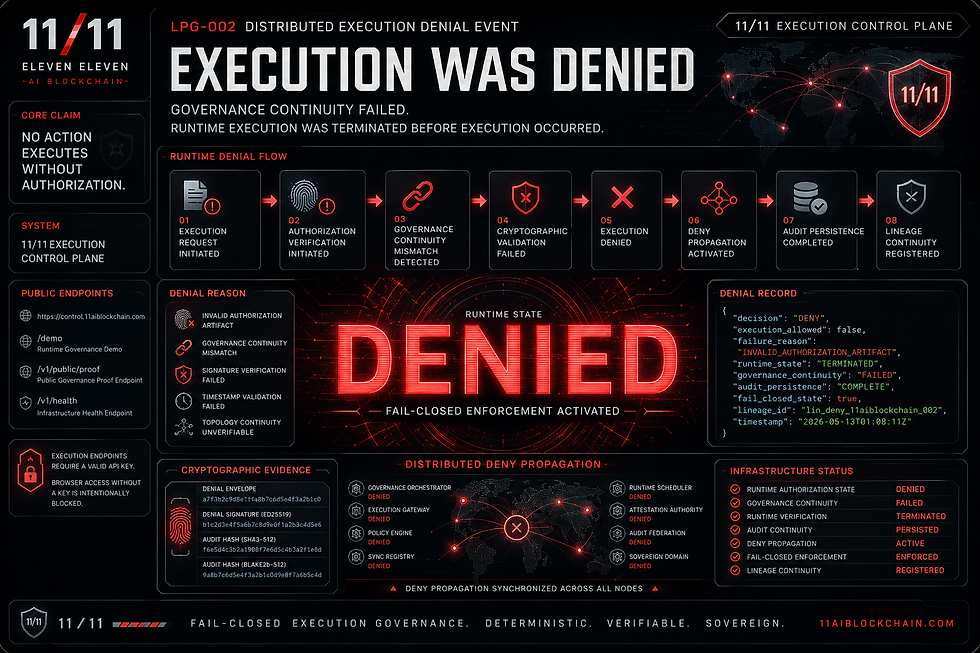
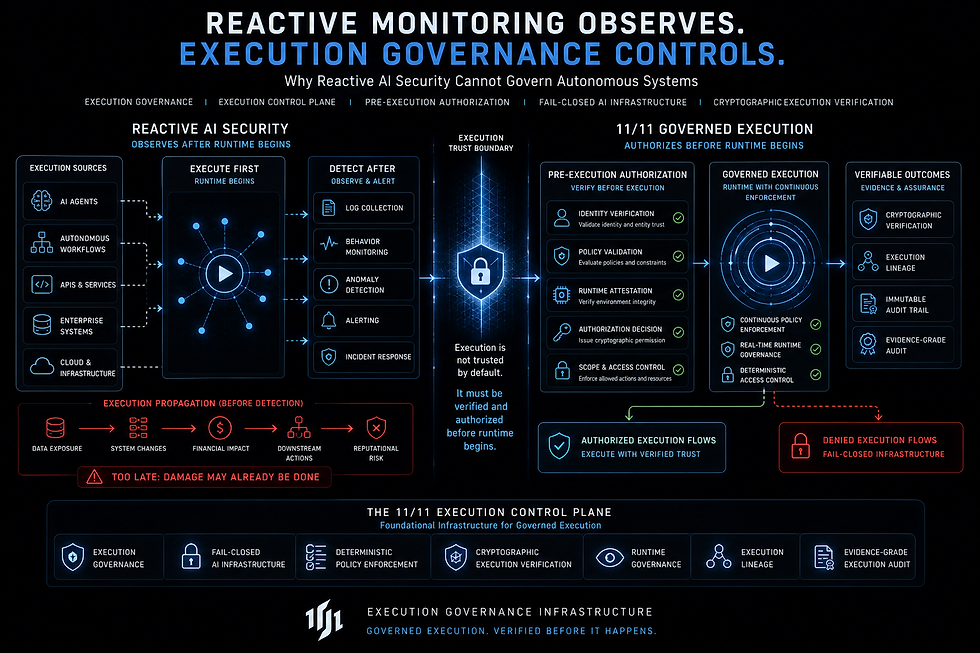
11/11 introduces Execution Governance™ infrastructure for governed autonomous execution and deterministic operational control.
Execution Governance™ Governed Execution™ EA-11™ • Execution Arithmetic™
Patent Pending
Public Infrastructure Endpoints

Comments