
Constitutional Failure Modes


Constitutions are often studied through the lens of success.
How constitutional orders emerge.
How constitutional authority is established.
How constitutional legitimacy is maintained.
How constitutional stability is preserved.
Yet constitutional systems reveal their deepest lessons through failure.
Every civilization that has possessed a constitutional order has eventually confronted a fundamental question:
How does constitutional order break down?
The answer is rarely dramatic.
Constitutions seldom collapse in a single moment.
More commonly, constitutional failure emerges gradually.
Principles weaken.
Boundaries erode.
Authority concentrates.
Exceptions accumulate.
Legitimacy declines.
The constitutional structure remains visible.
The constitutional reality slowly disappears.
This process introduces one of the most important areas of Constitutional Theory:
Constitutional Failure Modes.
The study of how constitutional systems lose coherence, continuity, and legitimacy over time.
Failure Is Usually Progressive
Most constitutional failures begin invisibly.
The foundational document remains.
Institutions continue operating.
Processes continue functioning.
The appearance of stability remains intact.
Yet beneath the surface, constitutional assumptions begin changing.
The danger is not immediate collapse.
The danger is gradual transformation.
Constitutional systems often fail long before they appear to fail.
The visible collapse is frequently the final stage of a much longer process.
Boundary Erosion
One of the most common failure modes is boundary erosion.
Constitutional boundaries define limits.
Limits define legitimacy.
Legitimacy defines order.
When boundaries weaken, authority expands.
Expansion appears efficient.
Expansion appears practical.
Expansion appears temporary.
Over time, however, constitutional limitations become increasingly symbolic.
The boundary survives in language while disappearing in operation.
This is often the beginning of constitutional decline.
Exception Accumulation
Constitutions depend upon consistency.
Exceptions introduce inconsistency.
A single exception rarely causes failure.
Repeated exceptions gradually alter constitutional reality.
The process is subtle.
Each exception appears reasonable.
Each exception appears limited.
Eventually the exceptions become the rule.
The constitution remains unchanged.
The constitutional order becomes fundamentally different.
Authority Concentration
Stable constitutional systems distribute authority.
Unstable systems increasingly concentrate authority.
As authority accumulates, constitutional balance deteriorates.
Oversight weakens.
Constraints weaken.
Independence weakens.
The constitutional architecture remains visible.
The distribution of power that gave the architecture meaning disappears.
Constitutional concentration is therefore among the most dangerous indicators of systemic decline.
Interpretive Drift
Interpretation preserves meaning.
Interpretive drift alters meaning.
The distinction is critical.
When interpretation remains anchored to principle, continuity survives.
When interpretation becomes detached from principle, constitutional identity begins changing.
The words remain.
The assumptions beneath the words evolve.
Eventually the constitutional framework operates according to meanings never intended by its foundations.
The result is constitutional displacement.
Institutional Capture
Constitutions rely upon institutions.
Institutions rely upon incentives.
When institutional incentives become disconnected from constitutional principles, constitutional order weakens.
Institutions begin serving themselves rather than the constitutional framework they were created to preserve.
This phenomenon appears repeatedly throughout history.
Constitutional structures survive.
Constitutional purpose declines.
The result is institutional capture.
Legitimacy Degradation
Perhaps the most dangerous failure mode is legitimacy degradation.
Constitutional systems survive because they are recognized as legitimate.
Recognition creates continuity.
Continuity creates stability.
When legitimacy weakens, every other constitutional structure becomes vulnerable.
Authority becomes contested.
Boundaries become negotiable.
Interpretation becomes politicized.
The constitutional order gradually loses coherence.
Without legitimacy, constitutional systems eventually become dependent upon force rather than recognition.
Computational Failure Modes
Future computational constitutions will face similar risks.
Boundary erosion.
Authority concentration.
Interpretive drift.
Institutional capture.
Legitimacy degradation.
The technological environment may be new.
The constitutional dynamics remain familiar.
Computational civilization will likely confront many of the same constitutional challenges faced by institutional civilization.
Failure As A Diagnostic Tool
Understanding constitutional failure is not pessimistic.
It is preventative.
Failure modes reveal what constitutional systems must protect.
The study of collapse often reveals more about constitutional durability than the study of success.
By understanding failure, constitutional systems become capable of preserving continuity.
Failure analysis becomes preservation analysis.
Conclusion
Constitutional systems rarely collapse overnight.
Most fail through gradual erosion of principles, boundaries, legitimacy, and institutional coherence.
Constitutional Failure Modes provide a framework for understanding these processes before collapse becomes visible.
The future of constitutional civilization may depend not only upon understanding how constitutions succeed.
It may depend upon understanding how constitutions fail.
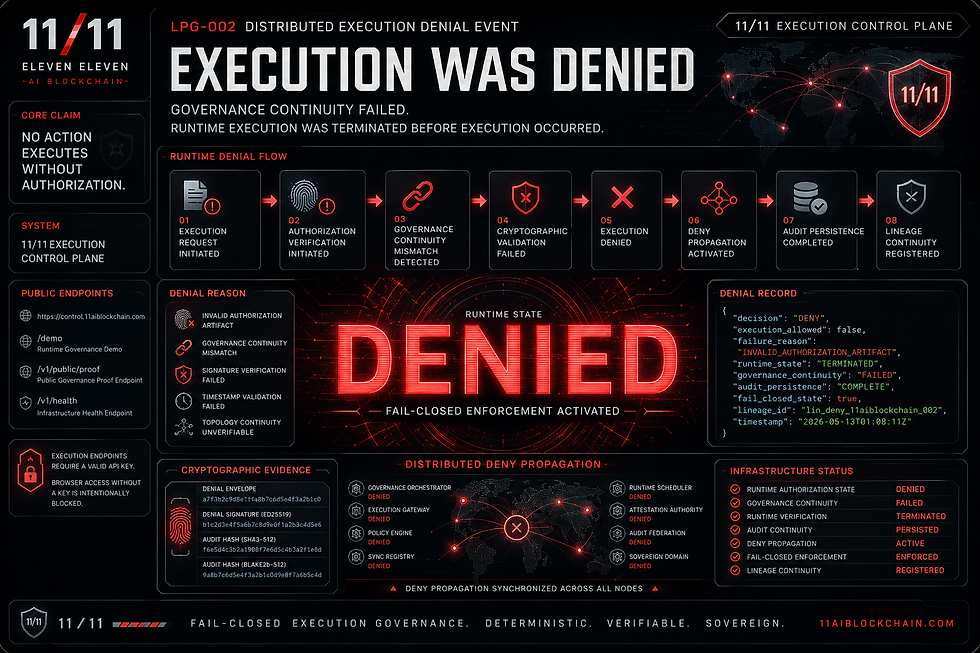
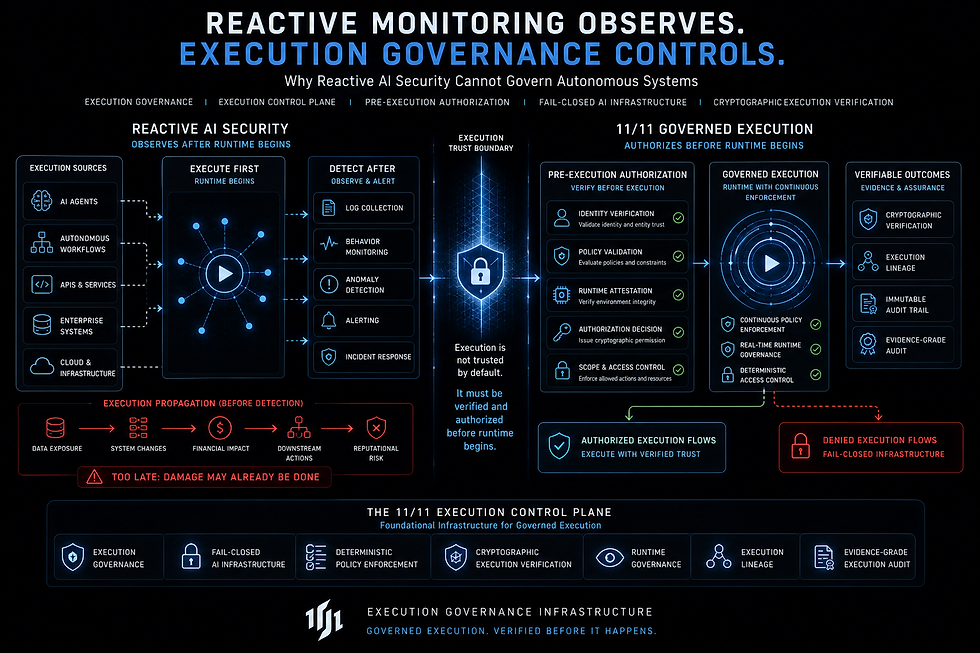
11/11 introduces Execution Governance™ infrastructure for governed autonomous execution and deterministic operational control.
Execution Governance™ Governed Execution™ EA-11™ Execution Arithmetic™
Patent Pending
Public Infrastructure Endpoints

Comments