
Constitutional Legitimacy
- 11/11 AI

- May 29
- 3 min read

Power can be imposed.
Authority can be exercised.
Rules can be enforced.
Yet none of these things explain legitimacy.
Legitimacy occupies a unique position within constitutional theory because it exists largely within recognition rather than force.
A government may possess power.
An institution may possess authority.
A system may possess capability.
But legitimacy asks a different question.
Why should that authority be accepted?
Why should that power be recognized?
Why should those rules be followed?
For centuries, constitutional systems have depended upon answers to these questions.
The same challenge increasingly applies to computational systems.
As computational infrastructures become larger, more autonomous, and more influential, legitimacy becomes one of the most important problems of computational civilization.
Computational systems may eventually possess extraordinary capability.
Capability alone will not create legitimacy.
Legitimacy Is Recognition
The simplest definition of legitimacy is recognized authority.
Recognition transforms force into governance.
Recognition transforms compliance into cooperation.
Recognition transforms institutions into durable institutions.
Without recognition, authority remains dependent upon continuous enforcement.
With recognition, authority becomes self-sustaining.
This distinction explains why legitimacy has historically been more valuable than power itself.
Power can compel behavior.
Legitimacy can stabilize behavior.
The Constitutional Source
Legitimacy does not emerge automatically.
It requires a source.
Constitutional systems solve this problem by locating legitimacy above ordinary authority.
The constitution becomes the origin of recognition.
The constitution becomes the source of authority.
The constitution becomes the foundation of legitimacy.
Authority is accepted because it derives from accepted principles.
The legitimacy of the actor depends upon the legitimacy of the foundation.
Power Without Legitimacy
History contains countless examples of powerful systems lacking legitimacy.
Such systems may function temporarily.
They rarely endure.
Without legitimacy:
Compliance becomes unstable
Authority becomes contested
Governance becomes fragile
Continuity becomes uncertain
The absence of legitimacy forces systems to rely increasingly upon coercion.
Coercion may produce obedience.
It rarely produces permanence.
Legitimacy Creates Durability
One of the most important functions of legitimacy is durability.
Institutions survive generations because legitimacy survives generations.
Constitutions persist because legitimacy persists.
Civilizations endure because legitimacy persists.
This observation becomes increasingly relevant for computational systems.
Future computational institutions may operate continuously across decades.
Durability will depend not only upon technical architecture but upon constitutional legitimacy.
The Difference Between Validity And Legitimacy
A system may be valid without being legitimate.
A rule may be operationally correct without being constitutionally accepted.
A process may function perfectly while lacking recognized authority.
Validity concerns correctness.
Legitimacy concerns acceptance.
Both are necessary.
Neither replaces the other.
Future computational theory must increasingly recognize this distinction.
Constitutional Continuity
Legitimacy is deeply connected to continuity.
Recognition accumulates over time.
Trust in constitutional structures accumulates over time.
Institutional acceptance accumulates over time.
The result is constitutional continuity.
This continuity allows systems to survive periods of uncertainty without losing coherence.
The constitution becomes a stabilizing reference point during periods of change.
Legitimacy And Self-Limitation
One of the strongest signals of legitimacy is self-limitation.
Systems that recognize limits often possess greater legitimacy than systems possessing greater power.
The reason is simple.
Limitation signals adherence to principle.
Unrestricted authority signals dependence upon power alone.
Constitutional systems derive legitimacy from demonstrating that power operates within recognized boundaries.
Computational Legitimacy
Future computational environments will increasingly confront legitimacy questions.
Who authorized the system?
What principles govern the system?
Where does authority originate?
How are limitations enforced?
Why should outcomes be recognized?
These questions move beyond engineering.
They enter the domain of constitutional theory.
The future challenge is not simply creating powerful computational environments.
The future challenge is creating legitimate computational environments.
Constitutional Civilization
Civilizations survive because legitimacy becomes institutionalized.
The same principle may eventually apply to computational civilization.
As computational systems acquire greater influence, constitutional legitimacy may become the difference between temporary capability and durable authority.
The systems that endure will not necessarily be the most powerful.
They may be the most legitimate.
Conclusion
Power explains capability.
Authority explains governance.
Legitimacy explains acceptance.
Constitutional legitimacy emerges when authority derives from recognized foundational principles that endure across time and change.
As computational systems continue evolving, legitimacy may become one of the defining requirements of constitutional computation.
The future belongs not merely to systems that can act.
The future belongs to systems whose actions are recognized as legitimate.
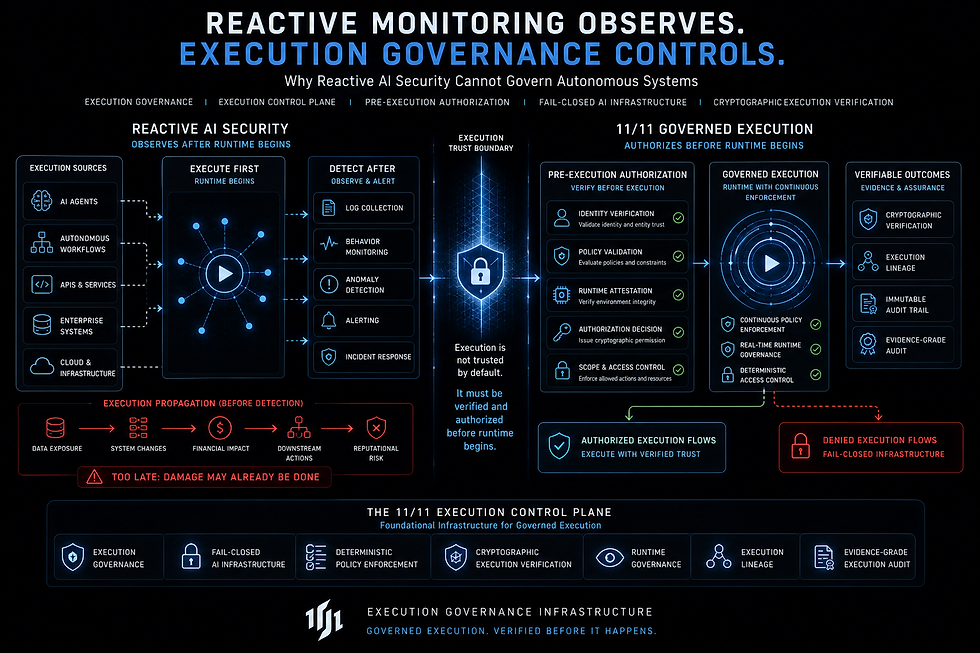
11/11 introduces Execution Governance™ infrastructure for governed autonomous execution and deterministic operational control.
Execution Governance™ Governed Execution™ EA-11™ Execution Arithmetic™
Patent Pending
Public Infrastructure Endpoints


Comments