
Cryptographic Authorization Artifacts Will Define Trusted Autonomous AI


Artificial intelligence infrastructure is rapidly evolving toward autonomous operational systems.
Modern AI systems increasingly possess the ability to:
execute workflows
orchestrate enterprise infrastructure
coordinate runtime environments
access sensitive operational systems
trigger machine-speed execution activity
interact autonomously with external systems
As these systems gain operational authority, a foundational infrastructure requirement emerges:
How does a runtime system prove execution was actually authorized?
Traditional AI architectures frequently rely on:
access controls
orchestration permissions
observability tooling
monitoring systems
retrospective audit analysis
These approaches may indicate that execution occurred.
They do not necessarily provide cryptographic proof that execution was authorized before runtime activity began.
11/11 introduces Execution Governance™ infrastructure designed around cryptographic authorization artifacts for autonomous AI systems.
What Authorization Artifacts Mean
Authorization artifacts are verifiable records proving that execution approval existed before runtime activity occurred.
These artifacts may contain:
execution intent
policy approvals
identity assertions
runtime constraints
authorization scope
verification conditions
execution eligibility metadata
Authorization artifacts transform governance from assumption into verifiable operational proof.
Execution no longer depends exclusively on trust in the runtime environment itself.
Execution becomes cryptographically provable.
Why Traditional Controls Become Insufficient
Many current systems rely heavily on:
access permissions
session controls
orchestration logic
runtime assumptions
post-event monitoring
These systems often assume:if a system executed an action, the action must have been authorized.
Autonomous AI systems invalidate that assumption.
As autonomous systems gain operational authority, infrastructure must independently verify:
who authorized execution
what policies approved execution
what runtime conditions existed
whether execution remained inside governance boundaries
Cryptographic authorization artifacts provide deterministic proof for these operational requirements.
Governance Before Execution
Execution Governance™ introduces a governance-first runtime architecture.
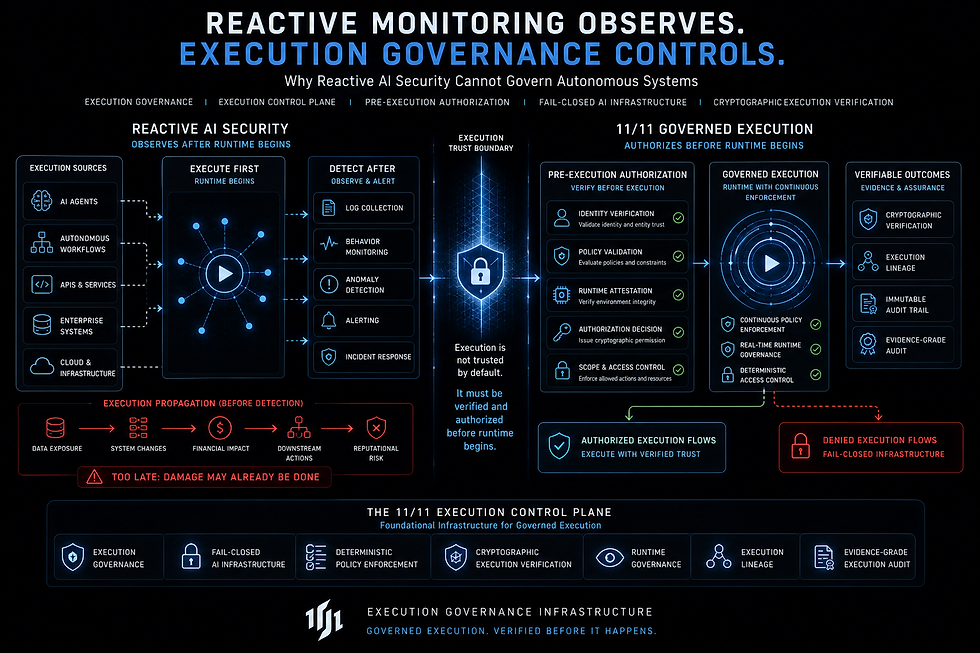
Instead of:execute → monitor → investigate
The infrastructure flow becomes:request → authorize → sign artifact → verify → execute → audit → persist lineage
Under this model:
authorization occurs before execution
artifacts are cryptographically generated
runtime systems verify artifact validity
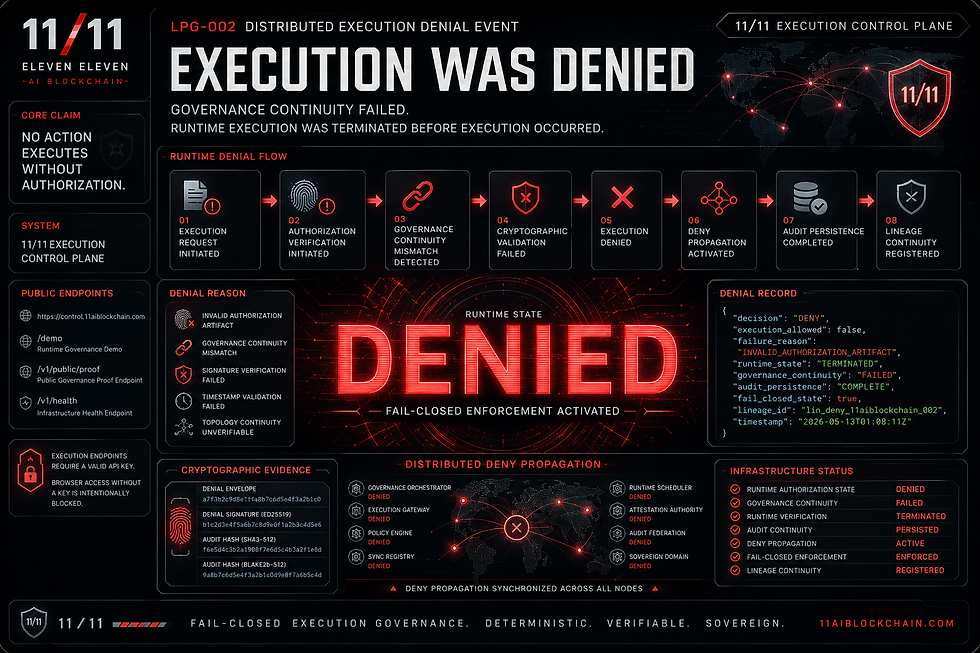
unauthorized activity fails closed
execution lineage becomes attributable and persistent
Execution becomes cryptographically accountable.
Autonomous Systems Require Verifiable Proof
As AI systems expand into:
finance
healthcare
defense
enterprise infrastructure
critical operational environments
…the requirement for verifiable operational proof becomes increasingly important.
Organizations increasingly need the ability to prove:
why execution occurred
whether execution was authorized
what policies governed actions
whether runtime verification succeeded
whether operational trust boundaries remained intact
Authorization artifacts provide deterministic operational accountability for autonomous systems.
The Future AI Runtime Stack
The next generation of AI infrastructure will increasingly require:
pre-execution authorization
cryptographic authorization artifacts
runtime verification
deterministic policy enforcement
fail-closed execution control
immutable execution lineage
Execution Governance becomes the cryptographic trust layer between autonomous intelligence and operational execution.
The Autonomous Infrastructure Era
The future of artificial intelligence infrastructure will not be defined solely by intelligence generation.
It will increasingly be defined by whether autonomous systems can produce verifiable proof that execution was authorized before runtime activity occurred.
Cryptographic authorization artifacts become foundational infrastructure for trusted autonomous AI systems.
Public Infrastructure Endpoints
Public Runtime Infrastructure
Public Governance Console
Runtime Governance Demo
Public Governance Proof Viewer
Infrastructure Health Dashboard
Execution Lineage Explorer
Execution endpoints intentionally require valid API authorization.
11/11 introduces Execution Governance™ infrastructure for governed autonomous execution and cryptographic runtime accountability.
Execution Governance™Governed Execution™Patent Pending

Comments