
Cryptographic Execution Verification Explained
- 11/11 AI

- May 8
- 4 min read

Most AI infrastructure today still depends heavily on procedural trust assumptions.
Systems generate logs.
Monitoring tools collect telemetry.
Audit systems reconstruct events afterward.
Organizations then trust that those systems operated correctly.
Autonomous infrastructure increasingly makes this model insufficient.
Execution now propagates dynamically across:
distributed runtime environments
orchestration systems
APIs
autonomous workflows
downstream execution chains
machine-driven operational infrastructure
Under these conditions, runtime trust can no longer depend solely on observational visibility.
Infrastructure increasingly requires cryptographic execution verification.
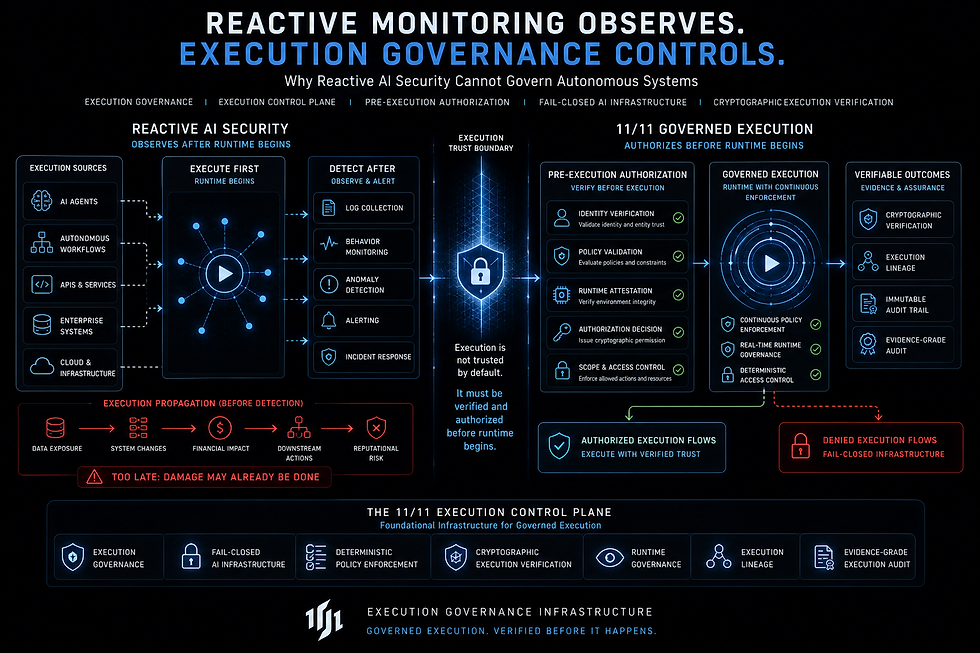
This is one of the foundational principles behind the 11/11 execution control plane.
Execution itself must become:
cryptographically verifiable
tamper-evident
independently auditable
continuously governed
evidence-grade
before runtime trust can be established reliably.
What Cryptographic Execution Verification Actually Means
Cryptographic execution verification means runtime execution produces independently verifiable evidence tied directly to execution activity itself.
This differs fundamentally from traditional logging systems.
Traditional systems typically answer:
“What happened?”
Cryptographic execution verification answers:
was execution authorized?
was policy enforcement valid?
was runtime integrity maintained?
was execution lineage preserved?
was execution tampered with?
can execution evidence be independently verified?
This creates a fundamentally different runtime trust model centered around governed execution.
Why Hashing Matters
One of the core mechanisms behind evidence-grade execution verification is cryptographic hashing.
Hashing transforms execution evidence into tamper-evident verification structures.
Under the 11/11 execution control plane, execution evidence may include:
authorization artifacts
runtime events
execution lineage
audit records
policy decisions
runtime attestations
These records are hashed to create immutable integrity verification structures.
Even small changes to execution evidence produce entirely different hashes.
This creates tamper-evident runtime verification.
SHA3-512 and BLAKE2b-512
The current 11/11 proof architecture demonstrates evidence hashing using:
SHA3-512
BLAKE2b-512
Example proof output:
{
"evidence_hashes": {
"sha3_512": "182c156665778c5bfc0e260b0c2e791233752b6edfd0630af66bc5f8d12404a6115e633bf1898d978ae3b5e8d96f654db390675e97f8a25333a4d76a9b09dbfd",
"blake2b_512": "1737a0fb6b13cd39ae37556aea25ec76ff37c9169c49043f28ff7670ccda4b158af8a96ea207bb50480ba46de25524c739cb71b73045674840d0f640dd91a8a1"
}
}
These hashes become part of the execution evidence structure itself.
Their role is not merely data storage.
Their role is runtime integrity verification.
If execution evidence changes, the hashes no longer match.
This creates cryptographic assurance that execution evidence remains intact.
Why Signed Authorization Artifacts Matter
The execution control plane also generates cryptographically signed authorization artifacts during governed execution approval.
Under pre-execution authorization:
execution permissions are issued
execution scope is defined
runtime conditions are attached
policy constraints are bound
authorization windows are enforced
These artifacts are signed using Ed25519 cryptographic signatures.
This creates:
tamper-evident authorization
independently verifiable execution approval
cryptographic runtime trust
evidence-grade authorization proof
Without a valid authorization artifact, runtime execution cannot proceed.
This is one of the defining operational characteristics of governed execution infrastructure.
Execution Lineage and Immutable Audit
Cryptographic execution verification extends beyond authorization issuance.
The execution control plane continuously records:
execution lineage
runtime events
authorization continuity
downstream propagation
policy enforcement state
runtime integrity signals
These records become part of immutable execution audit structures.
Execution lineage therefore creates:
end-to-end execution traceability
tamper-evident runtime continuity
evidence-grade execution verification
independently verifiable runtime governance
Execution governance is therefore not limited to runtime monitoring.
It becomes cryptographically provable runtime infrastructure.
Why Traditional Logging Is Insufficient
Traditional logging systems primarily focus on observability.
They collect events after runtime activity occurs.
This creates several limitations.
Traditional logs rarely prove:
execution authorization integrity
policy enforcement continuity
runtime integrity validity
execution lineage preservation
cryptographic execution authenticity
Most importantly:
Traditional logging systems are often not independently verifiable.
Governed execution infrastructure changes this entirely.
Cryptographic execution verification embeds runtime trust directly into execution architecture itself.
Why This Matters for Autonomous Infrastructure
Autonomous systems increasingly execute at machine speed across operational infrastructure.
Execution propagation may occur across:
APIs
orchestration systems
distributed runtime environments
infrastructure services
external systems
machine-driven workflows
Under these conditions, runtime trust becomes operationally critical.
Organizations increasingly require:
evidence-grade execution verification
immutable execution audit
deterministic policy enforcement
cryptographic runtime assurance
governed execution continuity
This becomes particularly important across:
financial systems
healthcare infrastructure
enterprise runtime environments
industrial automation
government systems
autonomous operational infrastructure
Execution governance increasingly becomes the runtime trust layer beneath operational AI systems.
The Execution Control Plane as a Verification Layer
The 11/11 execution control plane governs:
pre-execution authorization
deterministic policy enforcement
runtime governance
cryptographic execution verification
immutable execution audit
execution lineage
fail-closed enforcement
evidence-grade execution verification
Execution itself becomes continuously verifiable infrastructure.
Not merely observable infrastructure.
That distinction defines the operational purpose of execution governance.
Why Cryptographic Verification Defines the Next Infrastructure Standard
Infrastructure markets historically evolve toward stronger integrity verification models.
Enterprise systems evolved toward identity assurance.
Cloud infrastructure evolved toward orchestration integrity.
Distributed systems evolved toward cryptographic verification.
AI infrastructure is now evolving toward cryptographic execution assurance.
This transition increasingly requires:
execution governance
governed execution
cryptographic execution verification
deterministic policy enforcement
immutable execution audit
execution lineage
runtime governance
fail-closed AI infrastructure
evidence-grade execution verification
runtime integrity
pre-execution authorization
These systems increasingly become foundational infrastructure requirements for trusted autonomous environments.
Because infrastructure that cannot cryptographically prove execution integrity ultimately cannot guarantee runtime trust reliably.
Public Runtime Proof Infrastructure
Public demo:
Health endpoint:
Public proof endpoint:
These endpoints demonstrate operational execution governance infrastructure including:
execution governance
cryptographic execution verification
evidence-grade execution verification
immutable execution audit
governed execution
runtime governance
fail-closed infrastructure
Execution governance systems, execution control plane architectures, governed execution models, and related runtime authorization technologies described herein are patent pending under ongoing intellectual property filings associated with 11/11.


Comments