
PILLAR PAGE 09 Cryptographic Runtime Enforcement


Introduction
Modern AI infrastructure increasingly depends on autonomous runtime systems operating continuously across distributed environments.
AI systems now:
orchestrate runtime execution
automate operational workflows
coordinate distributed services
manage regulated compute infrastructure
execute machine-speed operational decisions
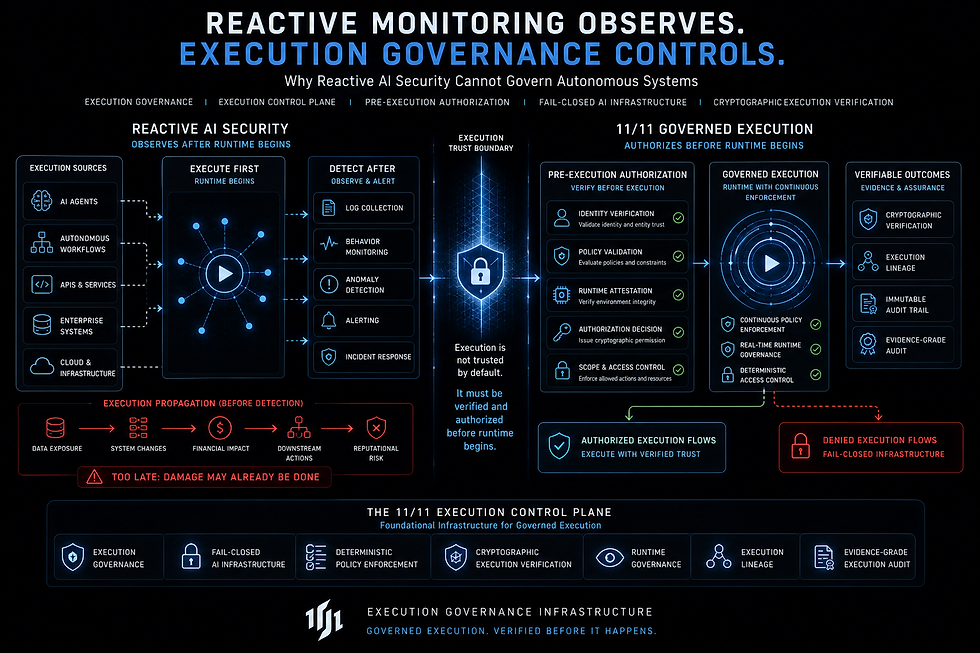
Traditional infrastructure security architectures were not designed to establish deterministic runtime trust.
Most existing systems still rely on:
implicit trust
reactive monitoring
telemetry analysis
post-execution response
best-effort security models
That model no longer scales.
Autonomous systems increasingly require:
cryptographic runtime enforcement.
No action executes without authorization.
What Cryptographic Runtime Enforcement Does
Cryptographic runtime enforcement establishes:
deterministic runtime authorization
signed execution validation
immutable execution lineage
continuous runtime verification
cryptographic runtime trust
fail-closed enforcement
Execution becomes:cryptographically governed infrastructure.
Why Autonomous Systems Require Cryptographic Enforcement
Autonomous systems increasingly:
execute independently
coordinate distributed infrastructure
operate continuously
execute machine-speed workflows
interact with critical systems
Traditional runtime trust models cannot provide deterministic accountability at autonomous scale.
Execution itself becomes:the operational trust boundary.
Cryptographic runtime enforcement establishes:provable runtime trust.
Core Components Of Cryptographic Runtime Enforcement
1. Signed Authorization Artifacts
Execution authorization becomes:
cryptographically signed
tamper resistant
verifiable
linked to execution context
continuously enforceable
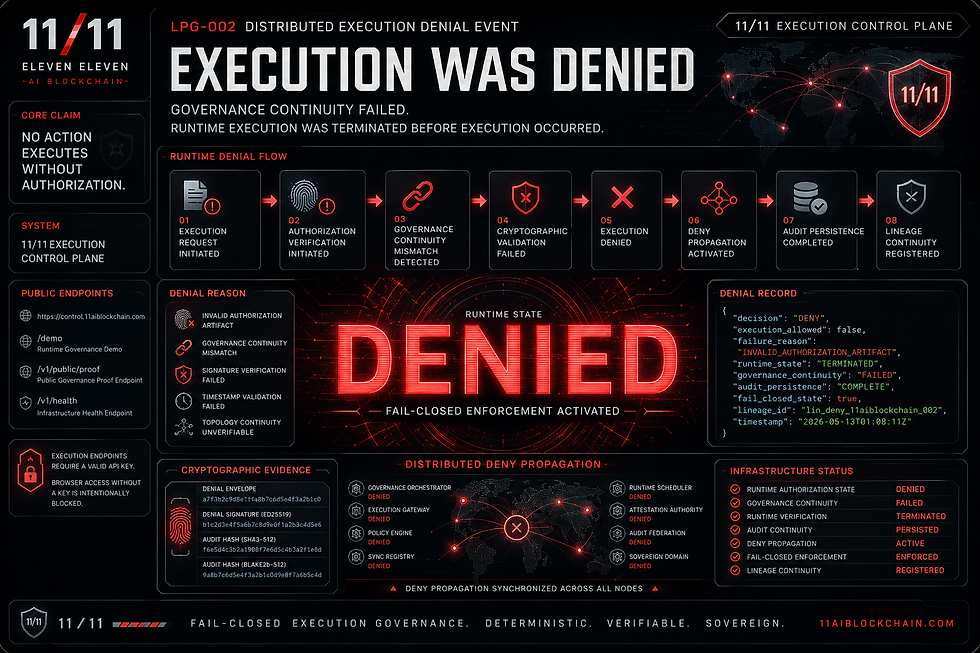
Unsigned execution fails closed.
2. Runtime Integrity Verification
Cryptographic runtime enforcement continuously verifies:
runtime integrity
environment trust
execution validity
state consistency
behavioral compliance
Integrity violations terminate execution.
3. Immutable Execution Lineage
Every execution event becomes:
cryptographically linked
immutably recorded
continuously traceable
verifiable
tamper resistant
Execution accountability becomes:persistent infrastructure.
4. Deterministic Evidence Generation
Execution governance continuously generates:
runtime proof
authorization evidence
integrity verification
lineage proof
execution state validation
Runtime trust becomes:provable.
Cryptographic Runtime Enforcement vs Traditional Security
Traditional Security | Cryptographic Runtime Enforcement |
Implicit trust | Verified trust |
Reactive monitoring | Continuous verification |
Detect after execution | Authorize before execution |
Best-effort integrity | Cryptographic validation |
Mutable logs | Immutable lineage |
Observe runtime | Govern runtime |
Fail-Closed Enforcement
Cryptographic runtime enforcement assumes:
uncertainty defaults to deny
unauthorized execution never proceeds
integrity violations terminate execution
runtime trust must remain continuously verifiable
No authorization:no execution.
Continuous Runtime Verification
Cryptographic runtime enforcement continuously verifies:
authorization validity
runtime integrity
policy state
environment trust
behavioral compliance
execution continuity
Execution remains:continuously governed.
Execution Lineage & Proof
Cryptographic runtime enforcement establishes:
immutable execution lineage
cryptographic audit persistence
signed execution artifacts
deterministic runtime evidence
traceable runtime accountability
Execution becomes:verifiable infrastructure.
Public Execution Governance Infrastructure
11/11 public execution governance infrastructure is operational:
Public Governance Console
Runtime Governance Demo
Public Governance Proof Viewer
Infrastructure Health Dashboard
Execution Lineage Explorer
The Future Of Runtime Trust
Autonomous systems increasingly require:
cryptographic runtime enforcement
deterministic authorization
immutable execution lineage
fail-closed infrastructure
runtime proof generation
continuous runtime verification
Cryptographic runtime enforcement becomes:foundational infrastructure for autonomous systems.
Conclusion
Cryptographic runtime enforcement establishes:deterministic trust for autonomous execution systems.
Execution can no longer rely on:
implicit trust
delayed analysis
reactive monitoring
best-effort validation
Execution must become:
authorized
governed
continuously verified
cryptographically provable
immutably recorded
fail-closed by design
11/11 is building the execution governance layer for AI and regulated compute infrastructure.

Comments