
EG-DEPLOY-003 Defense Runtime Coordination Blueprint
- 11/11 AI

- May 15
- 3 min read
11/11 Execution Governance Deployment Initiative
Version: Draft v0.1
Classification: Sovereign Defense Infrastructure Blueprint
Blueprint Family: Defense Runtime Governance Deployments

Abstract
EG-DEPLOY-003 defines a defense runtime coordination blueprint for regulated defense AI and orchestration environments.
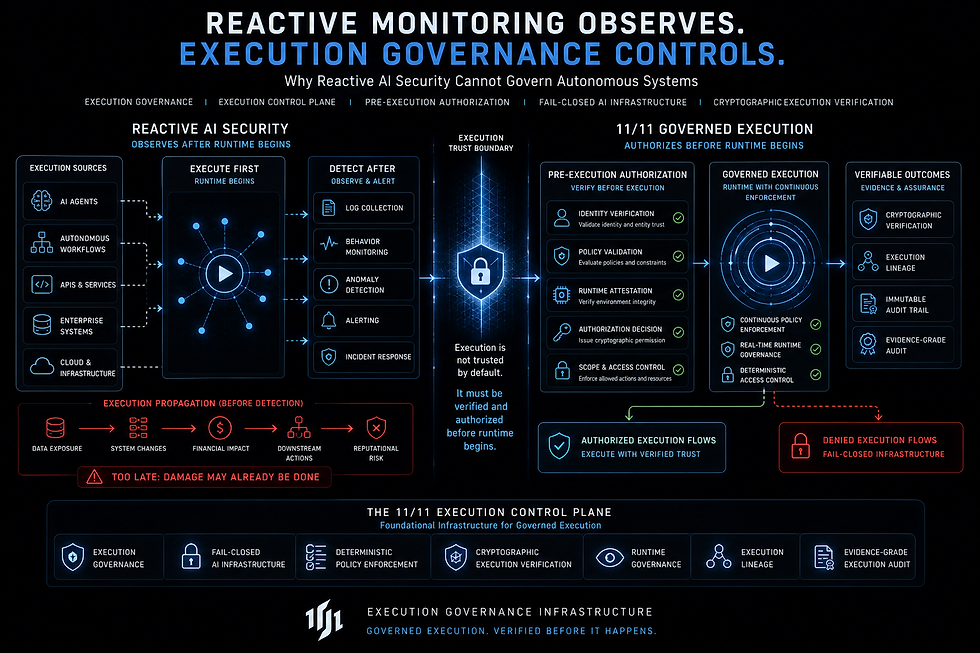
The blueprint establishes deterministic defense governance deployment requirements including fail-closed execution enforcement, cryptographic runtime verification, immutable operational lineage continuity, distributed telemetry synchronization, and governed runtime orchestration across sovereign defense infrastructure systems.
The framework positions defense AI deployment as a deterministic runtime governance architecture rather than a conventional operational software deployment model.
1. Defense Runtime Governance Principle
Defense AI infrastructure MUST operate through deterministic runtime governance enforcement.
Governed defense environments SHALL enforce:
• operational runtime authorization continuity• sovereign orchestration synchronization• cryptographic runtime verification• immutable operational lineage continuity• distributed telemetry synchronization• fail-closed execution protections
Any unverifiable runtime condition SHALL trigger deterministic containment protections.
2. Sovereign Defense Infrastructure Topology
Governed defense environments SHALL maintain:
• sovereign governance control planes• operational runtime orchestration layers• cryptographic verification infrastructure• immutable operational audit systems• distributed synchronization fabrics• operational lineage propagation systems
Infrastructure topology SHALL remain governed, isolated, and cryptographically verifiable.
3. Deterministic Operational Runtime Coordination
Execution governance systems SHALL coordinate:
Operational Runtime Authorization
Governance Policy Synchronization
Runtime Integrity Validation
Telemetry Continuity Verification
Cryptographic Coordination Validation
Immutable Operational Audit Synchronization
Distributed Runtime Consistency
Operational Execution Lineage Continuity
Coordination failures SHALL trigger fail-closed governance protections.
4. Fail-Closed Defense Enforcement
Defense runtime environments MUST operate under deterministic fail-closed protections.
Failure conditions SHALL trigger containment including:
• runtime authorization interruption• orchestration synchronization failure• cryptographic verification mismatch• operational telemetry desynchronization• immutable audit discontinuity• execution lineage corruption• distributed runtime inconsistency• unverifiable governance transitions
Execution MUST default to containment during runtime uncertainty.
5. Cryptographic Runtime Verification
Governed defense systems SHALL implement cryptographic verification supporting:
• signed governance decisions• runtime integrity verification• immutable proof continuity• distributed trust synchronization• governance evidence propagation• audit authenticity validation
Cryptographic verification SHALL remain continuous during runtime propagation.
6. Immutable Operational Governance Continuity
Defense execution environments SHALL maintain immutable governance continuity supporting:
• tamper-evident operational records• immutable runtime synchronization• distributed governance replication• telemetry continuity synchronization• audit persistence continuity• governance evidence traceability
Governance continuity SHALL remain immutable and verifiable across distributed defense systems.
7. Distributed Runtime Synchronization
Distributed runtime governance systems SHALL synchronize:
• runtime coordination continuity• telemetry propagation synchronization• execution integrity continuity• cryptographic synchronization continuity• immutable audit persistence• distributed runtime consistency
Desynchronization SHALL trigger deterministic containment protections.
8. Operational Runtime Traceability
Governed defense environments SHALL maintain deterministic runtime traceability including:
• authorization lifecycle records• governance synchronization telemetry• orchestration routing references• cryptographic proof references• immutable audit records• distributed runtime metadata• execution continuity records
Runtime traceability SHALL remain continuously available for verification and audit inspection.
9. Defense Deployment Lifecycle Flow
Operational Runtime Initialization
Runtime Authorization Validation
Governance Synchronization
Runtime Integrity Verification
Cryptographic Validation Inspection
Telemetry Continuity Verification
Fail-Closed Enforcement Evaluation
Runtime Coordination Approval
Immutable Governance Synchronization
Operational Lineage Persistence
10. Deployment Contexts
• Sovereign Defense Infrastructure
• Autonomous Runtime Coordination
• Mission Runtime Governance
• Operational AI Enforcement
• Enterprise Defense Governance
• Regulated Multi-Agent Systems
• Kubernetes Runtime Governance
• Distributed Runtime Synchronization
Public Governance Infrastructure
Public Governance Console
Runtime Governance Demo
Public Governance Proof Viewer
Infrastructure Health Dashboard
Execution Lineage Explorer
Standards Positioning
EG-DEPLOY-003 establishes defense runtime coordination blueprint requirements for sovereign defense infrastructure environments requiring deterministic runtime governance, fail-closed execution protections, cryptographic runtime verification, immutable governance synchronization, and distributed operational continuity.
Part of the 11/11 Execution Governance Deployment Initiative.Establishing deployment standards for deterministic runtime governance infrastructure systems.


Comments