
Detecting malicious AI behavior is valuable. Preventing unauthorized execution is essential.


AI Red Teaming Is Revealing a New Reality
Artificial intelligence security has entered a new phase.
Recent collaborative red-teaming research by the U.S. National Institute of Standards and Technology (NIST) and the UK AI Safety Institute demonstrated that increasingly capable attacks against AI agents can achieve substantially higher success rates than earlier baseline attacks. The findings also showed that attack techniques can transfer across different agent environments.
The lesson is straightforward.
Attackers continue improving.
Detection alone does not stop execution.
Detection Happens After Something Has Already Occurred
Modern AI security products focus heavily on:
Monitoring
Detection
Alerting
Behavioral analysis
Threat intelligence
Post-event investigation
These capabilities are valuable.
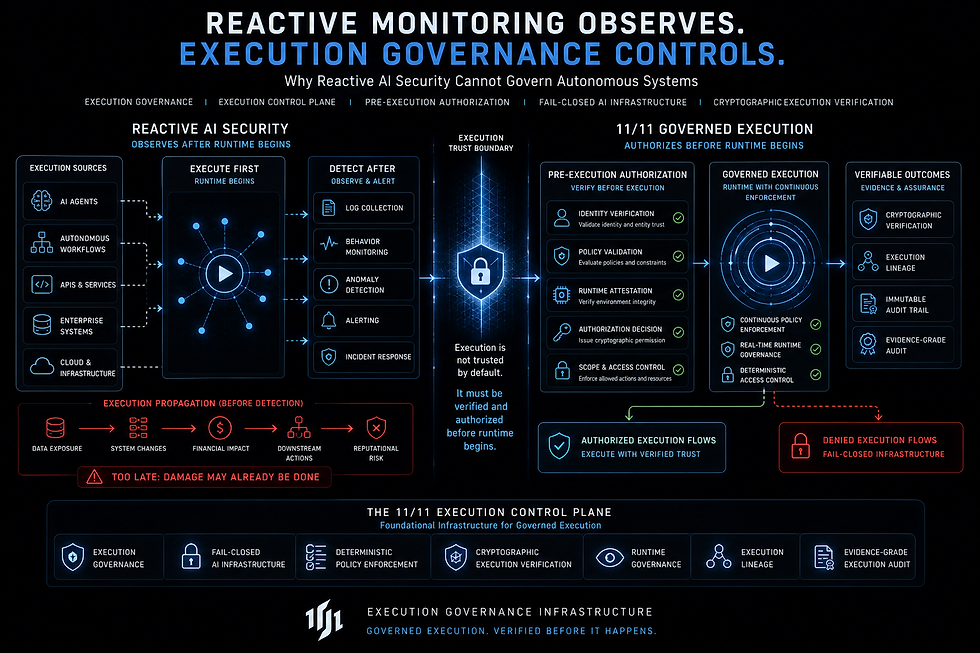
However, they generally answer a different question:
What happened?
Execution Governance asks a different question.
Should this action be allowed to occur at all?
Every Autonomous Action Crosses a Decision Boundary
Regardless of how an AI system is manipulated, every successful attack eventually reaches the same operational moment.
Execution.
Whether an attack originates from:
Prompt injection
Tool poisoning
Memory manipulation
Multi-agent coordination
Credential abuse
Workflow hijacking
The objective remains the same.
Cause an unauthorized action to execute.
That moment becomes the most important security boundary in the entire system.
Authorization Before Runtime
Execution Governance establishes an independent authorization layer immediately before execution.
Every request is evaluated against governance requirements including:
• Identity
• Policy
• Operational context
• Runtime conditions
• Organizational authority
• Compliance requirements
If authorization succeeds:
Execution proceeds.
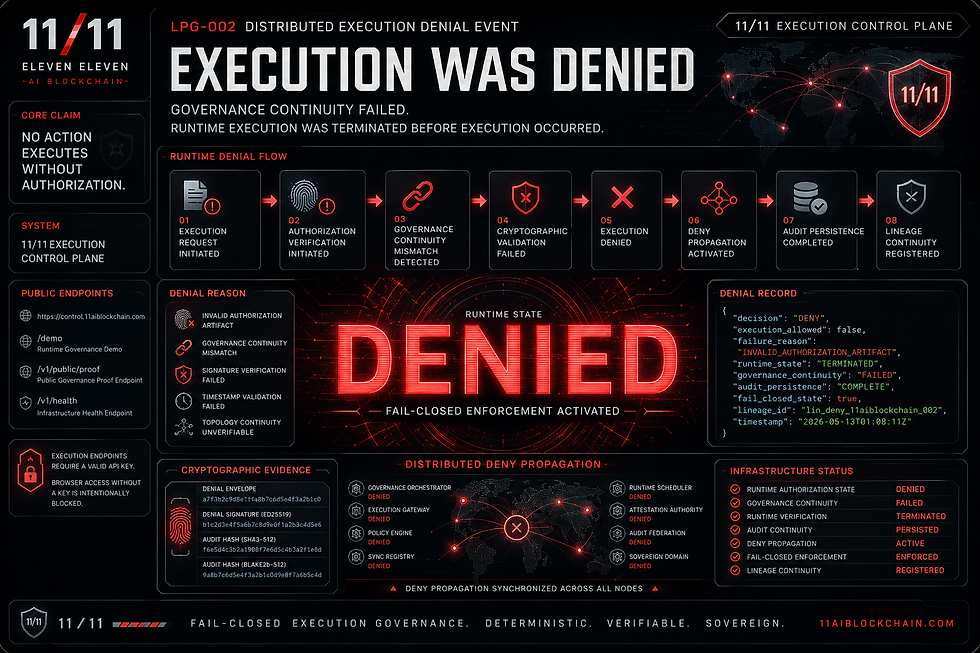
If authorization fails:
Execution does not occur.
Fail Closed.
Detection Complements Governance
Detection remains essential.
Organizations need visibility into attacks, investigations, and operational telemetry.
Execution Governance does not replace those capabilities.
It complements them by preventing unauthorized execution before operational impact occurs.
Detection explains what happened.
Execution Governance determines whether it is allowed to happen.
Building Trustworthy AI Infrastructure
As AI systems become increasingly autonomous, organizations require infrastructure capable of independently evaluating execution requests rather than assuming authenticated systems should automatically act.
This creates an additional layer of operational trust beyond monitoring alone.
The objective is simple.
Every autonomous action should require explicit authorization.
Every authorization should produce verifiable proof.
Looking Forward
AI red teaming will continue improving.
Attack techniques will continue evolving.
Detection systems will become more sophisticated.
Yet every autonomous attack still depends upon one common requirement.
Execution.
Execution Governance establishes an authorization boundary designed to evaluate every autonomous action before runtime.
That boundary remains constant even as attack techniques continue changing.
Detection tells you what happened. Execution Governance determines whether it should happen at all.
Key Takeaways
AI attacks ultimately seek unauthorized execution.
Detection alone cannot prevent execution.
Execution Governance evaluates every autonomous action before runtime.
Trustworthy AI requires authorization in addition to observation.
Execution Governance™ • Governed Execution™ • EA-11™ Execution Arithmetic™
Patent Pending
Public Infrastructure
Research & Executive Briefings
This version expands your original social post into a full briefing while remaining careful about the external claims: it accurately describes the NIST/UK AI Safety Institute red-teaming work without overstating specific statistics or implying conclusions beyond the reported findings.

Comments