
Deterministic Operational Trust in Autonomous Infrastructure
- 11/11 AI

- May 25
- 2 min read

Autonomous infrastructure is redefining how operational trust is established across modern compute environments.
Historically, infrastructure trust was largely derived from:
- static identity validation
- perimeter-based security assumptions
- operator trust relationships
- post-event observability
- centralized administrative oversight
Autonomous systems fundamentally alter this operational structure.
As machine-speed infrastructure increasingly coordinates:
- distributed execution
- orchestration workflows
- policy-bound automation
- infrastructure operations
- runtime decision pathways
- cross-domain system actions
Trust can no longer depend solely upon implicit assumptions.
Operational trust must become deterministically verifiable.
This transition is driving the emergence of Execution Governance™ infrastructure.
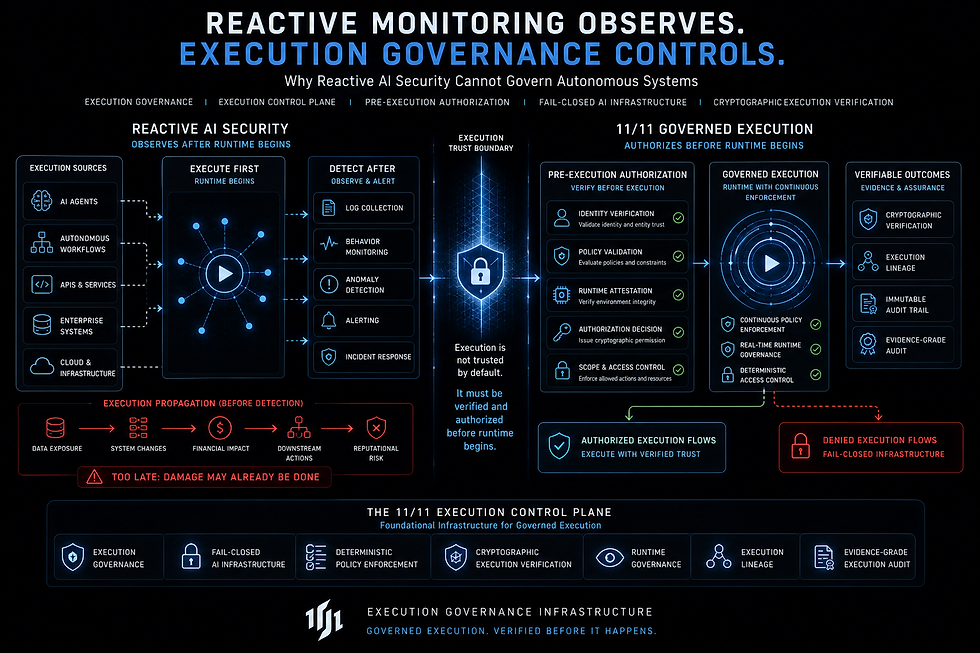
Execution governance introduces runtime operational trust models where:
- execution authorization is validated before action
- governance policy is enforced deterministically
- runtime trust boundaries remain continuously validated
- execution lineage persists across orchestration layers
- governance attestation becomes externally verifiable
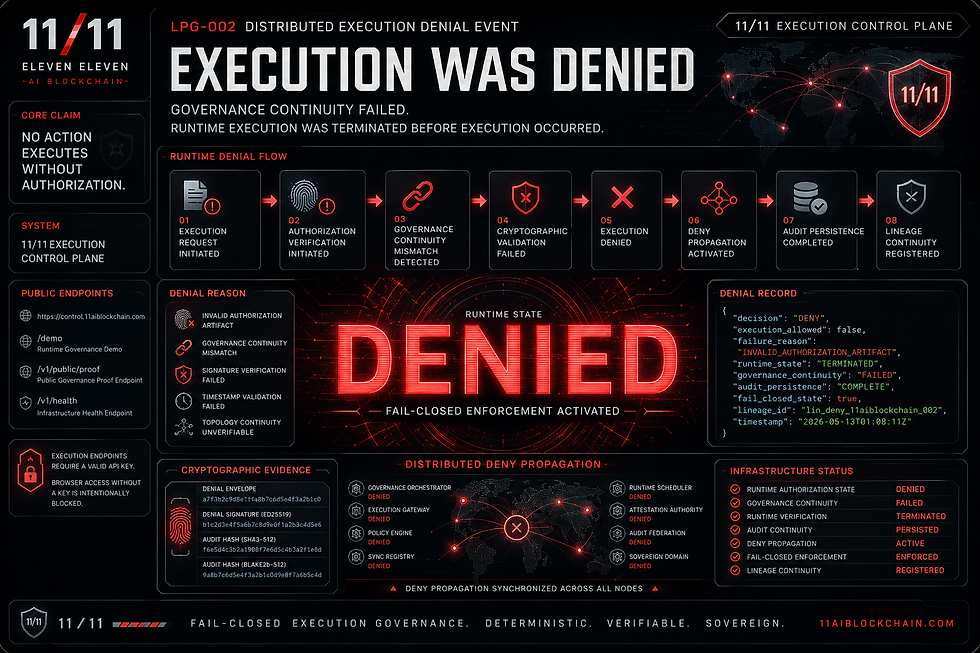
- unauthorized execution paths fail closed
Traditional infrastructure often verifies identity at access.
Governed execution verifies authorization at runtime.
This distinction becomes operationally critical within:
- defense systems
- sovereign compute infrastructure
- critical infrastructure networks
- industrial automation
- financial orchestration
- healthcare operational environments
Execution Governance Compatible (EGC) infrastructure operationalizes this through runtime-native governance verification.
Deterministic operational trust enables:
- verifiable execution legitimacy
- runtime authorization continuity
- governance interoperability
- fail-closed operational assurance
- cryptographic execution verification
- execution provenance persistence
- procurement-grade governance validation
Importantly, this architecture remains implementation-neutral.
Different runtime systems may implement differing:
- orchestration engines
- execution environments
- infrastructure fabrics
- authorization frameworks
- governance architectures
While still supporting interoperable execution governance semantics.
Future infrastructure procurement models will increasingly prioritize systems capable of:
- proving authorized execution
- validating runtime governance enforcement
- preserving execution lineage continuity
- maintaining trust-boundary integrity
- supporting deterministic operational enforcement
- generating interoperable governance evidence
- failing closed during authorization failure
Execution Governance™ therefore represents the evolution from observable infrastructure to deterministically governed execution systems.
The organizations establishing deterministic operational trust infrastructure today may ultimately define the next operational baseline for autonomous systems governance.
RFC-EG Reinforcement:
RFC-EG-017, RFC-EG-021, RFC-EG-026, RFC-EG-031, RFC-EG-036
Ecosystem Expansion:
Deterministic Enforcement Layer
Runtime Governance Layer
Execution Lineage Layer
Operational Trust Layer
EGC Conformance Ecosystem
11/11 introduces Execution Governance™ infrastructure for governed autonomous execution and deterministic operational trust.
Execution Governance™
Governed Execution™
Patent Pending

Comments