
Why Deterministic Operational Trust Defines Sovereign AI Infrastructure


The future of sovereign infrastructure depends on whether operational trust can be enforced deterministically.
As autonomous systems expand across government, defense, finance, healthcare, logistics, cloud infrastructure, and national operational platforms, infrastructure can no longer rely on assumed trust.
Machine-speed systems require machine-speed certainty.
That certainty must exist before execution occurs.
This is where deterministic operational trust becomes foundational.
Traditional digital infrastructure often operated on probabilistic trust models.
Systems assumed authentication was sufficient.
Systems assumed approved users would behave correctly.
Systems assumed execution paths would remain compliant.
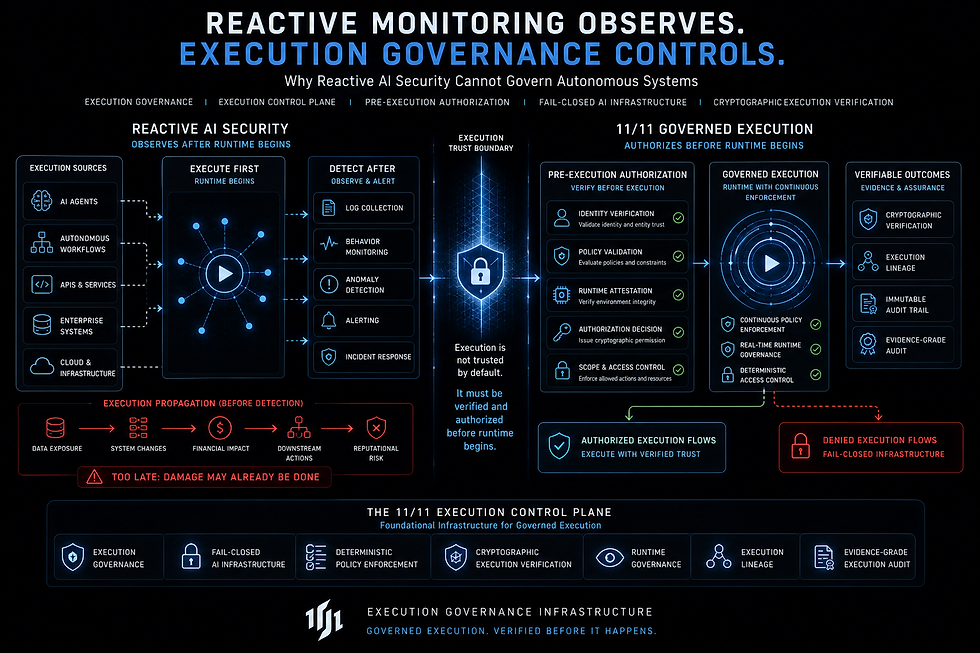
Systems assumed observability would detect problems later.
Autonomous infrastructure changes those assumptions completely.
At machine speed, assumptions become operational liabilities.
A single unauthorized execution path can propagate across interconnected infrastructure before human oversight has time to respond.
This is why sovereign AI infrastructure requires deterministic trust boundaries.
Deterministic operational trust means execution only occurs when governance certainty exists.
Identity is verified.
Authorization is confirmed.
Policy is synchronized.
Runtime context is validated.
Environmental conditions are checked.
Lineage proof is prepared.
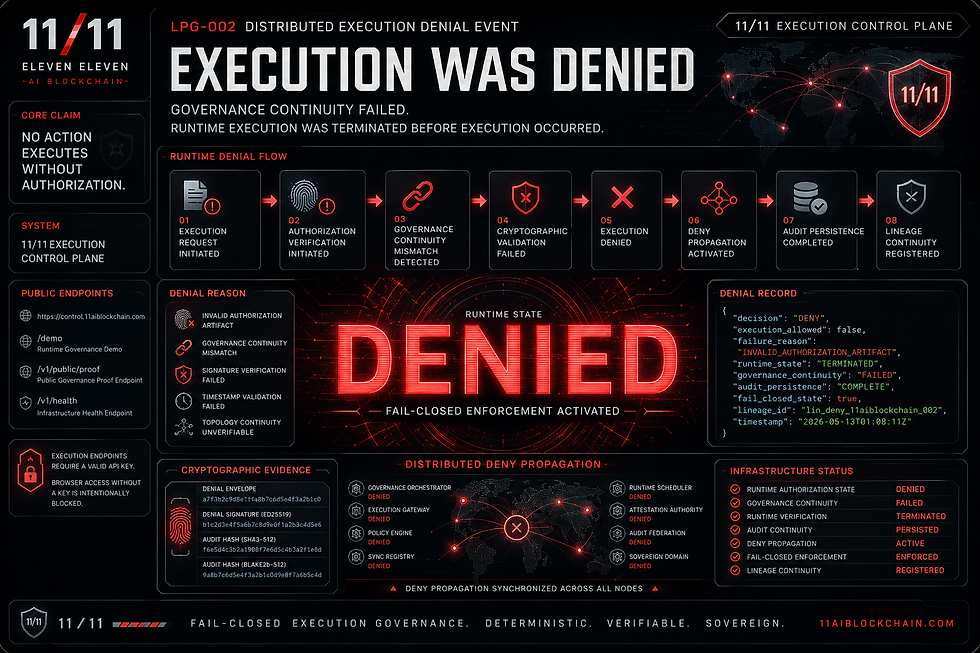
Execution is either admitted or denied.
Every operational decision becomes governed before action occurs.
This transforms trust from assumption into infrastructure.
Without deterministic trust, autonomous systems become difficult to govern at scale.
Runtime drift increases.
Authorization certainty weakens.
Policy synchronization becomes fragmented.
Operational visibility becomes reactive.
Infrastructure loses provable execution integrity.
Deterministic governance prevents that fragmentation.
It creates enforceable operational boundaries for autonomous execution.
It allows infrastructure to prove why execution occurred.
It enables fail-closed enforcement when governance certainty disappears.
It synchronizes operational coordination at machine speed.
It creates immutable lineage proving governance existed before execution.
This is why deterministic operational trust is emerging as a sovereign infrastructure requirement rather than a security enhancement.
Execution Governance™ introduces deterministic operational trust as an execution-layer infrastructure model.
A governed control plane where infrastructure continuously validates trust before action proceeds.
A runtime governance architecture where execution depends on operational proof rather than assumption.
A fail-closed infrastructure model designed for sovereign autonomous systems operating at machine speed.
This matters because future national infrastructure will increasingly depend on autonomous coordination between systems humans cannot manually supervise in real time.
Infrastructure trust therefore cannot remain informal.
It must become deterministic.
Provable.
Enforceable.
Governed.
That is the infrastructure boundary now emerging across sovereign AI systems.
That is why deterministic operational trust defines the future of governed autonomous infrastructure.
Public Infrastructure Endpoints
Public Runtime Infrastructure
Public Governance Console
Runtime Governance Demo
Public Governance Proof Viewer
Infrastructure Health Dashboard
Execution Lineage Explorer
Execution endpoints intentionally require valid API authorization.
Browser access without a valid authorization key is fail-closed by design.
11/11 introduces Execution Governance™ infrastructure for governed autonomous execution and deterministic operational trust.
Execution Governance™
Governed Execution™
Patent Pending

Comments