
RFC-EG-071 Deterministic Runtime Governance Replaces Implicit Trust in AI Infrastructure

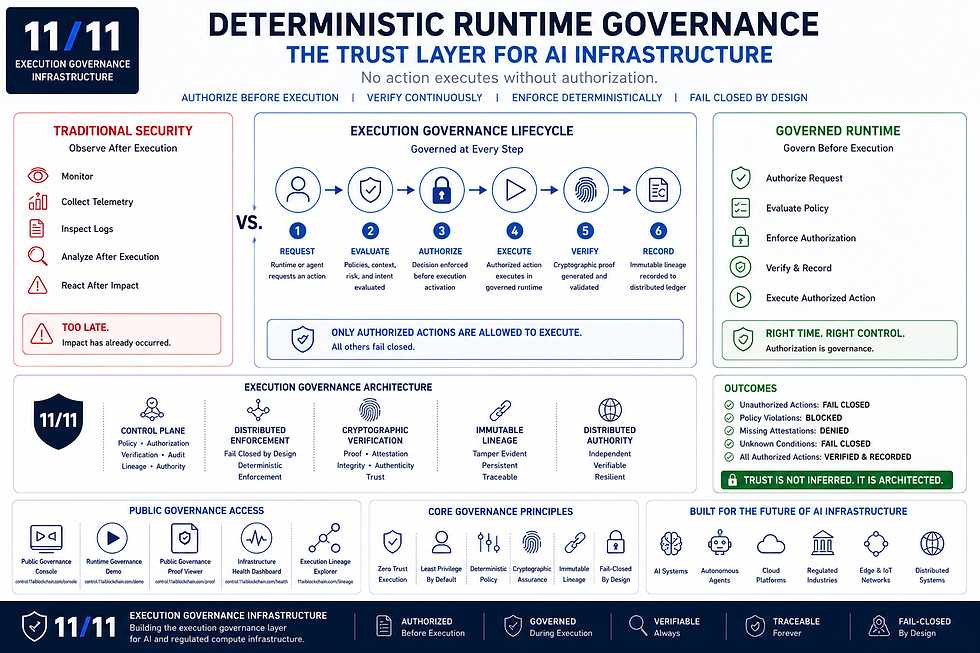
Modern AI infrastructure increasingly operates through autonomous execution.
AI systems now:
coordinate distributed runtimes
orchestrate operational workflows
automate infrastructure actions
manage regulated compute processes
trigger machine-speed decisions
operate continuously across cloud-native environments
This fundamentally changes infrastructure trust architecture.
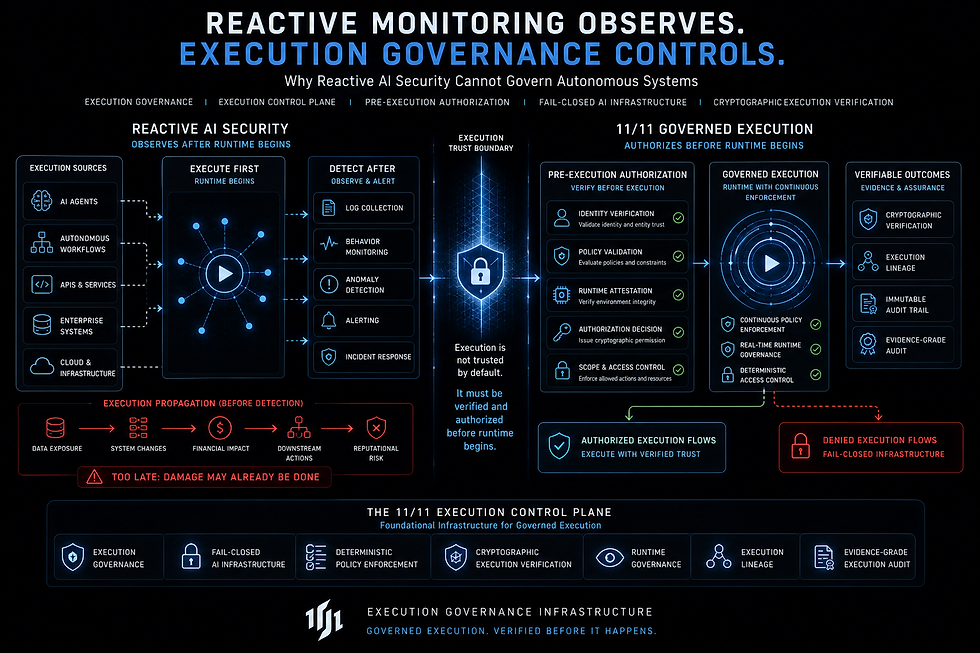
Traditional runtime security models rely primarily on:
monitoring
observability
telemetry collection
post-execution inspection
reactive response systems
These systems analyze execution after runtime activation.
They do not establish deterministic trust before execution occurs.
As autonomous infrastructure expands, this becomes operationally insufficient.
Execution itself becomes the infrastructure trust boundary.
Infrastructure now requires deterministic governance enforced directly at runtime.
11/11 Execution Governance Infrastructure establishes a governed runtime model where deterministic runtime governance replaces implicit trust assumptions.
No action executes without authorization.
Under this architecture:
runtime authorization occurs before execution activation
governance enforcement remains continuously active
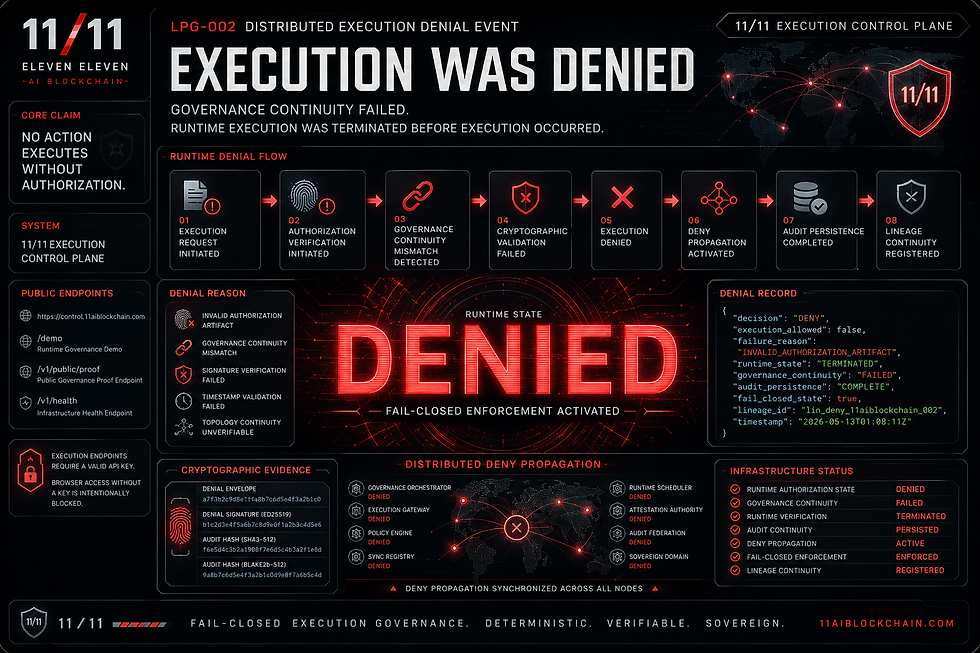
unauthorized execution fails closed
cryptographic verification validates runtime trust
immutable execution lineage persists across runtime states
distributed governance authority remains independently enforceable
This creates governed autonomous execution infrastructure.
Execution transitions from:
“implicitly trusted runtime”to:“deterministically governed execution.”
That operational transition fundamentally changes infrastructure control architecture.
The future runtime stack increasingly requires:
execution governance
runtime authorization
deterministic policy enforcement
cryptographic execution verification
immutable execution lineage
fail-closed runtime semantics
Public execution governance infrastructure is now operational:
Public Governance Console
Runtime Governance Demo
Public Governance Proof Viewer
Infrastructure Health Dashboard
Execution Lineage Explorer
This infrastructure evolution increasingly resembles the emergence of:
Zero Trust infrastructure
Kubernetes admission control
runtime attestation systems
distributed trust verification
cryptographic infrastructure enforcement
Execution governance now emerges as the deterministic trust layer for autonomous compute infrastructure.
Execution can no longer rely on:
inferred trust
reactive monitoring
observational telemetry
delayed operational response
Execution must become:
authorized
governed
deterministic
cryptographically verifiable
persistently traceable
fail-closed by design
11/11 is building the execution governance layer for AI and regulated compute infrastructure.

Comments