
EG-009 Execution Governance Maturity Model

Updated: May 13

AI infrastructure is entering a governance transition phase.
Most systems today still operate with:
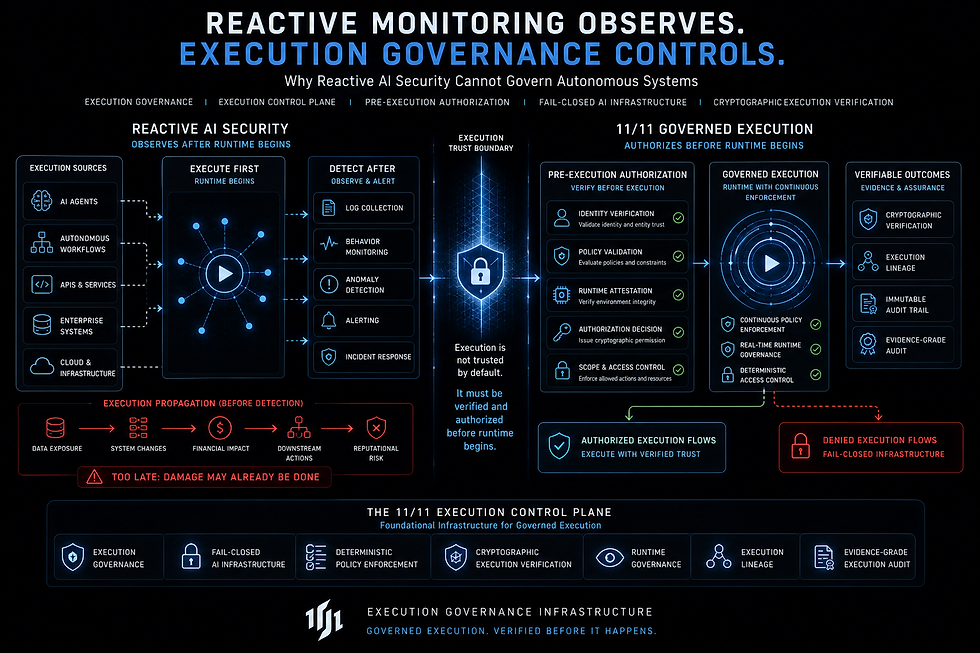
reactive monitoring
permissive execution
post-execution analysis
fragmented policy enforcement
inconsistent runtime trust
Autonomous infrastructure cannot safely scale under these models.
Execution governance maturity becomes infrastructure-critical.
11/11 defines the Execution Governance Maturity Model as the canonical framework used to classify, evaluate, and standardize runtime governance maturity across autonomous execution systems.
Execution governance becomes measurable operational infrastructure.
Why Governance Maturity Models Matter
Modern infrastructure already uses maturity frameworks for:
cybersecurity
cloud operations
compliance systems
software delivery
risk management
identity governance
Autonomous execution systems now require:execution governance maturity standards.
Without maturity models:
governance capabilities remain undefined
runtime trust becomes inconsistent
infrastructure assurance weakens
execution accountability fragments
governance evolution becomes difficult to measure
Execution governance requires operational standardization.
EG-009 Governance Maturity Tiers
Level 0 — Ungoverned Execution
Characteristics:
execution trust assumed
reactive security only
no runtime authorization
no lineage continuity
no deterministic governance
fail-open infrastructure behavior
Risk Profile:
High-risk autonomous infrastructure.
Level 1 — Reactive Governance
Characteristics:
monitoring after execution
event logging
anomaly detection
manual intervention workflows
fragmented governance controls
Risk Profile:
Limited operational governance maturity.
Level 2 — Policy-Aware Governance
Characteristics:
policy enforcement introduced
constrained runtime permissions
partial execution verification
environment-aware controls
limited governance coordination
Risk Profile:
Moderate governance maturity.
Level 3 — Governed Execution Infrastructure
Characteristics:
deterministic policy enforcement
runtime authorization artifacts
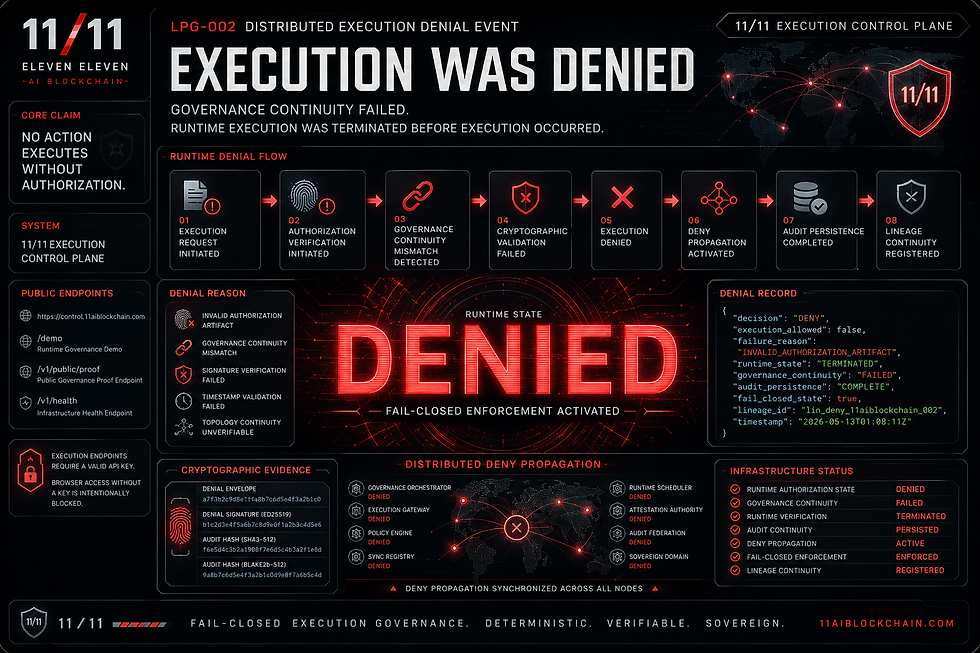
fail-closed execution controls
immutable execution lineage
cryptographic verification systems
Risk Profile:
Enterprise-grade governed execution maturity.
Level 4 — Autonomous Runtime Governance
Characteristics:
continuous runtime verification
distributed governance orchestration
autonomous trust enforcement
synchronized governance meshes
operational trust continuity
Risk Profile:
Advanced autonomous governance maturity.
Level 5 — Sovereign Execution Governance
Characteristics:
globally coordinated trust systems
sovereign governance domains
cross-environment trust orchestration
machine-scale governance automation
cryptographically provable execution infrastructure
Risk Profile:
Strategic sovereign-grade execution governance maturity.
EG-009 Core Governance Dimensions
Execution governance maturity is evaluated across:
runtime authorization
trust verification
deterministic enforcement
fail-closed controls
execution lineage
governance orchestration
distributed trust coordination
cryptographic verification
runtime containment
operational governance continuity
Execution trust itself becomes measurable.
Governance Maturity Becomes Infrastructure-Critical
Future enterprise and sovereign systems increasingly require:
measurable runtime trust maturity
deterministic governance standards
cryptographic execution assurance
fail-closed runtime controls
governed execution continuity
operational governance classification
Execution governance becomes auditable infrastructure maturity.
Autonomous Infrastructure Requires Governance Evolution
As AI systems scale:
governance maturity itself becomes strategic infrastructure capability.
Future systems increasingly compete on:
runtime trust assurance
execution governance maturity
operational governance continuity
deterministic enforcement capability
distributed trust orchestration
cryptographic runtime verification
Governance maturity becomes infrastructure differentiation.
Governance Models Change Infrastructure Semantics
Historically:
infrastructure maturity focused on:
uptime
performance
scalability
redundancy
Execution governance introduces a new maturity dimension:
runtime trust assurance.
Future infrastructure increasingly governs:
whether execution remains provable
whether runtime trust persists
whether governance continuity scales
whether execution remains constrained
whether trust becomes autonomous
Execution governance maturity becomes foundational infrastructure classification.
11/11 Positioning
11/11 is positioned as the execution governance layer for AI infrastructure.
Its governance architecture establishes:
execution governance maturity frameworks
deterministic runtime enforcement
fail-closed execution controls
cryptographic trust verification
immutable execution lineage
operational governance continuity
before and during execution.
Execution itself becomes the trust boundary.
Official Proof Systems
Public Governance Console
Runtime Governance Demo
Public Governance Proof Viewer
Infrastructure Health Dashboard
Execution Lineage Explorer
Autonomous infrastructure cannot scale safely without governance maturity.
Execution trust itself must become measurable infrastructure.

Comments