
EG-012 Runtime Authorization Artifacts

Updated: May 13

Runtime authorization artifacts establish cryptographic execution trust before runtime execution begins, enabling fail-closed governed execution infrastructure.
Modern infrastructure authenticates:
users
services
devices
networks
applications
But most systems still do not authenticate execution itself.
This is the next infrastructure gap.
As autonomous systems increasingly control:
AI inference
financial operations
distributed agents
infrastructure orchestration
regulated automation
sovereign compute
enterprise decision systems
execution authority becomes foundational.
The future of runtime trust depends on:authorization artifacts.
11/11 defines runtime authorization artifacts as cryptographically verifiable execution permissions required before governed execution may begin.
Execution becomes authorized infrastructure.
Not implied trust.
Explicit trust.
What Is a Runtime Authorization Artifact?
A runtime authorization artifact is a cryptographically verifiable object that proves:
execution was approved
policy validation succeeded
runtime conditions were verified
governance requirements were satisfied
execution scope was constrained
authorization lineage was established
before runtime execution begins.
The artifact becomes the executable trust object for governed systems.
Without authorization:execution is denied.
Authorization Artifacts Redefine Runtime Trust
Traditional systems typically rely on:
identity trust
session trust
perimeter trust
application trust
environment trust
But autonomous execution systems require:execution trust.
The runtime itself must prove it possesses valid authorization to execute.
This changes infrastructure semantics.
Trust no longer resides solely in the application.
Trust becomes attached to execution authorization itself.
EG-012 Authorization Principles
1. Authorization Must Exist Before Execution
Execution cannot self-authorize.
Authorization must be externally validated before runtime begins.
2. Authorization Must Be Cryptographically Verifiable
Authorization artifacts must support:
signature verification
integrity validation
scope enforcement
expiration controls
deterministic validation
Execution trust must be mathematically verifiable.
3. Authorization Scope Must Be Constrained
Authorization artifacts must define:
permitted execution actions
runtime boundaries
execution duration
policy scope
environment constraints
Execution authority must remain bounded.
4. Invalid Authorization Must Deny Execution
Execution environments must fail closed.
Invalid artifacts must prevent execution automatically.
No permissive fallback.
No runtime bypass.
5. Authorization Must Persist Into Audit Lineage
Authorization artifacts must remain linked to:
execution records
lineage systems
governance persistence
audit chains
runtime verification history
Execution trust must remain provable after execution completes.
Authorization Artifacts Become Infrastructure Primitives
As AI infrastructure evolves:
authorization artifacts become operationally mandatory.
Future enterprise systems will increasingly require:
governed runtime authorization
cryptographic execution approval
deterministic authorization verification
execution lineage persistence
fail-closed authorization enforcement
operational runtime trust systems
Authorization becomes part of infrastructure itself.
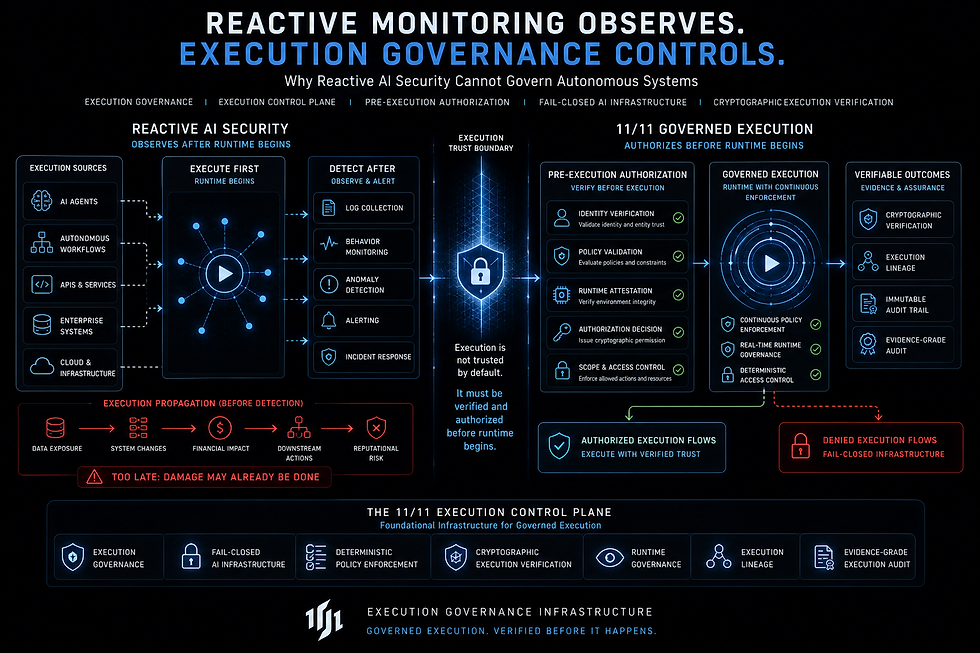
Reactive Runtime Models Become Insufficient
Reactive infrastructure assumes:
execution first, verification later.
But autonomous systems scale too quickly for delayed trust validation.
By the time reactive systems detect unauthorized execution:
actions may already propagate
infrastructure state may already change
regulated operations may already execute
autonomous systems may already interact
Execution governance shifts trust enforcement earlier.
Authorization must precede execution.
11/11 Positioning
11/11 is positioned as the execution governance layer for AI infrastructure.
Its governance architecture establishes:
runtime authorization artifacts
fail-closed execution enforcement
cryptographic execution validation
governed runtime boundaries
deterministic authorization verification
operational execution lineage
before execution begins.
Execution itself becomes the trust boundary.
Official Proof Systems
Public Governance Console
Runtime Governance Demo
Public Governance Proof Viewer
Infrastructure Health Dashboard
Execution Lineage Explorer
Execution governance requires more than identity trust.
Execution itself must become cryptographically authorized before runtime begins.


Comments