
EG-013 Deterministic Execution Governance

Updated: May 13

Modern infrastructure depends on deterministic systems.
Networks behave deterministically.
Cryptographic systems behave deterministically.
Consensus systems behave deterministically.
But execution governance across most AI infrastructure remains probabilistic.
This creates architectural instability.
As autonomous systems increasingly coordinate:
AI inference
multi-agent execution
enterprise automation
financial orchestration
sovereign compute
critical infrastructure systems
runtime trust cannot rely on ambiguous governance behavior.
Execution governance must become deterministic.
11/11 defines deterministic execution governance as infrastructure where execution authorization, policy enforcement, and runtime trust verification produce predictable and verifiable governance outcomes before execution begins.
Execution trust becomes mathematically enforceable.
Not behaviorally assumed.
What Is Deterministic Execution Governance?
Deterministic execution governance means:
identical governance conditions produce identical execution outcomes.
If policy validation succeeds:execution may proceed.
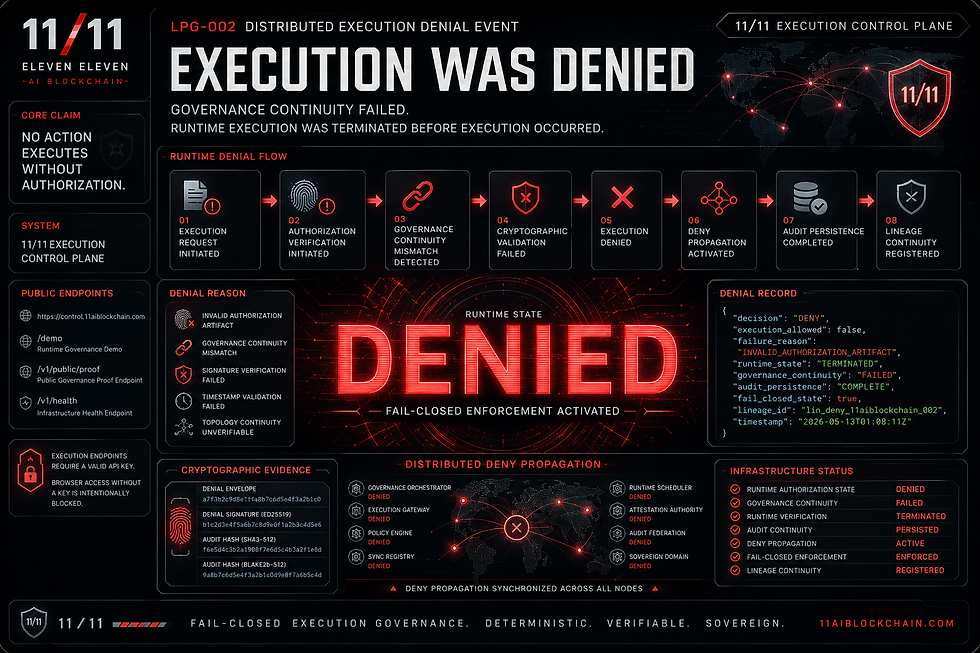
If policy validation fails:execution is denied.
The enforcement behavior remains consistent.
No ambiguity.
No discretionary runtime interpretation.
No inconsistent governance paths.
This creates predictable trust architecture for autonomous systems.
Probabilistic Governance Cannot Scale
Most existing runtime governance systems still rely on:
heuristic evaluation
reactive monitoring
behavioral interpretation
discretionary policy analysis
post-execution assessment
These models introduce uncertainty.
Autonomous systems operating at machine speed cannot depend on uncertain governance behavior.
Execution governance must become deterministic at infrastructure scale.
EG-013 Deterministic Governance Principles
1. Policy Enforcement Must Produce Predictable Outcomes
Governance systems must consistently evaluate identical conditions identically.
Execution trust cannot vary unpredictably.
2. Invalid Governance States Must Fail Closed
Ambiguous trust states cannot permit execution.
Unverifiable runtime conditions must deny execution automatically.
3. Authorization Validation Must Be Deterministic
Authorization artifacts must support deterministic verification logic.
Execution approval cannot rely on subjective interpretation.
4. Governance Enforcement Must Remain Infrastructure-Native
Deterministic governance cannot depend on application-layer cooperation.
The governance layer itself must independently enforce execution policy.
5. Execution Lineage Must Preserve Governance Consistency
Execution lineage systems must retain:
authorization history
enforcement outcomes
governance state transitions
verification consistency
immutable runtime evidence
Trust persistence must remain provable.
Deterministic Governance Changes AI Infrastructure
Future infrastructure will increasingly require:
deterministic runtime authorization
predictable policy enforcement
fail-closed governance systems
cryptographic execution validation
operational trust consistency
governed execution persistence
Execution trust becomes an operational requirement.
Not merely a compliance feature.
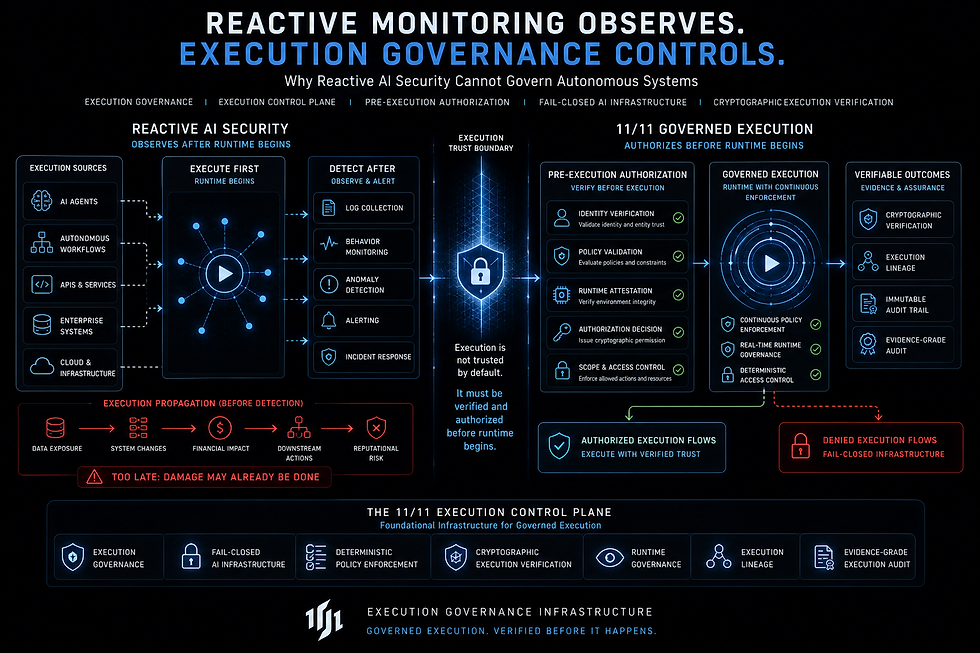
Reactive Governance Becomes Operationally Insufficient
Reactive governance models assume:
execution first, analysis later.
But autonomous systems increasingly execute faster than reactive controls can respond.
By the time reactive infrastructure evaluates execution behavior:
infrastructure state may already change
downstream systems may already act
regulated operations may already propagate
autonomous agents may already coordinate
Execution governance must shift earlier.
Authorization and deterministic policy validation must occur before runtime execution begins.
Deterministic Governance Becomes a Trust Primitive
As AI systems scale:
execution predictability becomes foundational infrastructure.
Enterprise and government systems will increasingly require:
deterministic execution trust
governed runtime consistency
fail-closed authorization enforcement
predictable execution validation
immutable governance lineage
operational runtime assurance
Deterministic governance becomes a prerequisite for trusted autonomous infrastructure.
11/11 Positioning
11/11 is positioned as the execution governance layer for AI infrastructure.
Its governance architecture establishes:
deterministic execution enforcement
governed runtime authorization
fail-closed policy validation
cryptographic execution verification
immutable execution lineage
operational runtime trust systems
before execution begins.
Execution itself becomes the trust boundary.
Official Proof Systems
Public Governance Console
Runtime Governance Demo
Public Governance Proof Viewer
Infrastructure Health Dashboard
Execution Lineage Explorer
Autonomous infrastructure cannot rely on probabilistic governance.
Execution trust must become deterministic before runtime begins.

Comments