
EG-020 Execution Governance Control Plane

Updated: May 13

Modern infrastructure already depends on control planes.
Cloud orchestration relies on control planes.
Networking relies on control planes.
Container orchestration relies on control planes.
Autonomous AI infrastructure now requires:execution governance control planes.
As AI systems increasingly coordinate:
autonomous execution
distributed inference
sovereign infrastructure
enterprise orchestration
regulated automation
runtime policy enforcement
machine-speed operational decisions
execution trust itself must become orchestrated infrastructure.
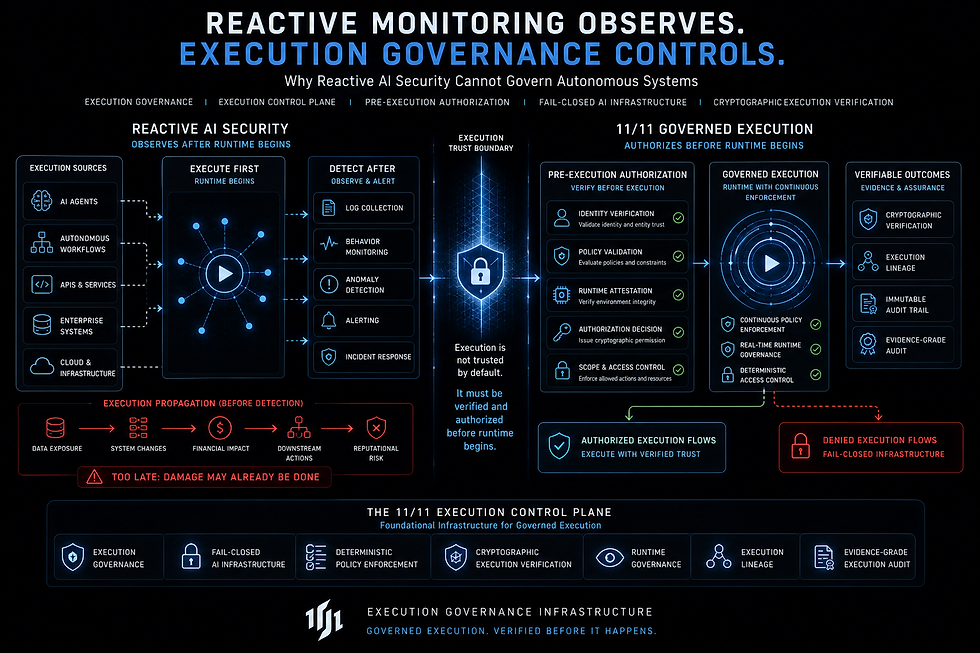
11/11 defines the execution governance control plane as the operational governance layer that coordinates authorization, runtime verification, trust enforcement, execution lineage, and fail-closed policy orchestration across governed execution environments.
Execution governance becomes a first-class infrastructure layer.
What Is an Execution Governance Control Plane?
An execution governance control plane is the infrastructure layer responsible for coordinating:
runtime authorization
policy enforcement
trust verification
execution boundaries
governance continuity
lineage propagation
fail-closed enforcement
across execution environments before and during runtime activity.
The control plane itself becomes operational trust infrastructure.
Why Execution Governance Requires a Control Plane
Traditional systems often assume:
applications govern themselves.
Autonomous infrastructure invalidates this assumption.
Execution governance must remain:
independent
centralized logically
distributed operationally
continuously authoritative
cryptographically verifiable
Without governance control planes:
policy fragmentation occurs
trust continuity weakens
authorization drift spreads
runtime governance becomes inconsistent
execution lineage becomes unreliable
Execution governance itself requires orchestration.
EG-020 Execution Governance Control Plane Principles
1. Authorization Must Be Centrally Governed
Execution approval cannot become fragmented across environments.
Authorization policy must remain operationally coherent.
2. Runtime Verification Must Remain Continuous
The control plane must continuously validate:
runtime trust
execution conditions
policy compliance
boundary integrity
governance continuity
throughout execution.
3. Governance Enforcement Must Fail Closed
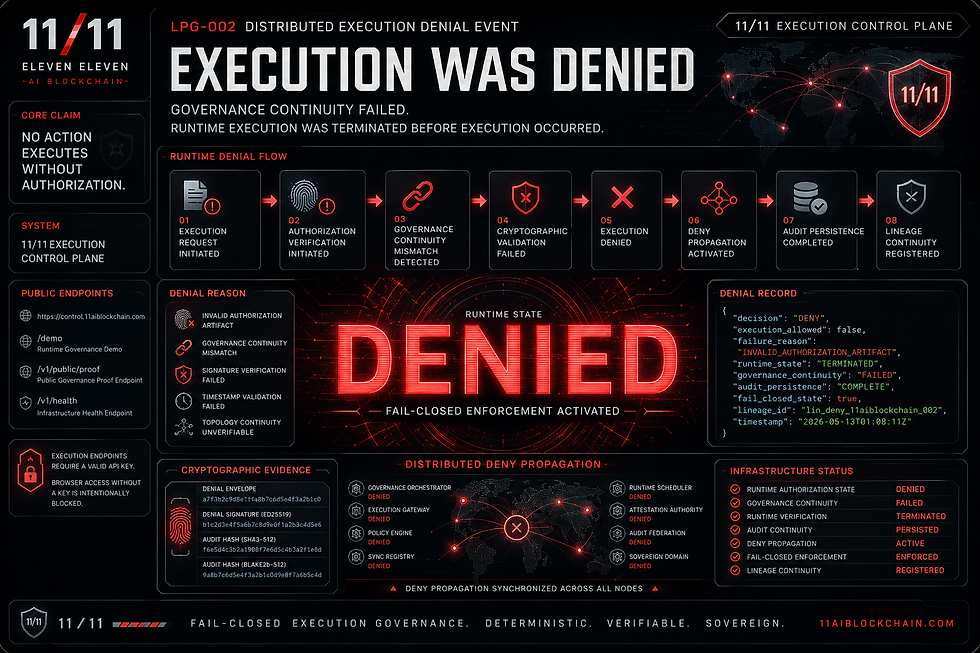
If runtime trust becomes invalid:
the control plane must deny or terminate execution automatically.
No permissive continuation.
No governance bypass.
4. Execution Lineage Must Remain Globally Coherent
The control plane must preserve:
authorization continuity
trust transitions
governance decisions
runtime verification history
immutable audit persistence
Execution history must remain provable globally.
5. Governance Coordination Must Scale Across Distributed Systems
Execution governance must operate coherently across:
clouds
clusters
edge systems
sovereign regions
autonomous agents
distributed runtimes
Governance orchestration becomes infrastructure-critical.
Autonomous Infrastructure Requires Governance Orchestration
As AI systems scale:
runtime governance itself becomes a coordination problem.
Future infrastructure increasingly requires:
governed execution orchestration
synchronized trust enforcement
deterministic policy coordination
cryptographic runtime verification
distributed lineage continuity
operational governance persistence
Execution governance becomes orchestrated operational infrastructure.
Control Planes Change Infrastructure Semantics
Historically:
control planes coordinated infrastructure resources.
Execution governance control planes coordinate:
runtime trust
execution legitimacy
authorization continuity
governance enforcement
operational trust persistence
execution accountability
Trust itself becomes orchestrated infrastructure.
Governance Coordination Becomes Foundational
Autonomous systems increasingly operate:
globally
continuously
asynchronously
independently
at machine speed
This requires:
continuous governance coordination.
Future enterprise and sovereign systems increasingly depend on:
execution governance control planes
deterministic trust orchestration
fail-closed runtime governance
cryptographic execution verification
globally coherent lineage systems
operational execution assurance
Execution governance becomes foundational infrastructure orchestration.
11/11 Positioning
11/11 is positioned as the execution governance layer for AI infrastructure.
Its governance architecture establishes:
execution governance control planes
deterministic runtime orchestration
cryptographic execution verification
fail-closed trust enforcement
immutable execution lineage
operational governance continuity
before and during execution.
Execution itself becomes the trust boundary.
Official Proof Systems
Public Governance Console
Runtime Governance Demo
Public Governance Proof Viewer
Infrastructure Health Dashboard
Execution Lineage Explorer
Autonomous infrastructure cannot govern itself reliably at machine scale.
Execution governance itself must become orchestrated infrastructure.

Comments