
EG-021 Governed Execution Compliance Framework

Updated: May 13

Traditional compliance systems were designed for static infrastructure.
Autonomous systems invalidate this model.
Modern AI infrastructure increasingly operates:
continuously
autonomously
asynchronously
across distributed environments
at machine speed
Compliance itself must become runtime-native.
11/11 defines the Governed Execution Compliance Framework as the operational governance system that continuously validates, enforces, records, and proves runtime compliance before and during execution activity.
Compliance becomes continuous infrastructure.
Not periodic review.
Why Runtime Compliance Changes Everything
Traditional compliance models rely on:
scheduled audits
manual evidence collection
post-event reporting
fragmented policy controls
delayed remediation
These systems assume:
execution is relatively static.
Autonomous infrastructure operates continuously.
Execution governance requires:
continuous runtime compliance assurance.
What Is Governed Execution Compliance?
Governed execution compliance establishes infrastructure where:
execution policies remain enforced
runtime trust remains validated
governance lineage remains immutable
authorization continuity persists
policy violations fail closed
audit evidence remains continuously provable
throughout runtime activity.
Compliance itself becomes operational infrastructure.
EG-021 Compliance Framework Principles
1. Compliance Validation Must Remain Continuous
Governance systems must continuously verify:
runtime trust
policy integrity
authorization scope
execution containment
operational constraints
Compliance cannot depend on periodic review alone.
2. Violations Must Fail Closed
If execution violates governance policy:
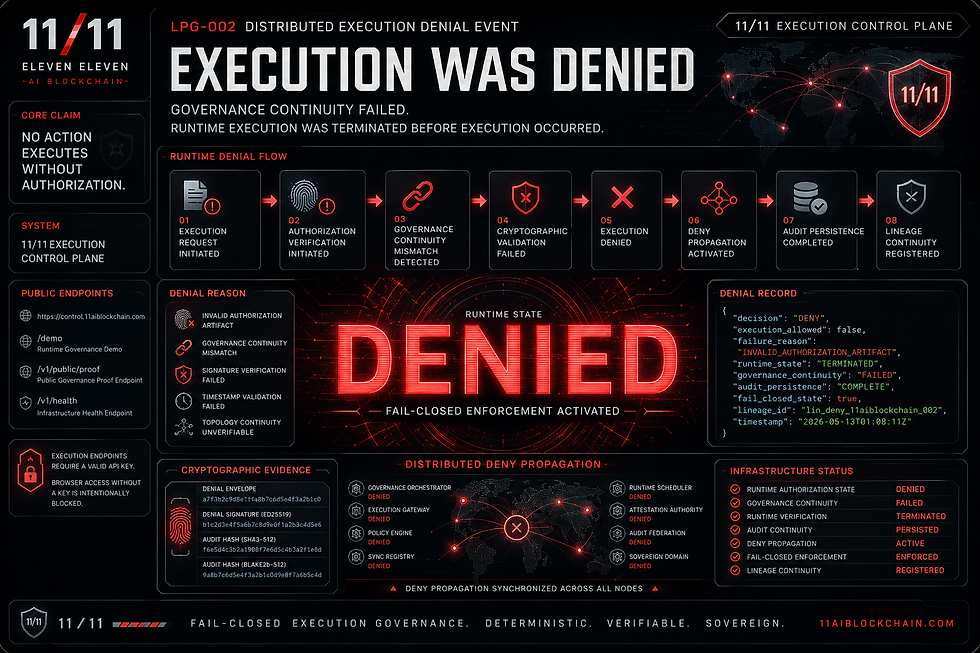
execution must stop automatically.
No permissive exceptions.
No delayed remediation paths.
3. Compliance Evidence Must Remain Immutable
Governance systems must preserve:
authorization history
runtime trust states
policy evaluations
enforcement actions
execution lineage
cryptographic audit records
Compliance evidence must remain historically provable.
4. Governance Enforcement Must Be Deterministic
Compliance behavior cannot rely on ambiguous runtime interpretation.
Governance outcomes must remain:
predictable
verifiable
consistent
independently provable
Execution trust must remain operationally deterministic.
5. Compliance Must Scale Across Distributed Systems
Future governance systems increasingly operate across:
clouds
sovereign regions
edge systems
autonomous agents
distributed runtimes
enterprise execution meshes
Compliance itself must become distributed infrastructure.
Compliance Becomes Runtime Infrastructure
Future enterprise and sovereign systems increasingly require:
continuous runtime compliance
deterministic governance enforcement
cryptographic execution verification
fail-closed trust assurance
immutable governance lineage
operational compliance continuity
Compliance evolves from documentation into infrastructure.
Autonomous Systems Require Continuous Assurance
As AI systems scale:
compliance itself becomes a runtime problem.
Future infrastructure increasingly governs:
whether execution remains compliant
whether runtime trust persists
whether governance continuity remains intact
whether authorization remains valid
whether policy enforcement remains provable
Execution compliance becomes continuously enforced infrastructure.
Governance Compliance Changes Infrastructure Semantics
Historically:
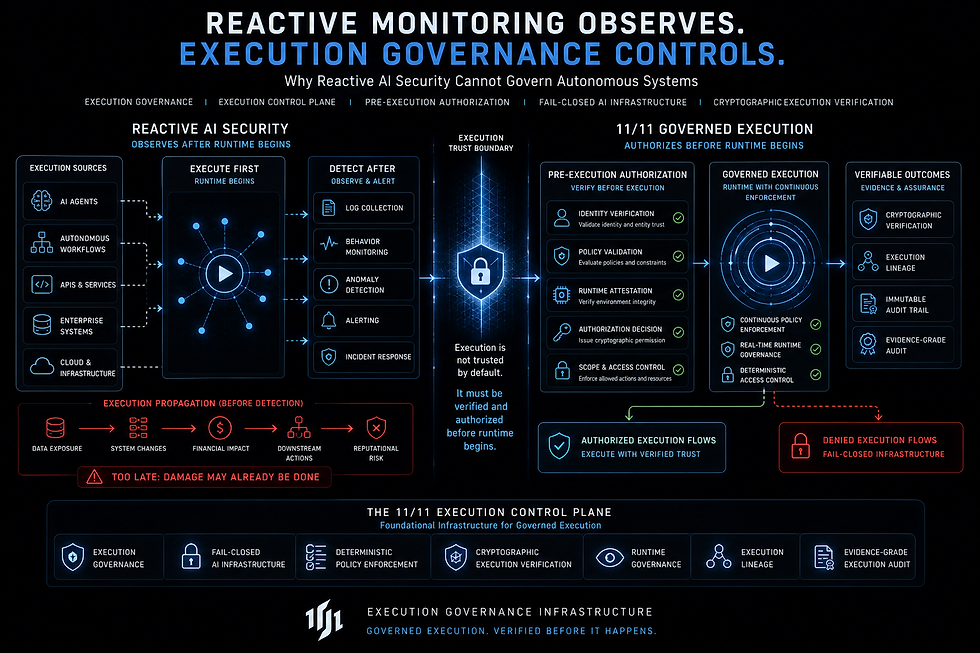
compliance verified infrastructure after execution.
Execution governance establishes:
compliance before and during execution.
This fundamentally changes infrastructure assurance models.
Trust itself becomes continuously measurable operational infrastructure.
Compliance Assurance Becomes Foundational
Autonomous systems increasingly coordinate across:
enterprise AI systems
sovereign compute environments
regulated automation platforms
distributed execution meshes
financial orchestration systems
mission-critical runtime environments
This requires:
continuous governance assurance.
Execution governance compliance becomes foundational operational infrastructure.
11/11 Positioning
11/11 is positioned as the execution governance layer for AI infrastructure.
Its governance architecture establishes:
governed execution compliance frameworks
deterministic runtime enforcement
fail-closed governance controls
cryptographic execution verification
immutable governance lineage
operational trust continuity
before and during execution.
Execution itself becomes the trust boundary.
Official Proof Systems
Public Governance Console
Runtime Governance Demo
Public Governance Proof Viewer
Infrastructure Health Dashboard
Execution Lineage Explorer
Autonomous infrastructure cannot rely on delayed compliance validation.
Compliance itself must become continuous runtime infrastructure.

Comments