
EG-022 Runtime Governance Assurance Levels

Updated: May 13

Autonomous infrastructure requires measurable trust assurance.
Traditional infrastructure often assumes:
trusted execution environments
policy compliance
operational integrity
runtime legitimacy
without continuously proving those conditions.
Autonomous systems invalidate assumption-based infrastructure trust.
11/11 defines Runtime Governance Assurance Levels as the standardized trust classification framework used to measure execution governance strength, runtime verification confidence, policy enforcement maturity, and operational trust continuity across governed infrastructure systems.
Execution trust becomes classifiable infrastructure.
Why Governance Assurance Levels Matter
Modern infrastructure already classifies assurance across:
cryptographic systems
identity systems
compliance controls
safety systems
operational risk environments
Governed execution infrastructure now requires:
runtime trust assurance classifications.
Without assurance standards:
governance quality becomes ambiguous
execution trust varies unpredictably
operational risk becomes difficult to quantify
runtime legitimacy weakens
governance maturity becomes unverifiable
Execution governance requires measurable assurance.
EG-022 Runtime Governance Assurance Tiers
Assurance Level A0 — Unverified Runtime
Characteristics:
execution trust assumed
no deterministic enforcement
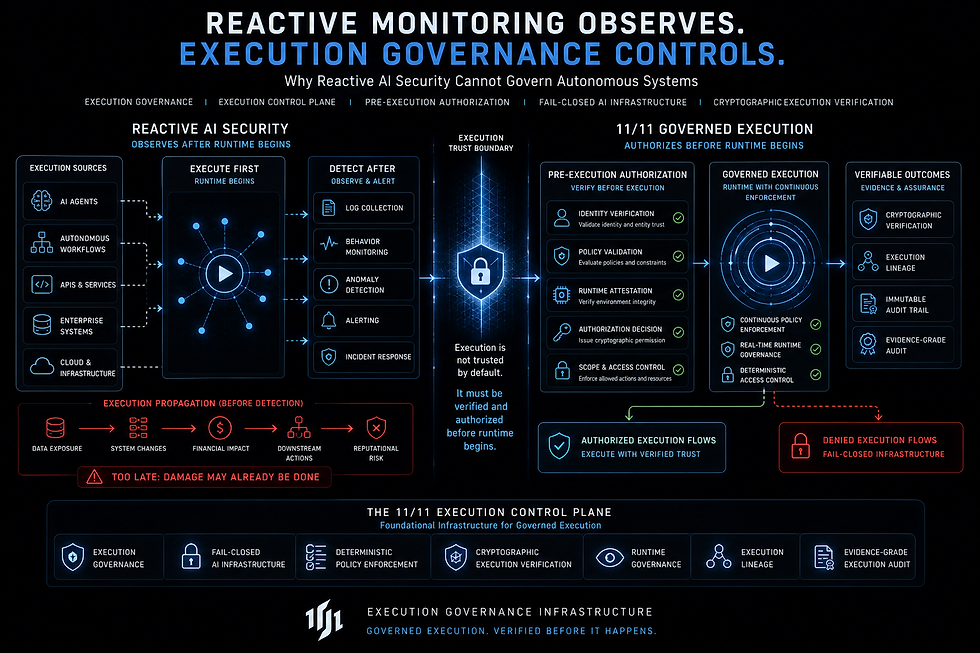
reactive monitoring only
no runtime authorization
no cryptographic verification
Trust Model:
Implicit trust infrastructure.
Assurance Level A1 — Observed Runtime
Characteristics:
monitoring and telemetry active
runtime logging enabled
anomaly detection introduced
partial governance visibility
Trust Model:
Observed execution infrastructure.
Assurance Level A2 — Policy-Constrained Runtime
Characteristics:
constrained execution scope
policy-aware controls
bounded runtime permissions
limited verification continuity
Trust Model:
Policy-governed infrastructure.
Assurance Level A3 — Verified Runtime Governance
Characteristics:
deterministic enforcement
authorization artifacts
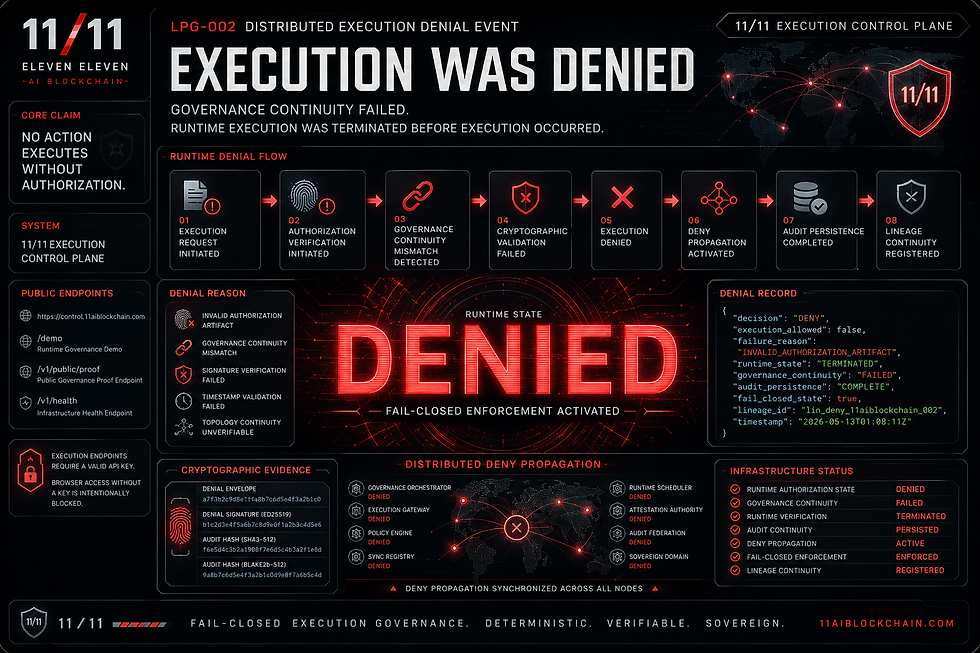
fail-closed execution controls
immutable execution lineage
cryptographic verification systems
Trust Model:
Provably governed infrastructure.
Assurance Level A4 — Autonomous Governance Assurance
Characteristics:
continuous runtime verification
autonomous trust enforcement
distributed governance coordination
synchronized runtime governance
operational trust continuity
Trust Model:
Continuously governed autonomous infrastructure.
Assurance Level A5 — Sovereign Execution Assurance
Characteristics:
sovereign trust orchestration
globally coordinated governance
machine-scale runtime verification
cryptographically provable trust systems
autonomous governance resilience
Trust Model:
Strategic sovereign-grade execution governance.
EG-022 Assurance Dimensions
Runtime governance assurance is evaluated across:
runtime authorization
trust verification
deterministic enforcement
fail-closed controls
execution lineage
governance orchestration
operational continuity
cryptographic assurance
runtime containment
autonomous governance capability
Execution trust itself becomes measurable.
Assurance Becomes Infrastructure-Critical
Future enterprise and sovereign systems increasingly require:
measurable runtime trust assurance
deterministic governance confidence
cryptographic execution verification
fail-closed runtime integrity
operational trust continuity
governed execution assurance classification
Trust assurance becomes operational infrastructure.
Autonomous Infrastructure Requires Quantifiable Trust
As AI systems scale:
runtime trust itself becomes an operational risk domain.
Future infrastructure increasingly governs:
whether execution remains trustworthy
whether governance continuity persists
whether runtime conditions remain compliant
whether verification remains provable
whether operational trust remains measurable
Execution governance becomes quantifiable infrastructure trust.
Assurance Models Change Infrastructure Semantics
Historically:
infrastructure assurance focused on:
uptime
redundancy
operational availability
compliance documentation
Execution governance introduces:
runtime trust assurance.
Future infrastructure increasingly measures:
execution legitimacy
governance continuity
runtime verification strength
operational trust resilience
autonomous governance capability
Execution assurance becomes foundational infrastructure classification.
11/11 Positioning
11/11 is positioned as the execution governance layer for AI infrastructure.
Its governance architecture establishes:
runtime governance assurance levels
deterministic trust enforcement
fail-closed runtime controls
cryptographic execution verification
immutable execution lineage
operational governance continuity
before and during execution.
Execution itself becomes the trust boundary.
Official Proof Systems
Public Governance Console
Runtime Governance Demo
Public Governance Proof Viewer
Infrastructure Health Dashboard
Execution Lineage Explorer
Autonomous infrastructure cannot rely on assumed runtime trust.
Execution trust itself must become measurable, classifiable, and continuously provable.

Comments