
EG-023 Execution Governance Reference Architecture

Updated: May 13
Autonomous infrastructure requires architectural standardization.
Modern infrastructure already relies on reference architectures for:
cloud systems
networking systems
identity infrastructure
security operations
distributed orchestration
enterprise governance
Governed execution infrastructure now requires:execution governance reference architectures.
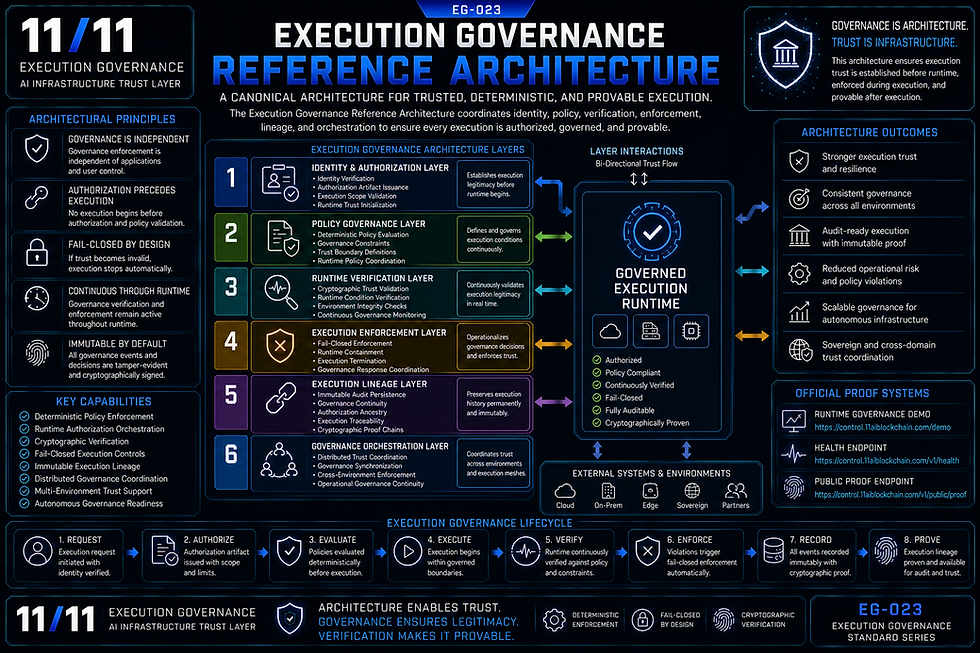
11/11 defines the Execution Governance Reference Architecture as the canonical operational model used to coordinate runtime authorization, deterministic governance enforcement, cryptographic verification, execution lineage, and fail-closed trust orchestration across autonomous execution environments.
Execution governance becomes architecture-native infrastructure.
Why Reference Architectures Matter
Without architectural standardization:
governance systems fragment
runtime trust becomes inconsistent
authorization continuity weakens
verification logic diverges
operational governance maturity slows
Execution governance requires:
canonical operational architecture.
Reference architectures establish the standardized trust coordination model for governed execution infrastructure.
Core Execution Governance Architecture Layers
1. Identity & Authorization Layer
Responsible for:
identity verification
authorization artifact issuance
execution scope validation
runtime trust initialization
This layer establishes execution legitimacy before runtime begins.
2. Policy Governance Layer
Responsible for:
deterministic policy evaluation
governance constraints
trust boundary definitions
runtime policy coordination
This layer governs execution conditions continuously.
3. Runtime Verification Layer
Responsible for:
cryptographic trust validation
runtime condition verification
environment integrity checks
continuous governance monitoring
This layer continuously validates execution legitimacy.
4. Execution Enforcement Layer
Responsible for:
fail-closed enforcement
runtime containment
execution termination
governance response coordination
This layer operationalizes governance decisions.
5. Execution Lineage Layer
Responsible for:
immutable audit persistence
governance continuity
authorization ancestry
execution traceability
cryptographic proof chains
This layer preserves execution history permanently.
6. Governance Orchestration Layer
Responsible for:
distributed trust coordination
governance synchronization
cross-environment enforcement
operational governance continuity
This layer coordinates trust across the execution mesh.
EG-023 Architectural Principles
1. Governance Must Remain Independent of Applications
Applications cannot self-govern execution legitimacy.
The governance architecture itself must independently enforce runtime trust.
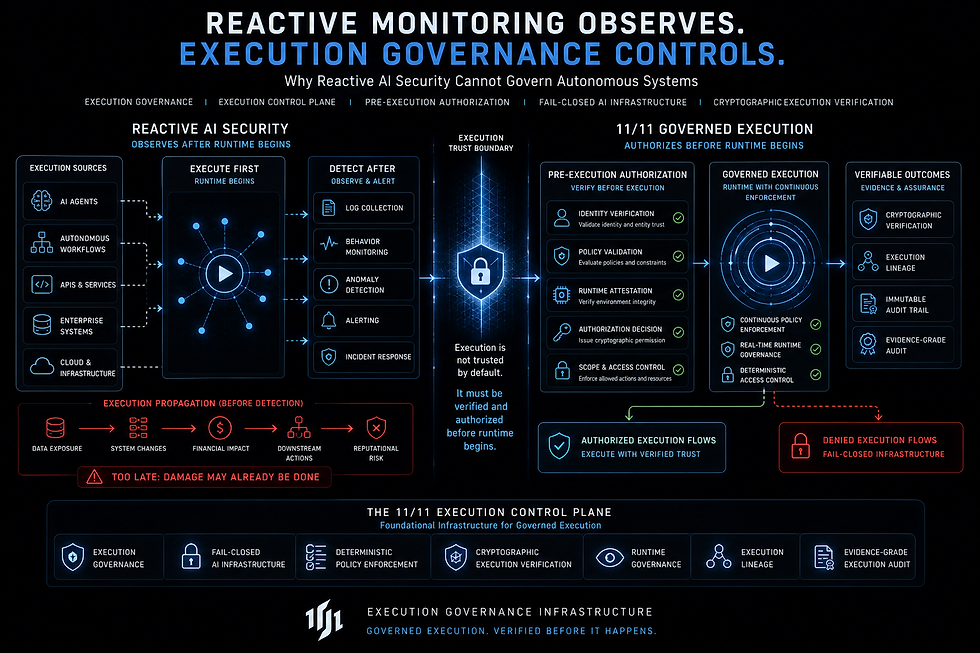
2. Authorization Must Precede Execution
Execution cannot begin before:
authorization validation
policy evaluation
trust verification
boundary establishment
Execution trust must be established first.
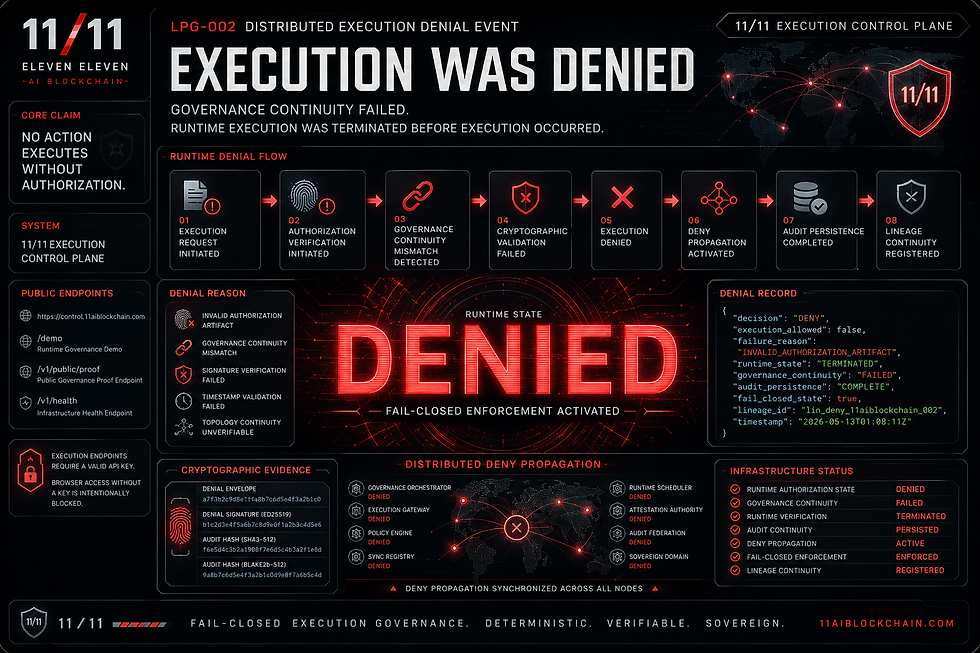
3. Governance Enforcement Must Fail Closed
If runtime trust becomes invalid:
execution must stop automatically.
No permissive execution continuation.
4. Governance Continuity Must Persist Throughout Runtime
Governance cannot stop after initialization.
Trust verification and policy enforcement must remain continuously operational.
5. Execution History Must Remain Immutable
Execution governance requires:
immutable lineage
cryptographic audit continuity
deterministic verification
persistent trust ancestry
Execution trust must remain historically provable.
Autonomous Infrastructure Requires Canonical Governance Models
Future enterprise and sovereign systems increasingly require:
standardized governance architectures
deterministic trust orchestration
fail-closed runtime enforcement
cryptographic execution verification
immutable execution lineage
distributed governance coordination
Execution governance becomes standardized operational infrastructure.
Reference Architectures Change Infrastructure Semantics
Historically:
reference architectures optimized:
scalability
redundancy
interoperability
operational efficiency
Execution governance introduces:
runtime trust orchestration.
Future infrastructure increasingly governs:
execution legitimacy
authorization continuity
runtime trust persistence
governance coordination
operational trust assurance
Execution governance itself becomes architectural infrastructure.
Governance Architecture Becomes Foundational
Autonomous systems increasingly coordinate across:
clouds
sovereign regions
edge systems
autonomous agents
enterprise orchestration systems
regulated runtime environments
This requires:
standardized governance coordination architecture.
Execution governance becomes foundational operational infrastructure.
11/11 Positioning
11/11 is positioned as the execution governance layer for AI infrastructure.
Its governance architecture establishes:
execution governance reference architectures
deterministic runtime enforcement
fail-closed governance controls
cryptographic execution verification
immutable execution lineage
operational trust continuity
before and during execution.
Execution itself becomes the trust boundary.
Official Proof Systems
Public Governance Console
Runtime Governance Demo
Public Governance Proof Viewer
Infrastructure Health Dashboard
Execution Lineage Explorer
Autonomous infrastructure cannot safely scale without standardized trust coordination.
Execution governance itself must become canonical infrastructure architecture.

Comments