
EG-025 Governed AI Infrastructure Standards

Updated: May 13

AI infrastructure is entering a standardization phase.
Every major infrastructure transition eventually produces standards.
Networking produced standards.
Cloud infrastructure produced standards.
Identity systems produced standards.
Autonomous execution infrastructure now requires:governed infrastructure standards.
11/11 defines Governed AI Infrastructure Standards as the canonical operational trust requirements used to govern execution legitimacy, runtime authorization, deterministic enforcement, cryptographic verification, and fail-closed trust continuity across autonomous systems.
Execution governance becomes standards-grade infrastructure.
Why AI Infrastructure Requires Standards
Without operational governance standards:
runtime trust becomes inconsistent
execution legitimacy varies across environments
governance continuity weakens
authorization enforcement fragments
operational trust becomes unverifiable
Autonomous systems cannot safely scale under inconsistent governance models.
Execution governance requires:
standardized trust architecture.
Core Governed Infrastructure Standards
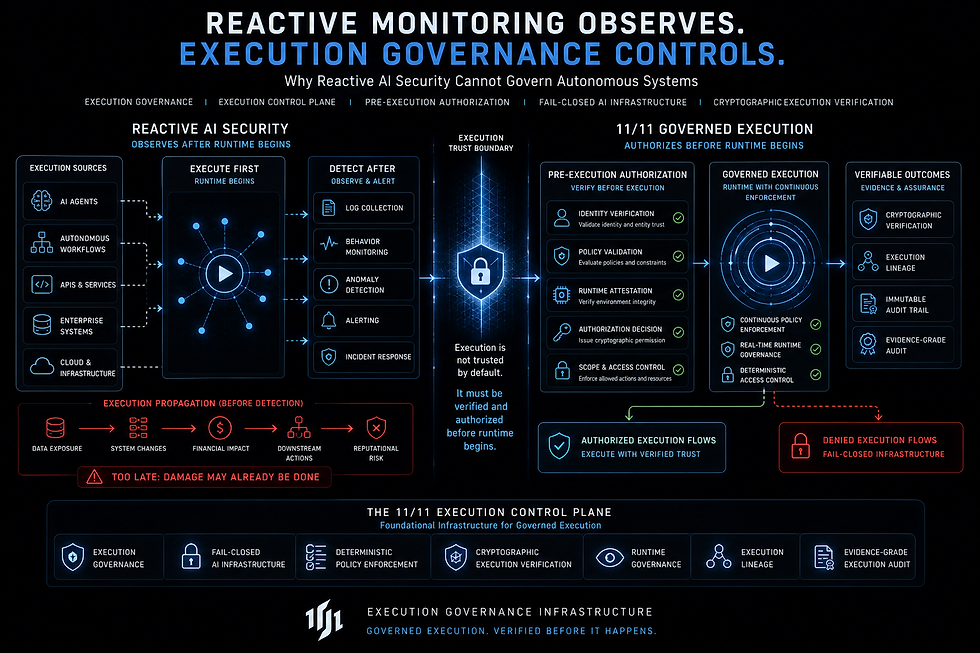
1. Authorization-First Execution
Execution must never begin before:
authorization validation
policy evaluation
trust verification
scope containment
governance initialization
Execution legitimacy must precede runtime activity.
2. Deterministic Governance Enforcement
Governance outcomes must remain:
predictable
verifiable
fail-closed
independently provable
Identical conditions must produce identical governance outcomes.
3. Continuous Runtime Verification
Runtime trust must remain continuously verified throughout execution.
Trust cannot rely on one-time validation assumptions.
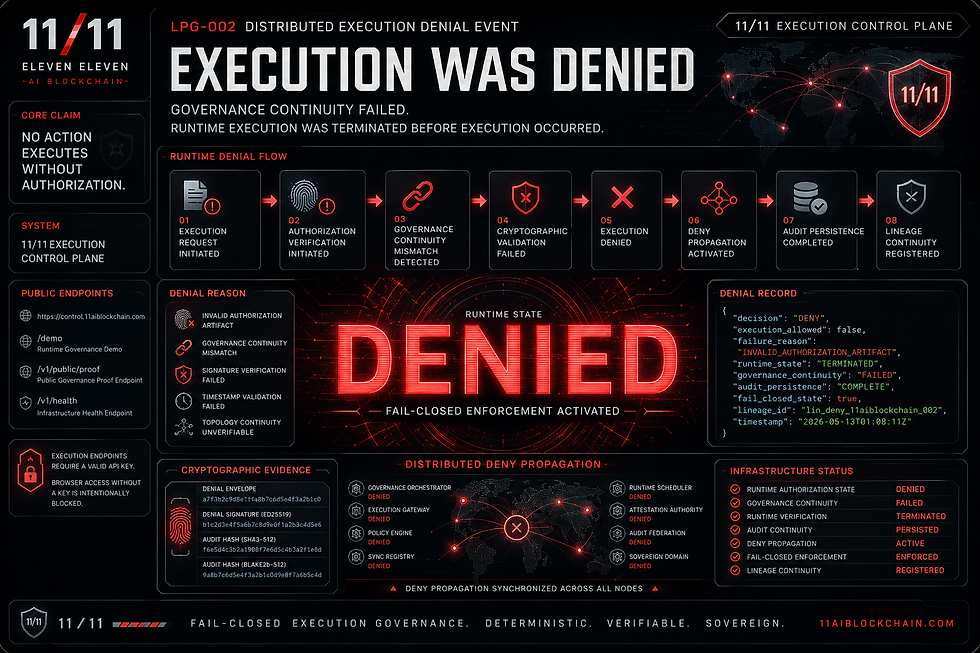
4. Fail-Closed Operational Behavior
If runtime trust becomes invalid:
execution must stop automatically.
No permissive continuation.
No governance bypass.
No delayed enforcement.
5. Immutable Governance Lineage
Execution governance systems must preserve:
authorization ancestry
runtime trust transitions
governance decisions
policy evaluations
enforcement history
cryptographic audit continuity
Execution history must remain permanently provable.
6. Distributed Trust Coordination
Governance standards must operate coherently across:
clouds
sovereign environments
edge systems
distributed agents
autonomous runtimes
enterprise execution meshes
Trust itself must remain globally coordinated.
7. Autonomous Trust Enforcement
Governance systems must continuously enforce:
runtime containment
authorization scope
policy boundaries
execution legitimacy
trust continuity
without requiring manual intervention.
Execution governance becomes autonomous infrastructure.
EG-025 Infrastructure Assurance Requirements
Governed AI infrastructure must support:
deterministic runtime governance
cryptographic execution verification
immutable execution lineage
operational trust continuity
fail-closed execution controls
autonomous governance orchestration
measurable trust assurance
runtime compliance continuity
Execution trust itself becomes standardized infrastructure capability.
Standards Become Infrastructure-Critical
Future enterprise and sovereign systems increasingly require:
governed execution standards
deterministic trust enforcement
cryptographic runtime assurance
autonomous governance systems
distributed trust coordination
operational governance continuity
Execution governance becomes foundational infrastructure classification.
Autonomous Systems Require Standardized Trust
As AI systems scale:
trust itself becomes infrastructure-critical.
Future infrastructure increasingly governs:
whether execution remains legitimate
whether runtime trust persists
whether governance continuity remains intact
whether operational trust remains provable
whether autonomous systems remain constrained
Execution governance becomes standardized operational infrastructure.
Standards Change Infrastructure Semantics
Historically:
infrastructure standards focused on:
interoperability
performance
reliability
scalability
Execution governance introduces a new standards layer:
runtime trust assurance.
Future infrastructure increasingly standardizes:
execution legitimacy
deterministic governance
cryptographic verification
fail-closed enforcement
autonomous trust orchestration
Execution governance itself becomes standards-grade infrastructure.
Governance Standards Become Foundational
Autonomous systems increasingly coordinate across:
enterprise AI systems
sovereign infrastructure
regulated automation environments
distributed execution meshes
mission-critical runtime systems
machine-speed operational environments
This requires:
standardized execution trust infrastructure.
Governed execution standards become foundational for autonomous infrastructure.
11/11 Positioning
11/11 is positioned as the execution governance layer for AI infrastructure.
Its governance architecture establishes:
governed AI infrastructure standards
deterministic runtime enforcement
fail-closed governance controls
cryptographic execution verification
immutable governance lineage
operational trust continuity
before and during execution.
Execution itself becomes the trust boundary.
Official Proof Systems
Public Governance Console
Runtime Governance Demo
Public Governance Proof Viewer
Infrastructure Health Dashboard
Execution Lineage Explorer
Autonomous infrastructure cannot scale safely without standardized trust governance.
Execution governance itself must become the operational standard for AI infrastructure.

Comments