
EGS-003 Runtime Trust Verification Standard for Governed Execution Infrastructure
- 11/11 AI

- May 10
- 4 min read
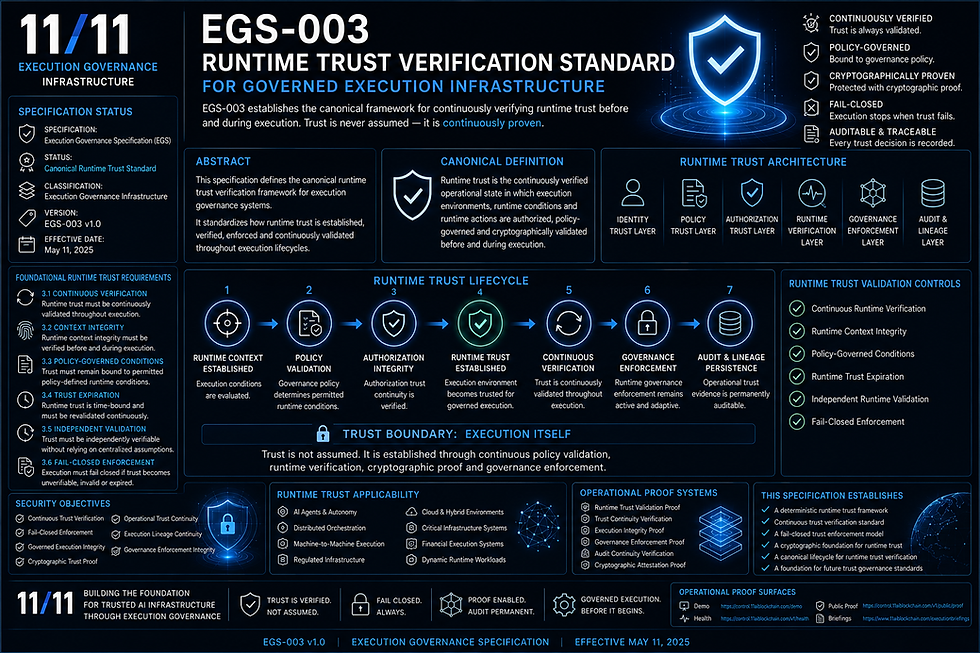
Specification Status
Execution Governance Specification (EGS)
Status:Canonical Runtime Trust Standard
Classification:Execution Governance Infrastructure
Version:EGS-003 v1.0
Abstract
This specification defines the canonical runtime trust verification framework for execution governance systems.
EGS-003 establishes foundational requirements for:
runtime trust validation
continuous runtime verification
governed execution integrity
fail-closed trust enforcement
runtime governance continuity
operational trust boundaries
cryptographic runtime validation
execution trust persistence
The objective of EGS-003 is to standardize how runtime trust is established, verified and continuously enforced before and during execution.
Trust becomes continuously governed infrastructure.
1. Purpose
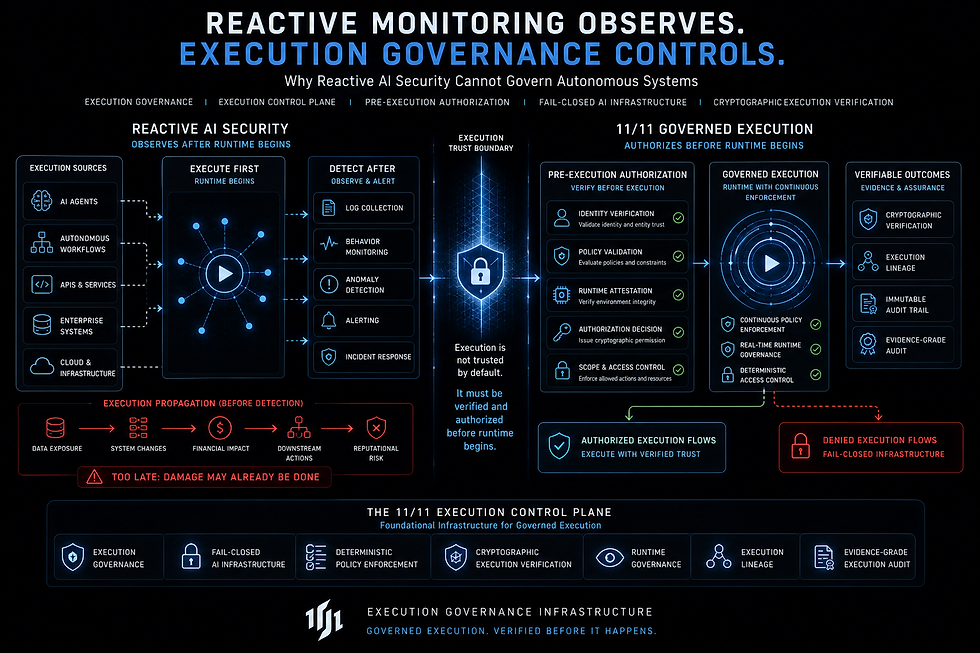
Traditional infrastructure models establish trust primarily through:
authentication
credentials
network boundaries
static authorization
infrastructure ownership
These models assume execution environments remain trustworthy after initial validation.
Modern runtime systems invalidate this assumption.
AI infrastructure increasingly depends on:
autonomous execution
dynamic orchestration
machine-generated runtime actions
distributed execution chains
continuously changing execution environments
EGS-003 introduces a deterministic runtime trust verification framework for governed execution systems.
Runtime trust becomes continuously verifiable.
2. Canonical Definition
Runtime trust is defined as:
the continuously verified operational state in which execution environments, runtime conditions and runtime actions are authorized, policy-governed and cryptographically validated before and during execution.
Runtime trust establishes:
governed execution integrity
continuous operational verification
execution trust continuity
runtime governance enforcement
cryptographic trust validation
Trust becomes operational infrastructure.
3. Foundational Runtime Trust Requirements
Execution governance systems compliant with EGS-003 MUST implement the following runtime trust controls.
3.1 Continuous Runtime Verification
Runtime trust MUST be continuously verified.
Trust MUST NOT rely solely on:
initial authentication
static credentials
one-time authorization
perimeter trust assumptions
Runtime verification SHOULD continuously evaluate:
execution integrity
policy compliance
authorization validity
environment state
runtime conditions
governance continuity
Trust becomes continuously enforced.
3.2 Runtime Context Integrity
Execution governance systems MUST validate runtime context integrity.
Runtime context MAY include:
infrastructure state
execution environment
workload conditions
runtime identity
operational policy state
execution lineage continuity
authorization context
environment integrity
Execution MUST fail closed if runtime integrity cannot be verified.
3.3 Policy-Governed Runtime Conditions
Runtime trust MUST remain policy-bound.
Governance policy MAY define:
permitted runtime states
workload boundaries
environment restrictions
execution constraints
infrastructure classifications
operational risk controls
trust continuity thresholds
Execution outside permitted trust conditions MUST fail closed.
3.4 Runtime Trust Expiration
Runtime trust MUST remain time-bound.
Execution governance systems SHOULD support:
trust expiration windows
continuous revalidation
runtime trust rotation
governance continuity enforcement
execution re-attestation
Trust MUST NOT persist indefinitely without verification.
3.5 Independent Runtime Validation
Runtime trust MUST support independent verification.
Verification SHOULD validate:
runtime integrity
authorization continuity
policy consistency
trust state validity
execution environment integrity
cryptographic trust proof
Trust MUST NOT rely solely on centralized assumptions.
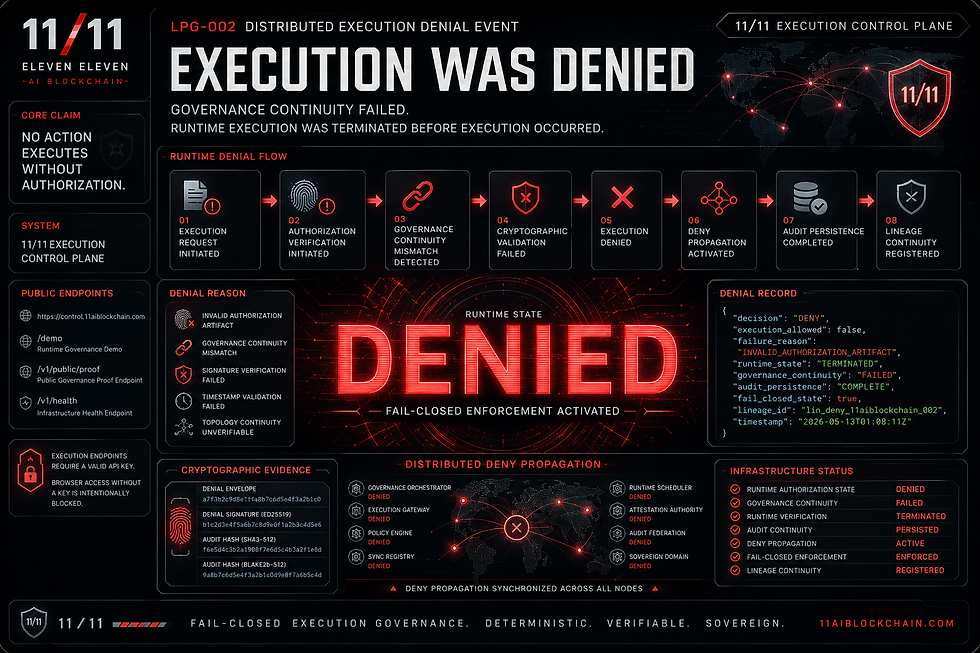
3.6 Fail-Closed Runtime Enforcement
Execution governance systems MUST fail closed if runtime trust becomes:
unverifiable
invalid
expired
policy-inconsistent
cryptographically compromised
operationally degraded
Execution MUST be denied or halted before untrusted execution proceeds.
4. Runtime Trust Architecture
EGS-003 defines the canonical runtime trust architecture.
Runtime trust systems SHOULD include:
identity trust layers
policy trust layers
authorization trust systems
runtime verification systems
governance enforcement layers
cryptographic integrity systems
audit continuity systems
execution lineage systems
Together, these systems establish governed runtime trust.
5. Runtime Trust Lifecycle
EGS-003 defines the canonical runtime trust lifecycle.
Phase 1 — Runtime Context Established
Execution conditions are evaluated.
Phase 2 — Governance Policy Validation
Governance policy determines permitted runtime conditions.
Phase 3 — Authorization Integrity Validation
Authorization trust continuity is verified.
Phase 4 — Runtime Trust Established
Execution environment becomes trusted for governed execution.
Phase 5 — Continuous Runtime Verification
Trust remains continuously validated throughout execution.
Phase 6 — Runtime Governance Enforcement
Execution governance systems enforce trust continuity.
Phase 7 — Audit and Lineage Persistence
Operational trust evidence becomes permanently auditable.
6. Runtime Trust Boundaries
EGS-003 defines execution itself as the operational trust boundary.
Trust MUST NOT exist solely because:
a user authenticated
infrastructure ownership exists
credentials were presented
runtime activity was requested
Trust MUST depend on continuously verifiable runtime integrity.
Execution becomes conditionally trusted infrastructure.
7. Runtime Trust and AI Infrastructure
AI systems increasingly generate autonomous runtime behavior.
AI agents may:
orchestrate infrastructure
invoke distributed systems
generate execution chains
trigger external actions
modify runtime environments
coordinate machine-to-machine execution
Without runtime trust verification:
AI infrastructure becomes operationally unverifiable.
EGS-003 introduces governed runtime trust into AI infrastructure.
This allows runtime systems to become:
governable
enforceable
continuously verifiable
cryptographically auditable
operationally trustworthy
before and during execution.
8. Security Objectives
EGS-003 establishes several foundational security objectives.
Runtime trust systems SHOULD provide:
continuous runtime verification
fail-closed trust enforcement
governed execution integrity
cryptographic runtime trust proof
operational trust continuity
execution lineage continuity
governance enforcement integrity
Trust becomes continuously governable infrastructure.
9. Operational Proof Systems
Runtime trust systems SHOULD support operational proof continuity.
Operational proof MAY include:
runtime trust validation proof
trust continuity verification
execution integrity proof
governance enforcement proof
cryptographic runtime attestations
audit continuity verification
execution lineage trust proof
Operational proof increases runtime governance transparency.
10. Future Specification Extensions
Future EGS specifications MAY define:
federated runtime trust systems
execution trust interoperability
distributed governance mesh trust
quantum-resistant runtime trust validation
runtime trust scoring systems
autonomous governance trust frameworks
multi-cloud runtime governance standards
EGS-003 establishes the foundational runtime trust verification standard.
11. Conclusion
Runtime trust can no longer rely on static infrastructure assumptions.
Governed execution requires:
continuous runtime verification
policy-governed trust enforcement
fail-closed runtime integrity
cryptographic trust validation
operational governance continuity
execution lineage continuity
EGS-003 defines the canonical runtime trust verification framework for governed execution infrastructure.
Trust becomes continuously governed infrastructure.
11/11 Runtime Trust Infrastructure
11/11 is developing runtime trust infrastructure designed to continuously verify whether execution environments remain trusted before and during runtime execution.
The architecture focuses on:
governed execution
continuous runtime verification
fail-closed trust enforcement
execution lineage
runtime governance continuity
cryptographic trust validation
operational proof systems
Runtime trust becomes continuously verifiable infrastructure.
Operational Proof Surfaces
Primary Proof Environment:
Runtime Health:
Public Verification Proof:
Execution Governance Briefings:

Comments