
Ensuring AI Accountability: Transforming Autonomous Execution for Safer Systems

Artificial intelligence is often seen as a powerful force reshaping our world. Yet, the real challenge is not AI’s power but how it is managed. Many AI failures stem from a lack of governance rather than from the technology itself. Today’s AI systems rely on outdated trust models designed for simpler software, not for autonomous systems making decisions at machine speed. This gap creates risks that grow as AI becomes more capable and widespread.
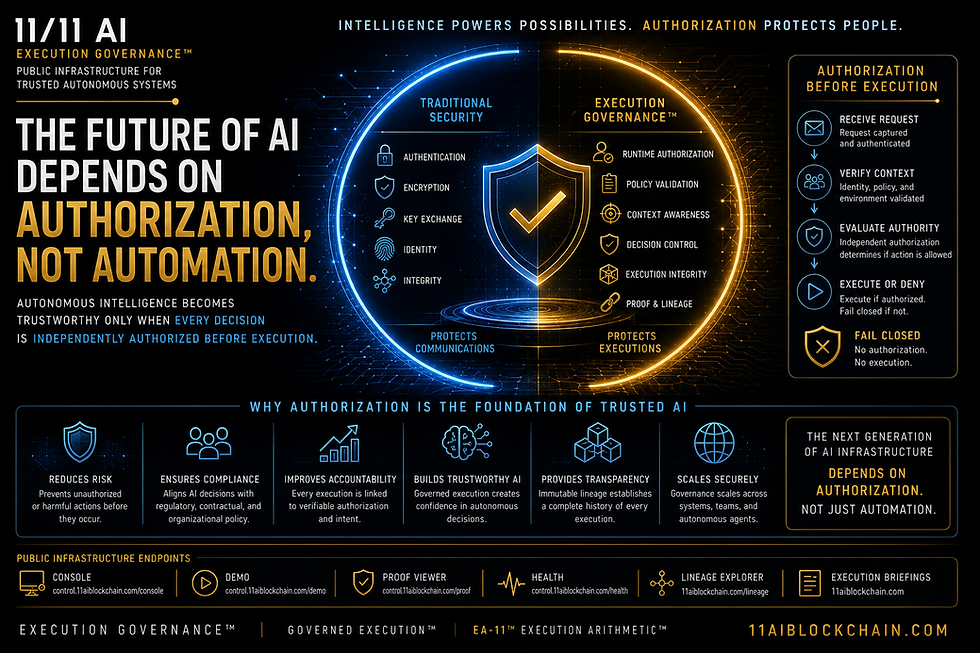
At 11/AI, researchers approach AI as an execution environment that requires strict constraints, verification and accountability built into its design. The future of AI safety depends on systems that can prove their actions are legitimate, keep their behavior within bounds and allow thorough audits of their outputs. This approach does not slow innovation but ensures AI can be safely deployed at scale.
Why AI Governance Matters More Than AI Power
AI systems today often operate under trust assumptions inherited from earlier software eras. These assumptions include:
Static permissions that do not adapt to changing contexts
Implicit authority granted without continuous verification
Post-hoc audits that occur after decisions have been made
These models worked when software was simpler and human oversight was constant. However, autonomous AI systems make decisions rapidly and independently, which demands new governance frameworks. Without these, AI can act unpredictably or cause harm before anyone notices.
For example, consider an autonomous financial trading system. If it operates without real-time constraints or verifiable decision paths, it might trigger market crashes or unfair trades. Traditional audits after the fact cannot prevent damage already done.
Treating AI as an Execution Environment
The key insight from 11/AI’s research is to view AI not just as a tool but as an environment where code executes autonomously. This environment must be designed with safety and accountability in mind. That means:
Constraining AI actions so they cannot exceed defined limits
Verifying decisions before or as they happen to ensure legitimacy
Auditing outputs to trace back how and why decisions were made
This approach shifts the focus from how smart AI appears to how safe and accountable it is. It requires new technical methods such as formal verification, runtime monitoring and transparent logging.

AI execution environments require hardware and software designed for real-time monitoring and control.
Proving Legitimacy of AI Actions
One of the biggest challenges in AI safety is proving that an AI system’s actions are legitimate. Legitimacy means the AI acts within its intended purpose and follows ethical and legal guidelines. To achieve this, systems must:
Define clear rules and boundaries for AI behavior
Use formal methods to verify compliance with these rules
Implement real-time checks to prevent unauthorized actions
For instance, an AI used in healthcare must only recommend treatments approved by medical standards. If it suggests unapproved procedures, the system should flag or block the action immediately.
Bounding AI Behavior
Bounding behavior means limiting what an AI system can do, preventing it from taking unexpected or harmful actions. This involves:
Setting operational limits on AI capabilities
Monitoring AI decisions continuously
Designing fallback mechanisms to intervene when limits are breached
Consider autonomous vehicles. Bounding their behavior includes speed limits, safe distance maintenance and emergency stop capabilities. These constraints reduce risks even if the AI encounters unusual situations.
Auditing AI Outputs
Auditing is essential for transparency and accountability. It allows humans to understand AI decisions and detect errors or biases. Effective auditing requires:
Detailed logging of AI inputs, processes, and outputs
Tools to analyze logs and reconstruct decision paths
Regular reviews by independent auditors or regulators
For example, in criminal justice, AI tools used for risk assessment must provide clear explanations for their recommendations. Audits help ensure these tools do not perpetuate bias or unfair treatment.
Balancing Innovation and Safety
Some fear that adding constraints and audits will slow AI progress. In reality, these measures enable sustainable innovation by building trust and preventing costly failures. Safe AI systems attract more users and regulators’ approval, opening wider markets.
By focusing on accountability, developers can create AI that is not only powerful but also reliable and ethical. This balance is crucial as AI integrates deeper into critical areas like finance, healthcare, and infrastructure.
Practical Steps for Building Accountable AI Systems
Organizations can start improving AI governance by:
Adopting execution environment models that treat AI as autonomous code needing constraints
Implementing formal verification tools to check AI decisions against rules
Developing real-time monitoring systems to detect and stop unsafe actions
Creating transparent logging mechanisms for auditing and accountability
Engaging multidisciplinary teams including ethicists, engineers, and legal experts
These steps help build AI systems that can explain why something happened, not just what happened.


Comments