
EG-ENTERPRISE-001 Enterprise Runtime Governance Adoption Framework

11/11 Enterprise Governance Initiative
Version: Draft v0.1
Classification: Enterprise Governance Framework
Specification Family: Execution Governance Infrastructure

Executive Overview
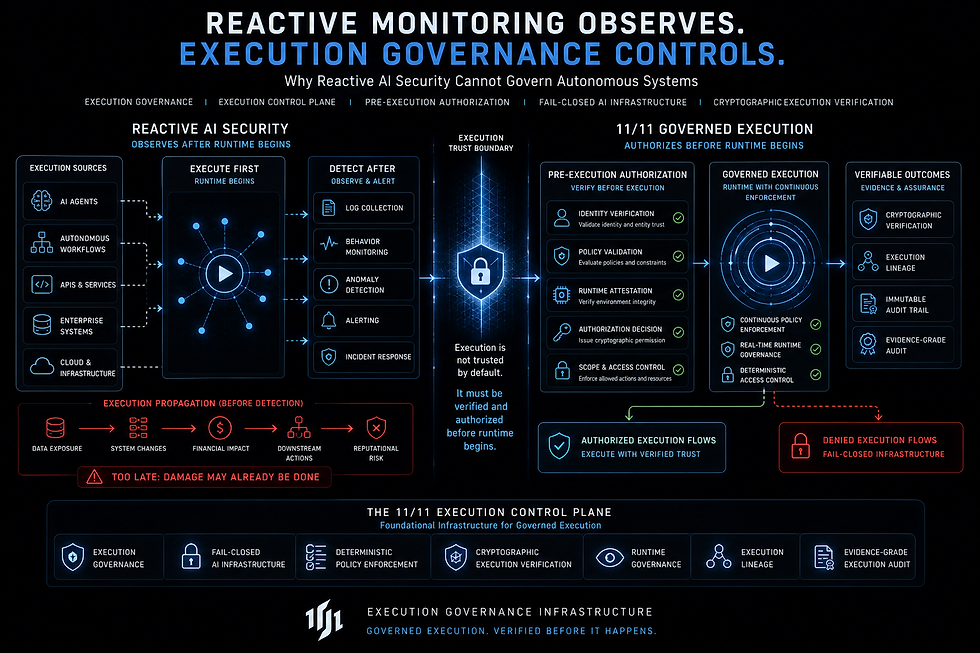
Modern enterprise infrastructure increasingly depends on distributed runtime coordination, artificial intelligence systems, sovereign operational continuity, and autonomous orchestration frameworks.
Traditional enterprise runtime systems remain:
• reactive after execution• permissive by default• weakly synchronized• inconsistently verifiable• operationally fragmented• vulnerable during runtime uncertainty
Execution governance introduces deterministic operational governance continuity across enterprise runtime systems.
1. Enterprise Governance Principle
Governed enterprise systems MUST maintain deterministic operational continuity across all runtime environments.
Governed runtime infrastructure SHALL enforce:
• deterministic runtime authorization• fail-closed operational enforcement• cryptographic operational verification• immutable synchronization continuity• distributed runtime coordination• execution lineage traceability
Any unverifiable operational condition SHALL trigger deterministic containment protections.
2. Enterprise Runtime Modernization
Execution governance introduces:
Runtime Authorization Before Execution
Cryptographic Runtime Verification
Immutable Operational Synchronization
Distributed Runtime Coordination
Sovereign Operational Governance
Execution Lineage Traceability
Runtime Federation Continuity
Cross-Domain Operational Synchronization
Execution governance transforms enterprise runtime infrastructure into governed operational systems.
3. Enterprise Governance Lifecycle
Execution governance systems SHALL validate:
Runtime Initialization
Governance Authorization
Runtime Integrity Verification
Cryptographic Validation
Telemetry Synchronization
Runtime Coordination Inspection
Fail-Closed Enforcement Evaluation
Runtime Approval
Immutable Synchronization Persistence
Audit Continuity Verification
Validation failures SHALL trigger deterministic containment protections.
4. Enterprise Runtime Governance Domains
Execution governance applies across:
AI Infrastructure
Financial Systems
Operational Infrastructure
Telecommunications Infrastructure
Distributed Runtime Systems
Federated Enterprise Coordination
Cross-Domain Operational Governance
Sovereign Operational Infrastructure
All enterprise infrastructure domains require deterministic runtime governance continuity.
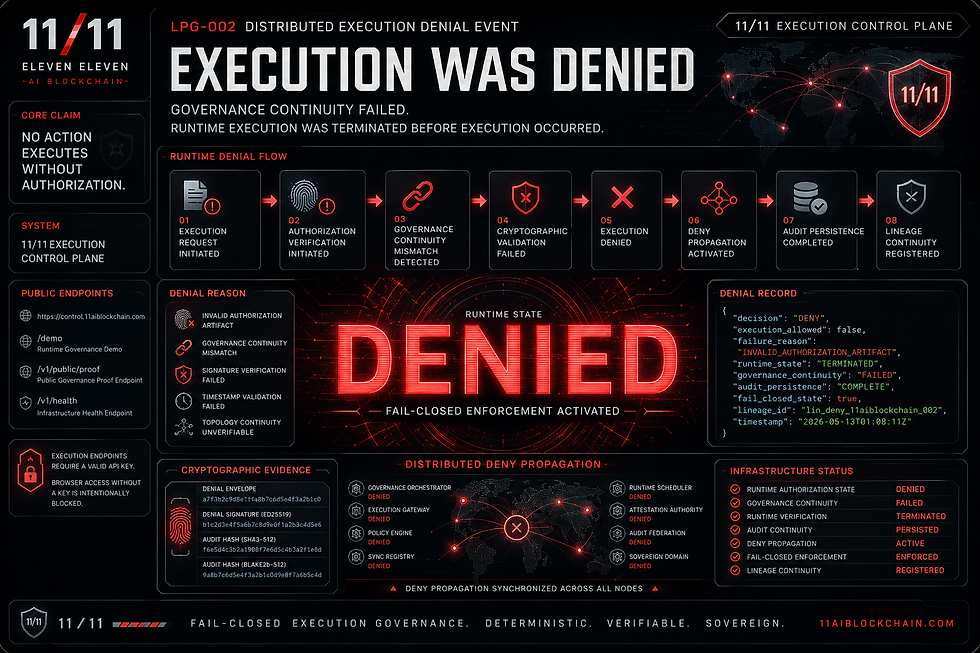
5. Fail-Closed Enterprise Runtime Protection
Execution governance infrastructure MUST default to deterministic containment during operational uncertainty.
Failure conditions SHALL trigger containment including:
• runtime synchronization interruption• cryptographic verification failure• distributed coordination inconsistency• unauthorized operational modification• runtime governance mismatch• immutable audit discontinuity• unverifiable runtime transitions• runtime state divergence
Operational infrastructure MUST default to containment during uncertainty.
6. Enterprise Governance Outcomes
Execution governance infrastructure enables:
Deterministic Operational Enforcement
Enterprise Runtime Coordination
Immutable Operational Continuity
Distributed Runtime Synchronization
Cryptographic Operational Verification
Fail-Closed Runtime Protection
Cross-Domain Runtime Federation
Execution Governance Assurance
The result is governed enterprise infrastructure where runtime execution remains continuously authorized, synchronized, and verifiable.
7. Strategic Enterprise Positioning
Execution governance infrastructure represents:
• deterministic runtime orchestration• sovereign operational governance• fail-closed runtime continuity• cryptographic operational verification• immutable operational traceability• distributed runtime synchronization
Execution governance establishes the operational architecture required for enterprise runtime systems.
8. Enterprise Adoption Framework
Enterprise modernization SHALL introduce:
Governance Control Planes
Runtime Verification Infrastructure
Immutable Audit Systems
Runtime Synchronization Frameworks
Trust Domain Coordination
Federation Governance Systems
Runtime Governance Certification
Governance Conformance Validation
The framework establishes measurable operational governance continuity.
9. Enterprise Operational Outcomes
Execution governance modernization enables:
• deterministic operational coordination• sovereign enterprise governance• immutable operational continuity• distributed synchronization continuity• runtime governance assurance• execution lineage traceability
Enterprise runtime systems become governed sovereign operational infrastructure.
10. Enterprise Framework Conclusion
Execution governance establishes:
the operational governance architecture for enterprise runtime systems.
The future of enterprise infrastructure will require:
• deterministic runtime authorization• cryptographic operational trust• immutable synchronization continuity• fail-closed runtime protections• distributed runtime coordination• sovereign operational governance
Execution governance establishes the modernization framework required for governed enterprise runtime infrastructure systems.
Public Governance Infrastructure
Public Governance Console
Runtime Governance Demo
Public Governance Proof Viewer
Infrastructure Health Dashboard
Execution Lineage Explorer
Enterprise Positioning
EG-ENTERPRISE-001 establishes the enterprise runtime governance adoption framework for deterministic runtime infrastructure systems requiring fail-closed operational protections, cryptographic verification continuity, immutable synchronization persistence, and distributed governance coordination.
Part of the 11/11 Enterprise Governance Initiative.Establishing deterministic governance modernization standards for enterprise runtime infrastructure systems.

Comments