
Enterprise Execution Governance Reference Architecture

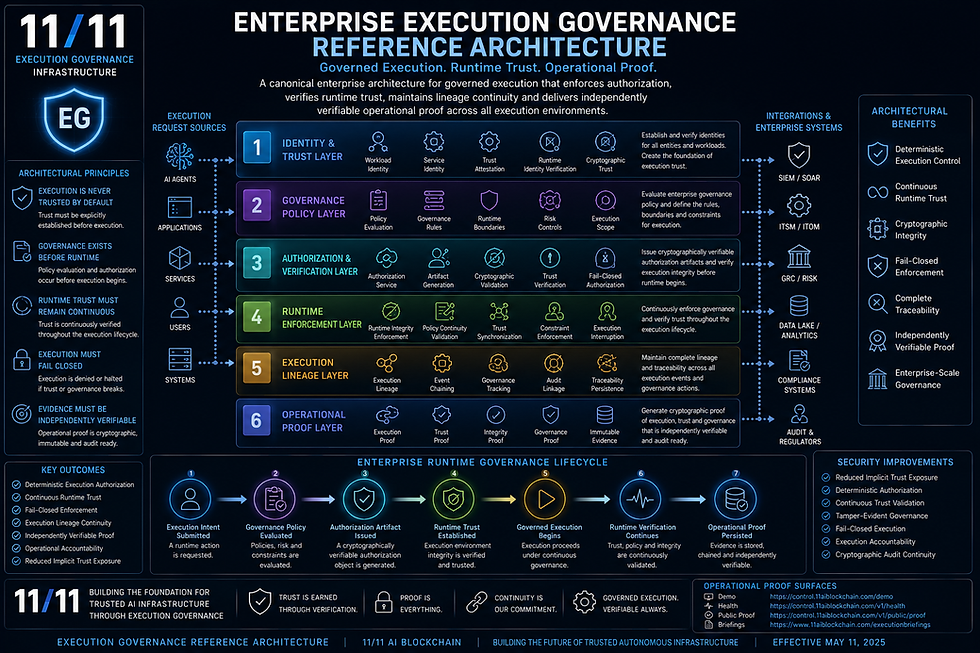
Enterprise infrastructure is entering a fundamental architectural transition.
Historically, enterprise systems were designed around:
identity trust
perimeter enforcement
reactive monitoring
static authorization
post-execution audit
This model increasingly fails in autonomous runtime environments.
Modern enterprise infrastructure now includes:
AI agents
autonomous orchestration systems
machine-to-machine execution
distributed cloud runtimes
dynamic execution chains
continuously evolving runtime systems
Execution itself becomes the operational trust boundary.
The Enterprise Execution Governance Reference Architecture defines the canonical infrastructure model for governed execution systems operating at enterprise scale.
Purpose of the Architecture
The Enterprise Execution Governance Reference Architecture establishes a canonical infrastructure topology for:
governed execution
runtime trust enforcement
authorization continuity
execution lineage persistence
cryptographic operational proof
fail-closed runtime enforcement
enterprise governance continuity
The architecture defines how enterprise infrastructure transitions from:
reactive runtime security
to:
deterministic governed execution systems
Execution governance becomes enterprise operational infrastructure.
Canonical Definition
Enterprise Execution Governance Architecture is defined as:
an infrastructure governance framework in which enterprise runtime execution is authorized, policy-governed, cryptographically verified and continuously enforced before and during execution.
The architecture establishes:
deterministic runtime authorization
governed execution continuity
runtime trust verification
authorization artifact validation
cryptographic operational proof
enterprise execution accountability
Execution becomes governed enterprise infrastructure.
Foundational Architectural Principles
The reference architecture is built around several foundational governance principles.
1. Execution Is Never Trusted By Default
Execution authorization must occur before runtime activity begins.
Enterprise systems MUST NOT assume execution trust solely because:
identity authentication succeeded
infrastructure ownership exists
a request originated internally
an AI generated execution intent
Execution trust must be explicitly established.
2. Governance Exists Before Runtime
Execution governance must occur before execution begins.
Governance includes:
policy validation
authorization evaluation
runtime trust verification
execution integrity validation
governance continuity enforcement
Governance becomes operational infrastructure.
3. Runtime Trust Must Remain Continuous
Execution trust cannot remain static.
Runtime trust must remain continuously verified throughout execution lifecycles.
This includes:
runtime integrity validation
authorization continuity
policy consistency enforcement
governance synchronization
operational trust continuity
Trust becomes continuously governed.
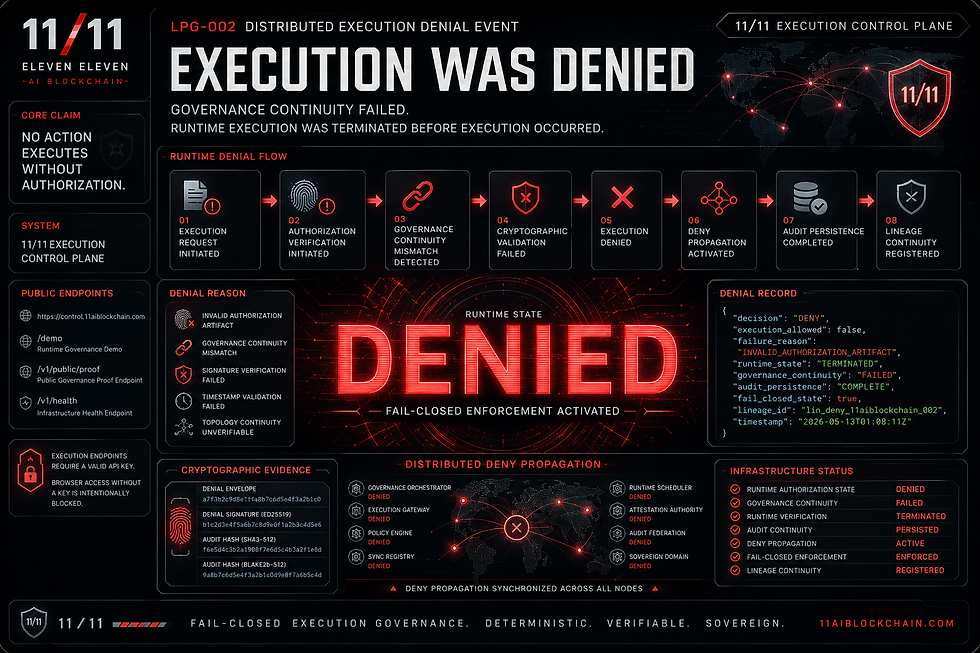
4. Execution Must Fail Closed
Enterprise execution governance systems must fail closed.
Execution must be denied or halted if:
authorization becomes invalid
runtime trust degrades
governance continuity breaks
lineage integrity fails
verification becomes impossible
Execution trust becomes enforceable infrastructure behavior.
Canonical Architecture Layers
The Enterprise Execution Governance Reference Architecture defines several foundational infrastructure layers.
Layer 1 — Identity and Trust Layer
This layer establishes foundational execution identity.
Capabilities may include:
workload identity
service identity
machine identity
trust attestation
runtime identity verification
cryptographic trust establishment
Identity becomes execution-aware.
Layer 2 — Governance Policy Layer
This layer defines enterprise governance policy.
Capabilities may include:
execution policy evaluation
governance rule enforcement
runtime boundary definitions
operational trust constraints
infrastructure risk governance
execution scope management
Governance becomes deterministic infrastructure logic.
Layer 3 — Authorization and Verification Layer
This layer establishes deterministic runtime authorization.
Capabilities may include:
authorization artifact generation
cryptographic authorization validation
runtime trust verification
execution authorization continuity
fail-closed authorization enforcement
Execution becomes independently verifiable.
Layer 4 — Runtime Enforcement Layer
This layer governs execution during runtime activity.
Capabilities may include:
runtime integrity enforcement
policy continuity validation
execution trust synchronization
runtime constraint enforcement
execution interruption controls
fail-closed governance continuity
Runtime execution becomes continuously governed.
Layer 5 — Execution Lineage Layer
This layer establishes execution continuity and traceability.
Capabilities may include:
execution lineage persistence
authorization continuity
runtime event chaining
governance continuity tracking
cryptographic audit linkage
operational traceability
Execution continuity becomes verifiable infrastructure.
Layer 6 — Operational Proof Layer
This layer establishes independently verifiable operational proof systems.
Capabilities may include:
execution verification proof
authorization validation proof
runtime trust proof
cryptographic audit continuity
governance continuity proof
independently verifiable evidence systems
Operational trust becomes measurable.
Enterprise Runtime Governance Lifecycle
The reference architecture commonly follows a deterministic runtime governance lifecycle.
Phase 1 — Execution Intent Submitted
A runtime action is requested.
Phase 2 — Governance Policy Evaluated
Enterprise governance systems determine whether execution is permitted.
Phase 3 — Authorization Artifact Issued
A cryptographically verifiable authorization object is generated.
Phase 4 — Runtime Trust Established
Execution environment integrity becomes trusted.
Phase 5 — Governed Execution Begins
Execution proceeds under continuous governance enforcement.
Phase 6 — Runtime Verification Continues
Trust continuity remains continuously validated.
Phase 7 — Operational Proof Persisted
Execution evidence becomes permanently auditable and independently verifiable.
Enterprise Deployment Characteristics
Enterprise execution governance environments commonly require:
distributed runtime orchestration
hybrid cloud governance
multi-environment trust continuity
federated execution enforcement
cross-domain authorization continuity
enterprise audit persistence
governance interoperability
Execution governance becomes infrastructure-scale.
Enterprise Security Improvements
The architecture significantly improves enterprise runtime governance posture.
Enterprise environments establish:
deterministic execution authorization
reduced implicit runtime trust exposure
cryptographic operational accountability
fail-closed execution enforcement
runtime trust continuity
execution lineage traceability
independently verifiable operational proof
Execution becomes governed enterprise infrastructure.
AI Infrastructure Applicability
AI systems dramatically increase enterprise runtime governance complexity.
Enterprise AI infrastructure increasingly includes:
autonomous agents
machine-generated execution chains
distributed orchestration systems
dynamic runtime decision systems
continuously adaptive workloads
Without execution governance:
AI systems inherit implicit runtime trust assumptions.
The reference architecture introduces deterministic governance into enterprise AI infrastructure.
This allows enterprise AI systems to become:
governable
enforceable
cryptographically verifiable
operationally auditable
continuously trustworthy
before and during execution.
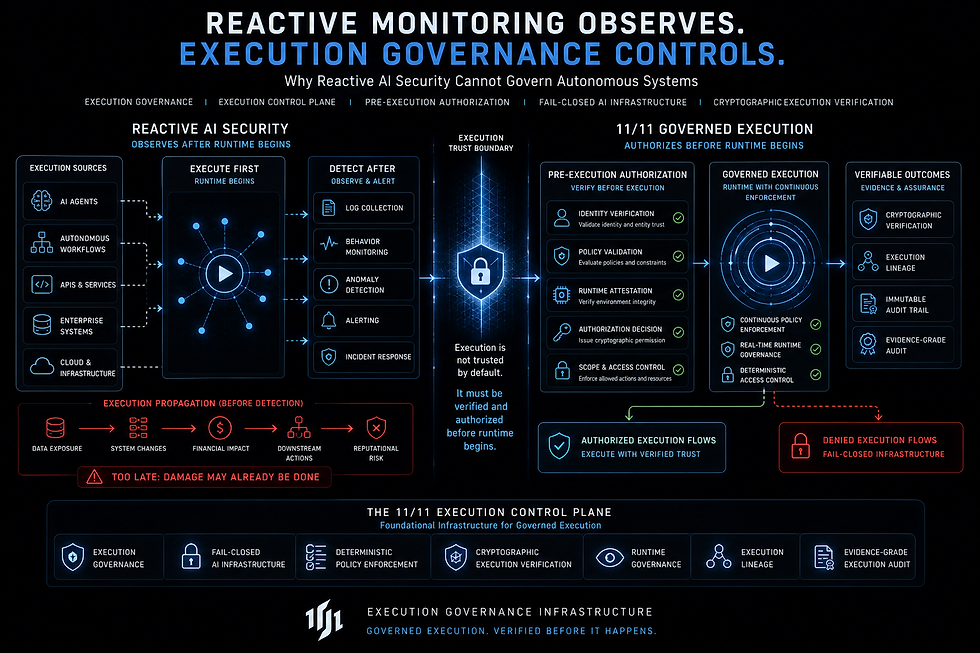
The Strategic Shift
The Enterprise Execution Governance Reference Architecture represents a broader infrastructure transition.
Historically:
enterprise infrastructure trusted execution first.
Modern infrastructure increasingly requires:
execution authorization before runtime begins.
This changes enterprise systems from:
reactive runtime monitoring
to:
deterministic execution governance
from:
operational trust assumptions
to:
continuously governed runtime trust
from:
fragmented runtime visibility
to:
infrastructure-grade execution governance
Execution itself becomes the enterprise trust boundary.
The Future of Enterprise Infrastructure
Enterprise infrastructure increasingly requires:
governed execution
continuous runtime trust validation
authorization continuity
fail-closed governance enforcement
cryptographic operational proof
deterministic execution accountability
Execution governance becomes foundational enterprise infrastructure.
11/11 Enterprise Execution Governance Infrastructure
11/11 is developing enterprise execution governance infrastructure focused on:
governed execution
runtime trust continuity
authorization artifact validation
cryptographic operational proof
execution lineage continuity
fail-closed governance enforcement
independently verifiable runtime trust
Execution governance becomes enterprise operational infrastructure.
Operational Proof Surfaces
Primary Proof Environment:
Runtime Health:
Public Verification Proof:
Execution Governance Briefings:

Comments