
Why Autonomous AI Systems Require Evidence-Grade Execution Audit

Most enterprise audit systems were designed for retrospective analysis.

Systems generated logs.
Security teams reviewed events afterward.
Investigations reconstructed operational history after incidents occurred.
This model functioned reasonably well for traditional enterprise environments where systems operated predictably and human activity remained central to execution.
Autonomous AI systems fundamentally change those assumptions.
Execution now propagates dynamically across:
autonomous workflows
distributed runtime environments
machine-generated orchestration chains
external APIs
continuously evolving infrastructure conditions
downstream execution dependencies
real-time operational systems
Under these conditions, traditional audit systems become increasingly insufficient.
Because retrospective logging alone cannot reliably establish runtime trust integrity.
Autonomous systems increasingly require evidence-grade execution audit.
The Structural Weakness of Traditional Logging
Traditional audit systems primarily focus on event recording.
They collect telemetry.
Store logs.
Aggregate operational activity.
Generate reporting visibility.
But logging alone does not guarantee runtime integrity.
Logs may be incomplete.
Events may lose execution context.
Runtime propagation may occur faster than operational analysis.
Dependencies may change during execution.
Downstream execution paths may become difficult to reconstruct deterministically.
Most importantly, traditional logging systems rarely prove:
why execution was authorized
whether runtime conditions remained trusted
whether policy enforcement remained intact
whether downstream propagation remained governed
whether execution lineage remained complete
whether runtime integrity degraded during execution
This creates a major infrastructure trust gap.
Organizations may observe execution outcomes without being able to prove execution integrity comprehensively.
As autonomous systems gain operational authority, that limitation becomes increasingly unacceptable.
Why Autonomous Systems Require Stronger Audit Guarantees
Autonomous systems increasingly execute without direct human intervention.
Execution chains may evolve dynamically during runtime activity itself.
Machine-generated workflows may propagate continuously across infrastructure layers.
This creates a new operational requirement.
Organizations increasingly need infrastructure capable of proving:
execution authorization integrity
runtime governance continuity
policy enforcement consistency
execution lineage preservation
cryptographic runtime verification
fail-closed enforcement integrity
downstream execution accountability
This requires more than logging.
It requires evidence-grade execution audit.
What Evidence-Grade Execution Audit Actually Means
Evidence-grade execution audit transforms audit infrastructure from observational reporting into independently verifiable runtime assurance.
Under governed execution architectures:
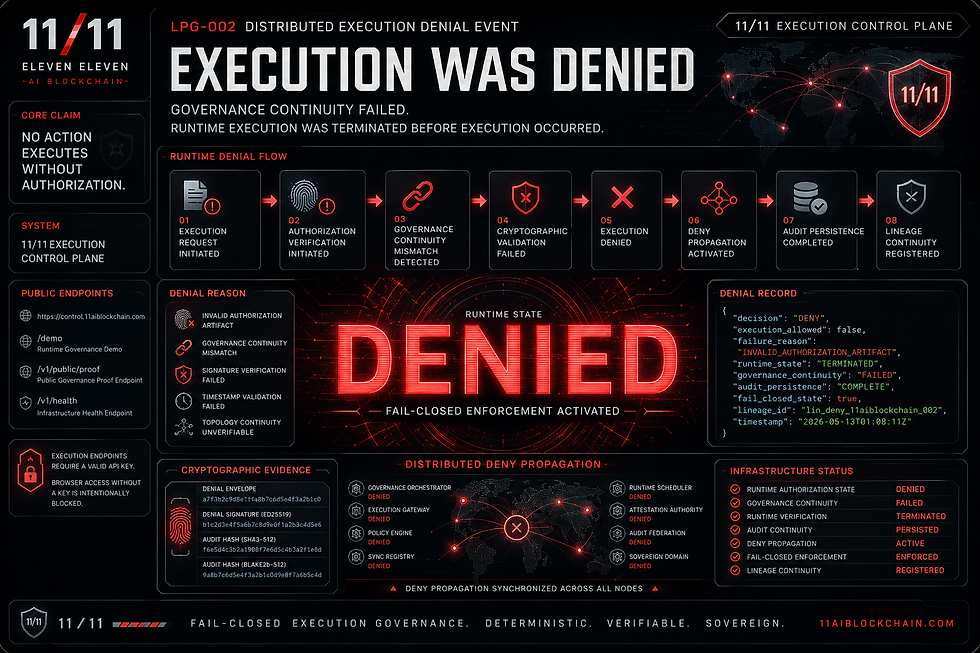
execution authorization becomes cryptographically provable
runtime attestations remain continuously verifiable
execution lineage becomes immutable
policy enforcement becomes auditable
runtime integrity becomes mathematically provable
execution propagation remains traceable end-to-end
Audit systems no longer simply collect events.
They establish continuously verifiable execution integrity.
That distinction fundamentally changes infrastructure trust.
Why Immutable Execution Lineage Matters
Autonomous infrastructure increasingly depends on execution continuity across distributed environments.
Without immutable execution lineage:
execution context may fragment
downstream propagation may become unverifiable
authorization continuity may degrade
runtime integrity may become difficult to prove
operational accountability may weaken
Execution lineage solves this by preserving:
execution origin
authorization chain
runtime attestations
policy enforcement history
downstream execution propagation
integrity verification continuity
This creates a continuously verifiable execution history across runtime activity itself.
Execution lineage therefore becomes foundational to evidence-grade execution audit.
The Execution Control Plane as an Audit Integrity Layer
The execution control plane becomes the infrastructure layer responsible for preserving execution integrity continuously throughout runtime activity.
Its role extends beyond visibility.
It governs:
pre-execution authorization
runtime authorization continuity
deterministic policy enforcement
execution lineage preservation
runtime integrity validation
cryptographic verification continuity
fail-closed enforcement actions
immutable audit assurance
This creates a continuously governed execution trust architecture.
Not merely a reporting framework.
An operational runtime integrity layer.
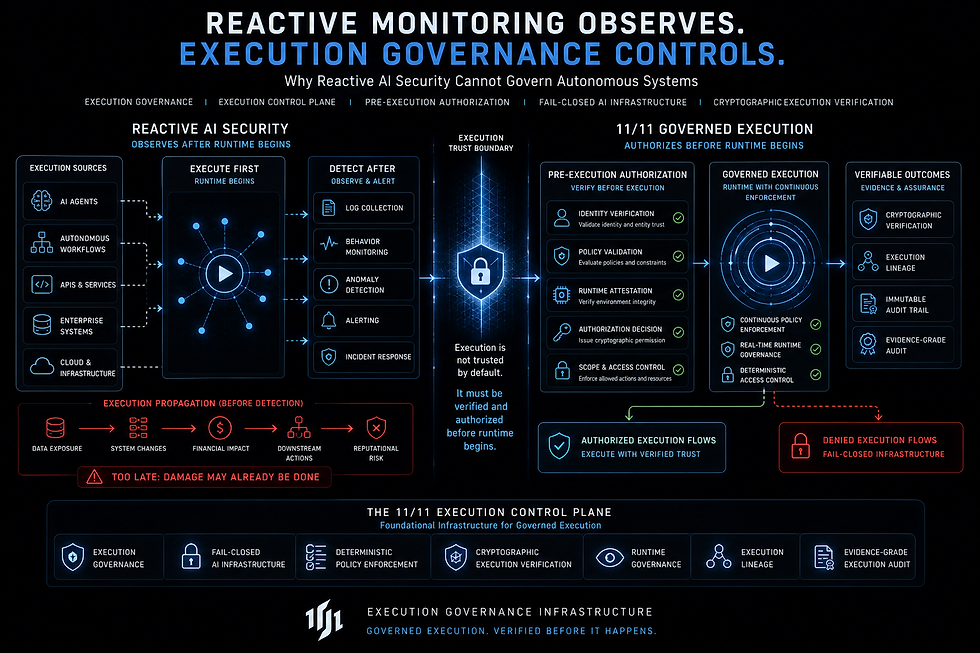
Why Reactive Logging Alone Cannot Guarantee Runtime Trust
Traditional audit systems largely operate after execution activity occurs.
This creates unavoidable trust gaps.
By the time logs are reviewed:
runtime conditions may already change
execution propagation may already expand
downstream systems may already execute
operational impact may already occur
integrity drift may already propagate
Reactive logging explains events retrospectively.
It does not continuously prove runtime integrity during execution itself.
Evidence-grade execution audit solves this by embedding verification directly into runtime governance architecture.
Audit becomes part of execution integrity itself.
Not merely an external observation layer.
Why Cryptographic Verification Changes Audit Infrastructure
Evidence-grade execution audit ultimately requires independently verifiable runtime assurance.
Not simply procedural confidence.
This is why cryptographic execution verification becomes foundational.
Under governed execution architectures:
authorization artifacts become cryptographically signed
runtime attestations remain independently provable
execution lineage becomes tamper-evident
policy enforcement integrity becomes verifiable
runtime state continuity becomes mathematically auditable
immutable execution audit becomes enforceable
This transforms audit infrastructure from event visibility into cryptographic runtime assurance.
The distinction becomes increasingly important across:
financial systems
healthcare infrastructure
industrial automation
enterprise runtime environments
government infrastructure
autonomous operational systems
Execution governance increasingly becomes the runtime trust layer beneath autonomous execution itself.
Why Evidence-Grade Audit Defines the Next Infrastructure Standard
Infrastructure markets historically evolve toward stronger operational assurance models.
Enterprise systems evolved toward identity assurance.
Cloud systems evolved toward orchestration integrity.
Distributed systems evolved toward cryptographic verification.
AI infrastructure is now evolving toward evidence-grade execution assurance.
This transition increasingly requires:
execution governance
governed execution
evidence-grade execution audit
immutable execution lineage
runtime governance
deterministic policy enforcement
pre-execution authorization
fail-closed AI infrastructure
runtime integrity enforcement
cryptographic execution verification
These systems increasingly become foundational infrastructure requirements for trusted autonomous environments.
Because infrastructure that cannot continuously prove execution integrity ultimately cannot guarantee operational trust reliably.
11/11 and the Future of Execution Assurance Infrastructure
11/11 is not positioned as a generic AI company.
11/11 is building execution governance infrastructure for autonomous systems and governed runtime environments.
The objective is to establish continuously verifiable execution assurance beneath runtime activity itself.
11/11 introduces infrastructure centered around:
execution governance
governed execution
evidence-grade execution audit
immutable execution lineage
runtime governance
deterministic policy enforcement
pre-execution authorization
fail-closed AI infrastructure
runtime integrity enforcement
cryptographic execution verification
As autonomous systems continue expanding across operational infrastructure, evidence-grade execution audit increasingly becomes mandatory for trusted runtime environments.
Because infrastructure that only records events after execution occurs ultimately cannot provide continuous execution assurance reliably.
Trusted infrastructure increasingly requires continuously verifiable runtime integrity embedded directly into execution governance architecture itself.
And that transition defines the rise of evidence-grade execution governance infrastructure.
Execution Governance™, Governed Execution™, and related execution control plane terminology are used by 11/11 to describe emerging infrastructure models centered on pre-execution authorization, deterministic policy enforcement, and cryptographic runtime verification for AI systems and autonomous infrastructure.
Patent Pending. Certain systems, architectures, infrastructure models, execution governance methods, and runtime authorization mechanisms described herein are subject to ongoing U.S. and international patent filings and related intellectual property protections by 11/11.

Comments