
Execution Authorization Becomes Mandatory AI Infrastructure
- 11/11 AI

- May 10
- 2 min read
Updated: May 13

Historically, most systems were allowed to execute by default.
Authorization often focused on:
users
devices
network access
application permissions
But AI infrastructure changes the location of trust.
The critical question is no longer simply:who has access.
The critical question becomes:what execution is authorized before runtime begins.
Execution authorization becomes mandatory infrastructure.
SECTION 1 — THE LIMITS OF ACCESS CONTROL
Traditional security architectures focused heavily on:identity and access management.
These systems determine:
who may log in
who may access systems
which permissions are assigned
which resources become visible
But access alone does not govern execution.
A valid identity can still:
execute unsafe workflows
invoke unauthorized actions
trigger harmful automation
coordinate unsafe agent behavior
operate outside runtime policy intent
AI infrastructure requires governance beyond identity alone.
SECTION 2 — EXECUTION IS THE NEW TRUST BOUNDARY
Modern AI systems increasingly execute:
autonomous orchestration
API coordination
infrastructure changes
financial operations
regulated data workflows
multi-agent reasoning chains
Execution itself becomes the operational risk surface.
This changes infrastructure requirements fundamentally.
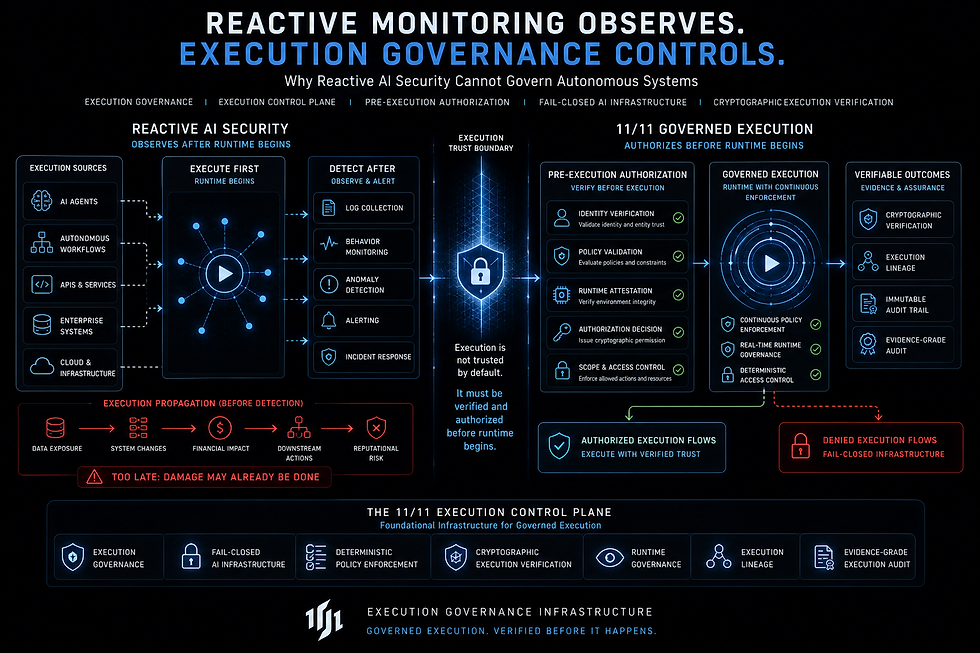
Trust must now be established:before execution begins.
Execution authorization becomes a runtime infrastructure primitive.
SECTION 3 — WHAT EXECUTION AUTHORIZATION MEANS
11/11 Authorization Fabric introduces:execution-scoped authorization.
Every execution request requires validation against:
runtime policy
environment state
identity context
execution scope
authorization windows
governance continuity
Execution becomes:explicitly permitted rather than implicitly trusted.
This creates deterministic execution governance.
SECTION 4 — AUTHORIZATION ARTIFACTS
11/11 Execution Control Plane issues cryptographic authorization artifacts tied to:
execution intent
policy constraints
trusted runtime state
execution boundaries
validity duration
governance requirements
These artifacts are validated:before execution begins.
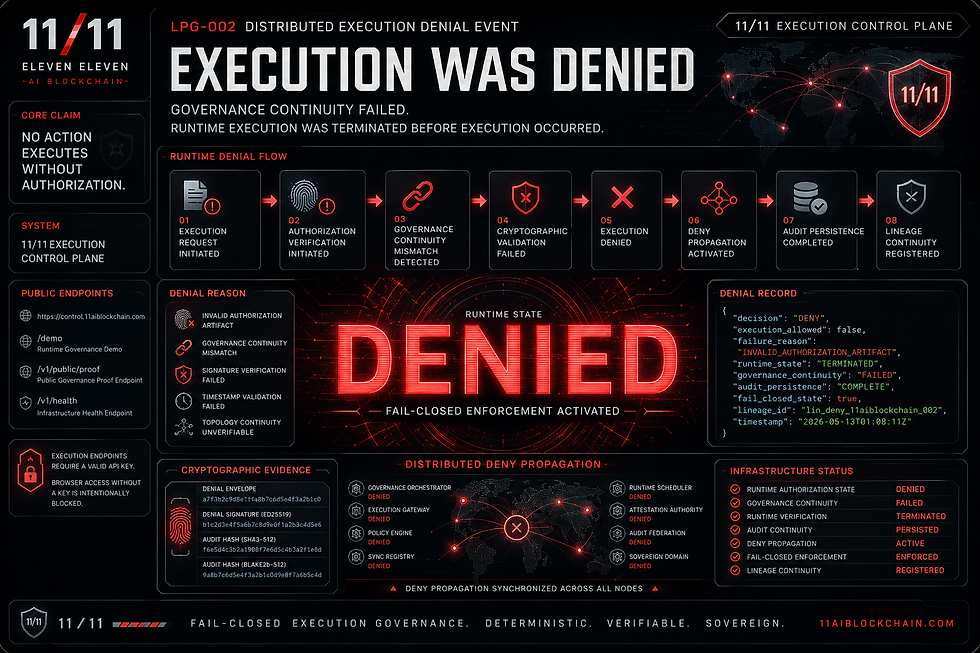
If authorization becomes invalid:execution is denied.
This transforms authorization from:session access
into:runtime execution authority.
SECTION 5 — RUNTIME GOVERNANCE CONTINUITY
Execution authorization is not a one-time event.
Trust continuity must persist during runtime itself.
11/11 Runtime Governance Layer continuously validates:
runtime integrity
execution continuity
policy compliance
governance validity
cryptographic trust state
If runtime trust degrades:execution can be denied or terminated.
Governance becomes continuously enforceable infrastructure logic.
SECTION 6 — FAIL-CLOSED EXECUTION AUTHORITY
Legacy systems often operate:fail-open.
If policy engines fail:execution may continue.
If verification becomes unavailable:execution may continue.
If authorization systems degrade:execution may continue.
11/11 Runtime Trust Architecture reverses this model.
The architecture operates:fail-closed.
Execution authority must remain continuously valid.
Otherwise:execution stops.
SECTION 7 — FROM ACCESS MANAGEMENT TO EXECUTION GOVERNANCE
The industry is moving beyond:access management.
Future infrastructure requires:execution governance.
This distinction becomes critical for:
enterprise AI systems
autonomous agents
regulated compute
healthcare AI
financial AI infrastructure
defense environments
The infrastructure itself must determine:what execution is permitted, under what conditions, and with what runtime trust guarantees.
SECTION 8 — EXECUTION AUTHORITY AS INFRASTRUCTURE
11/11 Authorization Fabric establishes:execution authorization as a foundational infrastructure layer.
This introduces:
deterministic runtime governance
cryptographic authorization enforcement
execution-scoped trust validation
governed runtime continuity
execution lineage persistence
evidence-grade audit infrastructure
Execution becomes:governed infrastructure.
Not implicit runtime behavior.
CLOSING
AI systems can no longer rely on implicit execution trust.
Execution itself becomes the trust boundary.
Every action must become:
authorized
policy validated
cryptographically verified
runtime governed
continuously enforceable
before execution begins.
Execution authorization becomes mandatory AI infrastructure.
Public Governance Console
Runtime Governance Demo
Public Governance Proof Viewer
Infrastructure Health Dashboard
Execution Lineage Explorer
11/11 is building the execution governance layer for AI infrastructure.

Comments