
The Execution Control Plane Architecture


Establishing Runtime Governance as Infrastructure
Modern infrastructure is entering a new operational era.
Historically, infrastructure primarily focused on:
compute orchestration
network transport
application deployment
workload scheduling
identity systems
observability tooling
Execution itself was rarely governed directly.
If execution was requested, runtime systems generally permitted execution automatically.
Verification often occurred later through:
monitoring
anomaly detection
post-execution audit
reactive security analysis
incident response
This operational model becomes increasingly insufficient as AI systems and autonomous infrastructure environments scale.
Execution itself now becomes the trust boundary.
This requires a new infrastructure layer:
the execution control plane.
What the Execution Control Plane Means
The execution control plane establishes governed execution infrastructure before runtime activity occurs.
It operates as the runtime governance layer responsible for:
execution authorization
runtime verification
deterministic policy enforcement
fail-closed governance
cryptographic trust validation
execution lineage
immutable audit persistence
Execution therefore no longer operates under implicit trust assumptions.
Execution becomes:governed infrastructure.
Why Infrastructure Needs an Execution Control Plane
Traditional infrastructure primarily controls:
networking
compute resources
application orchestration
transport security
workload placement
However, autonomous systems introduce a different operational challenge.
AI systems increasingly coordinate:
enterprise workflows
infrastructure automation
financial execution
machine-level orchestration
distributed runtime systems
autonomous operations
critical infrastructure processes
As autonomy expands, infrastructure must determine:
what is allowed to execute before execution begins.
This requires execution governance infrastructure.
The Failure of Open Execution
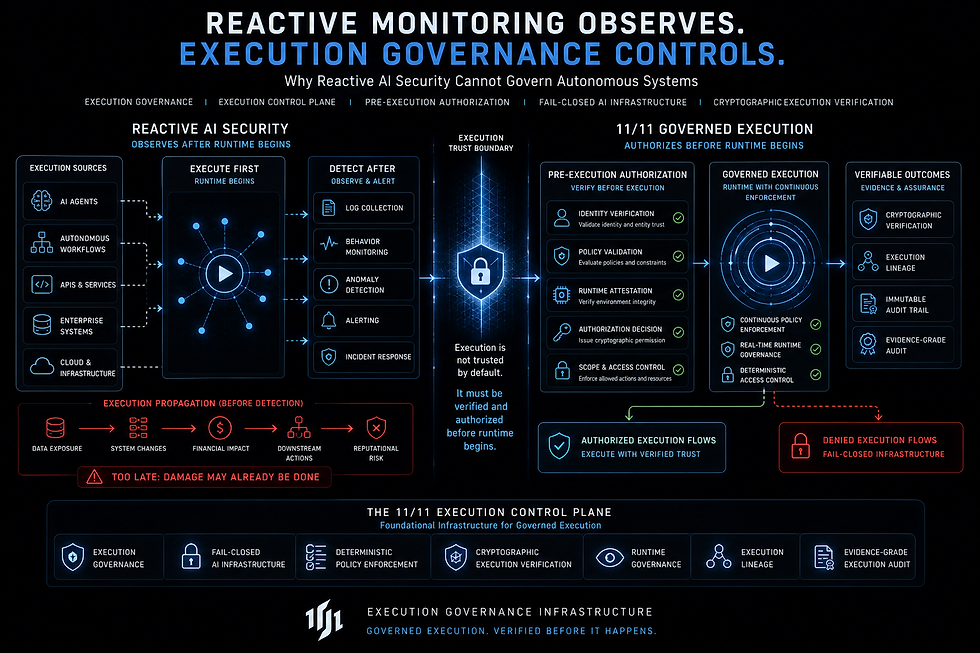
Traditional runtime environments largely assume:
execution is trusted by default.
If runtime systems receive requests, execution generally proceeds automatically.
This creates dangerous conditions for autonomous systems operating at machine speed.
By the time reactive systems identify:
unauthorized execution
policy violations
runtime compromise
operational drift
autonomous propagation
execution already occurred.
Execution governance therefore shifts infrastructure from:
trusted execution
to:
verified execution.
Core Components of the Execution Control Plane
The execution control plane may include multiple coordinated governance systems.
1. Policy Authority
Policy authorities establish:
governance rules
execution restrictions
authorization requirements
operational trust policies
runtime enforcement conditions
Policy therefore becomes operationally enforceable infrastructure.
2. Authorization Services
Authorization services determine whether execution is permitted before runtime activity begins.
Authorization systems may validate:
execution identity
execution scope
operational context
governance compliance
runtime trust conditions
Execution should not proceed without authorization approval.
3. Runtime Verification Engines
Verification systems validate:
authorization integrity
cryptographic signatures
policy consistency
runtime identity
environmental trust
governance metadata
execution lineage relationships
Execution therefore becomes continuously validated infrastructure.
4. Execution Gateways
Execution gateways enforce governance boundaries across runtime systems.
Gateways may:
permit execution
deny execution
enforce fail-closed policy
validate trust conditions
route governance decisions
establish runtime enforcement
Execution therefore becomes operationally governed.
5. Governance Mesh Infrastructure
Governance meshes coordinate distributed runtime enforcement across:
multi-cloud environments
distributed runtimes
autonomous systems
enterprise orchestration
machine-level infrastructure
AI coordination systems
This creates governance continuity across distributed execution environments.
6. Execution Lineage Systems
Execution lineage systems establish traceable runtime ancestry.
Lineage infrastructure tracks:
authorization origin
execution inheritance
policy authority relationships
runtime trust continuity
governance dependencies
distributed execution chains
Execution therefore becomes:
attributable
traceable
auditable
verifiable
evidence-capable
7. Immutable Audit Infrastructure
Immutable audit systems persist:
governance decisions
authorization records
execution events
verification states
cryptographic evidence
lineage continuity
Audit therefore evolves into:evidence infrastructure.
Pre-Execution Authorization
The execution control plane fundamentally depends upon pre-execution authorization.
Execution requests must first pass through:
policy validation
runtime verification
cryptographic trust checks
governance enforcement
operational attribution
environmental validation
Execution therefore no longer proceeds automatically.
Trust must first be established.
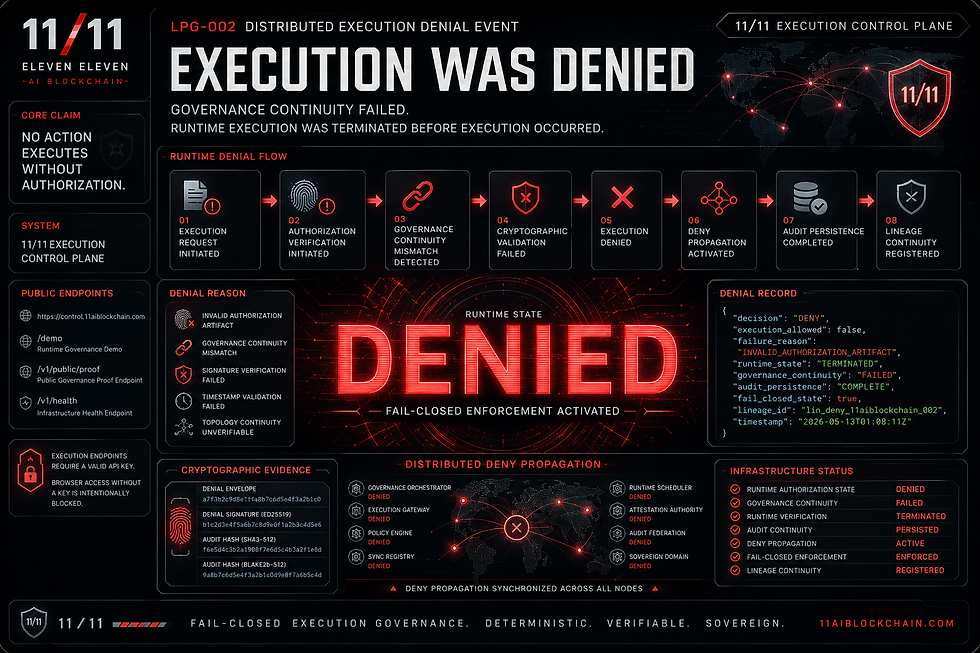
Fail-Closed Governance
The execution control plane requires fail-closed infrastructure enforcement.
Execution must be denied whenever governance validation fails.
Denial conditions may include:
missing authorization
invalid signatures
policy mismatch
environmental integrity failure
replay detection
runtime identity inconsistency
lineage discontinuity
revoked authorization
Failure to verify therefore results in denial.
This transforms governance into an enforceable infrastructure capability.
Autonomous Systems Require Control Planes
Autonomous systems dramatically increase the need for execution control planes.
Autonomous infrastructure can:
execute continuously
coordinate recursively
scale globally
propagate decisions autonomously
influence distributed environments
operate without direct human oversight
Reactive governance cannot safely manage autonomous execution at scale.
Autonomous systems therefore require:
governed execution
runtime verification
authorization enforcement
cryptographic governance
execution lineage
fail-closed execution
immutable audit
The execution control plane establishes this operational trust layer.
The Infrastructure Transition
Historically, infrastructure normalized:
encrypted transport
identity verification
Zero Trust networking
hardware trust anchors
Execution governance now emerges as the next foundational infrastructure layer.
Execution itself must become governed before runtime activity occurs.
Infrastructure therefore shifts from:
trusted execution
to:
authorized and verified execution.
The Future of Runtime Governance
The execution control plane increasingly becomes:
enterprise infrastructure
autonomous governance infrastructure
operational trust infrastructure
runtime security infrastructure
evidence infrastructure
cryptographic trust infrastructure
This fundamentally changes how infrastructure systems establish operational trust.
Conclusion
The execution control plane establishes the governance layer required for enterprise AI and autonomous infrastructure environments.
Under this model:
execution requires authorization
runtime governance becomes foundational
infrastructure fails closed
verification becomes continuous
execution becomes attributable
lineage becomes operationally necessary
audit becomes immutable
Execution can no longer remain implicitly trusted.
Execution must first become governed.
The execution control plane is becoming foundational infrastructure for the autonomous era.
“The future of infrastructure depends on controlling execution before runtime activity begins.”

Comments