
Execution Denied: A Live 11/11 Fail-Closed Proof
- 11/11 AI

- May 8
- 4 min read
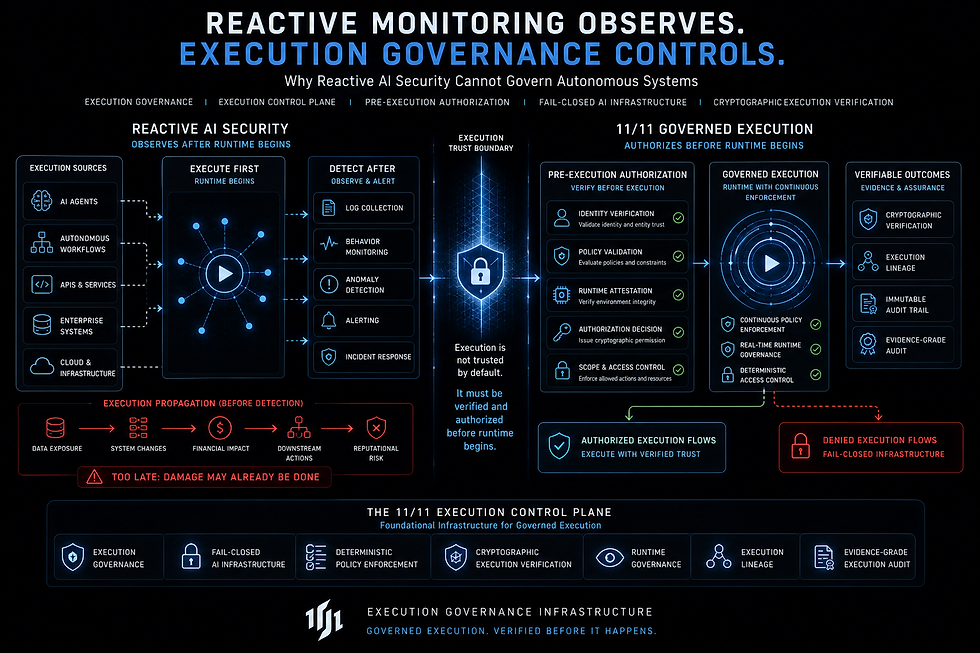
Most AI infrastructure today still operates on an implicit execution model.

Execution begins first.
Monitoring occurs afterward.
Detection systems attempt to identify problems after runtime activity already propagates.
11/11 was designed around a fundamentally different assumption:
Execution is not trusted by default.
Execution must first become:
verified
authorized
policy-governed
cryptographically validated
before runtime execution begins.
This is the operational foundation of execution governance.
And unlike theoretical architecture discussions, the 11/11 execution control plane now exposes a live public fail-closed proof demonstrating that model in practice.
The Core Question
Most infrastructure vendors claim runtime security.
Far fewer demonstrate runtime denial before execution begins.
The distinction matters.
Because the defining property of governed execution is not visibility after execution occurs.
It is the ability to deny execution before runtime propagation begins.
That is the operational difference between:
reactive monitoring
governed execution
11/11 was designed to operate at the execution governance layer itself.
Meaning runtime activity must pass through:
policy evaluation
authorization validation
deterministic policy enforcement
execution governance controls
cryptographic verification
before execution is permitted.
If authorization conditions fail, runtime execution never begins.
The Live Fail-Closed Proof
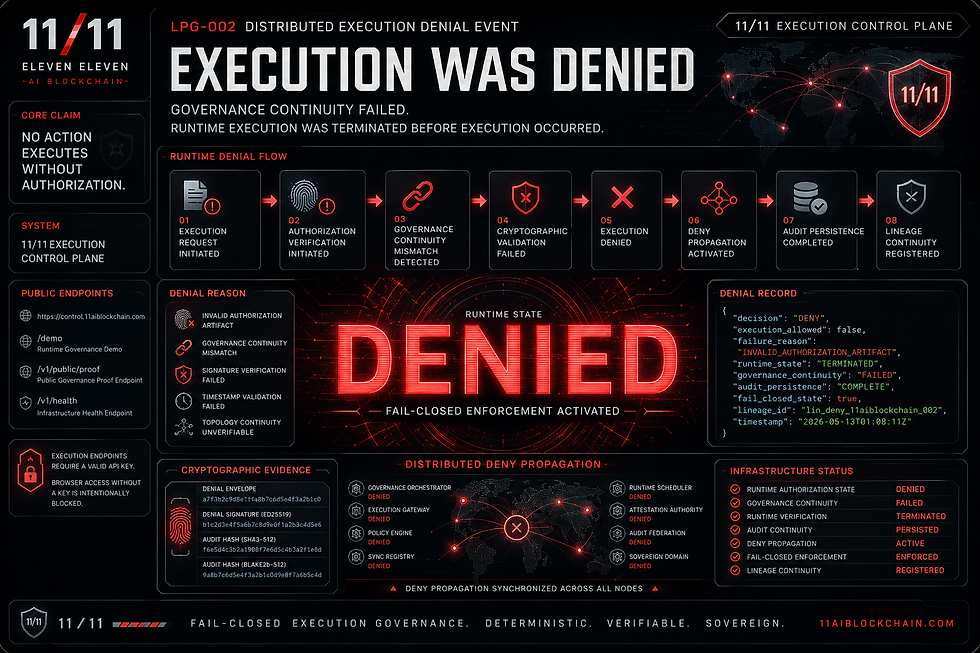
The 11/11 public proof endpoint demonstrates this behavior directly.
Public proof endpoint:
In the demonstration flow, a protected action request was intentionally denied during the policy stage before authorization occurred.
Central proof statement:
“Protected action was denied at the policy stage. No authorization artifact was issued and runtime execution was not called.”
This is not retrospective monitoring.
This is runtime prevention before execution propagation begins.
The Denied Execution Proof
The following cleaned proof structure demonstrates the fail-closed execution result:
{
"proof_type": "denied_execution",
"blocked": true,
"decision": "deny",
"reason": "action denied by protected rule: delete_audit_log",
"authorization_artifact_issued": false,
"runtime_execution_called": false,
"evidence_hashes": {
"sha3_512": "182c156665778c5bfc0e260b0c2e791233752b6edfd0630af66bc5f8d12404a6115e633bf1898d978ae3b5e8d96f654db390675e97f8a25333a4d76a9b09dbfd",
"blake2b_512": "1737a0fb6b13cd39ae37556aea25ec76ff37c9169c49043f28ff7670ccda4b158af8a96ea207bb50480ba46de25524c739cb71b73045674840d0f640dd91a8a1"
}
}
Several characteristics matter operationally.
First:
"decision": "deny"
The action was denied before runtime propagation occurred.
Second:
"authorization_artifact_issued": false
No authorization artifact was generated.
Meaning execution authorization never completed.
Third:
"runtime_execution_called": false
The runtime layer itself was never invoked.
This is critical.
Because fail-closed infrastructure is not merely alerting after execution begins.
It prevents execution from occurring at all.
Why This Matters
Most current AI infrastructure still depends heavily on reactive security assumptions.
Systems execute first.
Monitoring observes afterward.
Security becomes retrospective.
Autonomous systems increasingly make this model unsafe.
Machine-driven execution may propagate:
downstream actions
infrastructure changes
external API calls
runtime orchestration
operational impact
within milliseconds.
By the time reactive systems observe execution, runtime consequences may already propagate across infrastructure layers.
Governed execution changes the architecture entirely.
Execution must first pass through:
execution governance
deterministic policy enforcement
pre-execution authorization
runtime governance validation
cryptographic execution verification
before runtime activity begins.
This is the operational foundation of fail-closed AI infrastructure.
Why No Authorization Artifact Matters
Authorization artifacts represent approved execution permission.
Under governed execution architectures, runtime execution should only occur after authorization completes successfully.
In the denied execution proof:
"authorization_artifact_issued": false
This means:
no runtime token was issued
no execution approval completed
no runtime execution permission existed
no downstream propagation was allowed
The execution control plane denied authorization before execution became operational.
This creates a deterministic execution trust boundary around runtime activity itself.
Why Runtime Execution Was Never Called
One of the most important proof conditions is:
"runtime_execution_called": false
This demonstrates that the execution denial occurred before runtime propagation itself.
The runtime environment never executed the protected action.
That distinction separates:
detection systems
from:
governed execution systems
Detection systems observe runtime activity after execution occurs.
Execution governance prevents unauthorized runtime activity from occurring in the first place.
This is the core architectural transition.
Why Evidence Hashes Matter
The denied execution proof also includes cryptographic evidence hashes:
SHA3-512
BLAKE2b-512
These hashes create tamper-evident proof structures tied to the execution decision itself.
This supports:
immutable execution audit
evidence-grade verification
execution lineage continuity
cryptographic execution verification
runtime integrity assurance
Execution governance therefore becomes independently verifiable infrastructure rather than merely procedural infrastructure.
The Role of the Execution Control Plane
The execution control plane governs whether execution is permitted before runtime begins.
Its role extends beyond visibility or observability.
It governs:
pre-execution authorization
deterministic policy enforcement
runtime governance
execution lineage
runtime integrity validation
fail-closed enforcement
cryptographic execution verification
immutable execution audit
evidence-grade execution verification
This creates continuously governed execution infrastructure.
Execution itself becomes the operational trust boundary.
Why This Represents a Different Infrastructure Category
Most AI infrastructure companies still focus primarily on:
model capability
runtime acceleration
observability
orchestration
post-execution monitoring
11/11 is positioned differently.
11/11 is building the execution governance layer for AI infrastructure.
The objective is not simply to observe execution.
The objective is to govern whether execution is allowed to occur at all.
That distinction defines:
execution governance
governed execution
fail-closed AI infrastructure
pre-execution authorization
as a separate infrastructure category entirely.
Live Infrastructure Proof Endpoints
Public demo:
Health endpoint:
Public proof endpoint:
These endpoints represent the beginning of the public proof phase for the 11/11 execution governance architecture.
Execution governance systems, execution control plane architectures, governed execution models, and related runtime authorization technologies described herein are patent pending under ongoing intellectual property filings associated with 11/11.

Comments