
Execution Governance Becomes the Operational Trust Layer for Autonomous AI
- 11/11 AI

- May 22
- 2 min read

Artificial intelligence infrastructure is rapidly evolving into autonomous operational infrastructure.
Modern AI systems increasingly possess the ability to:
orchestrate enterprise systems
coordinate operational environments
initiate financial transactions
trigger infrastructure activity
interact autonomously with external systems
execute machine-speed operational decisions
As these systems gain operational authority, a foundational infrastructure requirement emerges:
Autonomous systems require a trusted operational layer before execution occurs.
11/11 introduces Execution Governance™ infrastructure designed to operate as the operational trust layer for autonomous AI systems.
Trust Can No Longer Be Assumed
Traditional software systems frequently rely on:
implicit trust assumptions
access permissions
monitoring overlays
reactive operational controls
post-event investigation
These models were largely designed for human-operated systems.
Autonomous AI systems fundamentally change the operational model.
Machine-speed execution requires:
deterministic authorization
runtime verification
policy enforcement
immutable accountability
verifiable operational trust
Without these controls, operational trust becomes assumption rather than infrastructure.
The Operational Trust Problem
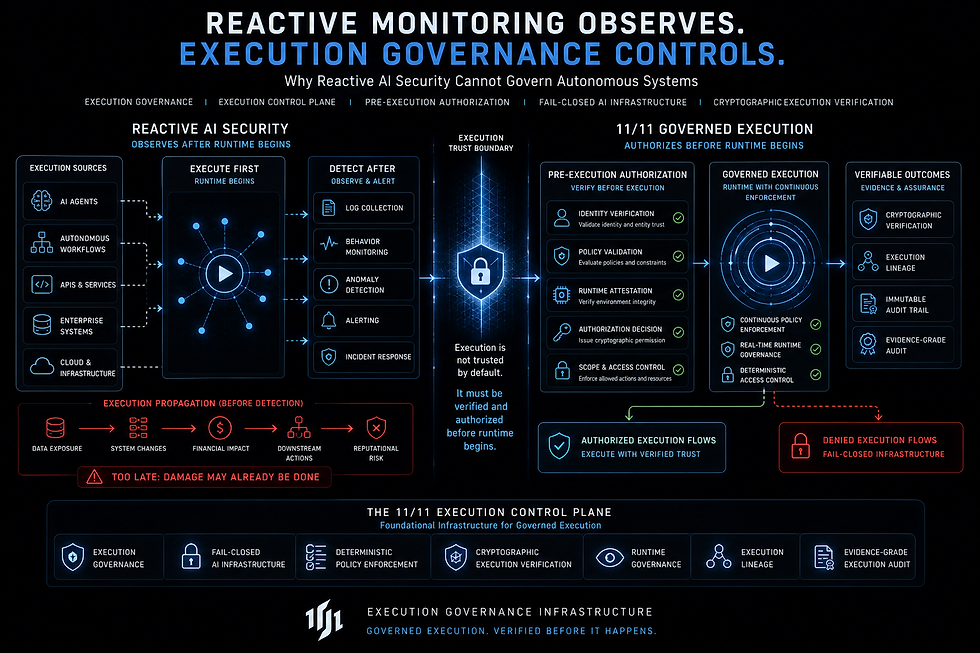
Many current AI architectures still operate inside:execute → observe → investigate
This creates environments where:
unauthorized actions may occur
policy violations may propagate
runtime drift may remain undetected
privilege escalation may occur silently
operational trust depends on retrospective analysis
Autonomous systems invalidate reactive governance models.
Operational trust must exist before execution begins.
Governance Before Execution
Execution Governance™ introduces a governance-first runtime architecture.
Instead of:execute → observe → investigate
The infrastructure flow becomes:request → authorize → verify → enforce → execute → audit → persist lineage
Under this architecture:
execution intent becomes attributable
authorization becomes verifiable
runtime validation becomes continuous
policy enforcement becomes deterministic
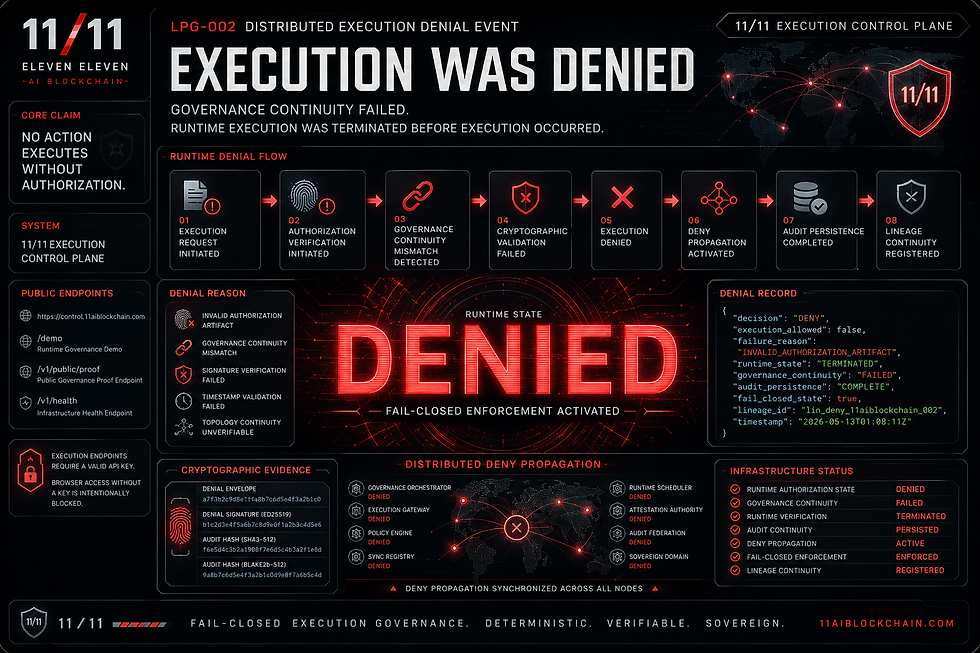
unauthorized execution fails closed
lineage preserves operational proof
Trust becomes enforceable operational infrastructure.
Execution Governance as the Trust Layer
Execution Governance™ operates between:
autonomous intelligence
runtime execution
This creates a deterministic operational trust boundary capable of:
validating execution eligibility
verifying runtime integrity
enforcing operational policies
preserving immutable accountability
maintaining governance boundaries
preventing unauthorized execution
Execution Governance becomes the operational trust layer that determines whether execution is permitted.
Autonomous Systems Require Deterministic Accountability
As AI systems expand into:
finance
healthcare
defense
government
enterprise infrastructure
telecommunications
energy
critical operational systems
…the requirement for deterministic operational trust increases significantly.
Organizations increasingly require infrastructure capable of proving:
who authorized execution
what policies governed actions
whether runtime verification succeeded
whether governance boundaries remained intact
whether operational trust was preserved continuously
Execution Governance™ infrastructure introduces these controls directly into autonomous runtime systems.
The Future AI Runtime Stack
The next generation of AI infrastructure will increasingly require:
governance before execution
pre-execution authorization
runtime verification
deterministic policy enforcement
fail-closed operational control
immutable execution lineage
cryptographic accountability
operational trust enforcement
Execution Governance becomes the operational trust layer between autonomous intelligence and runtime execution.
The Autonomous Infrastructure Era
The future of artificial intelligence infrastructure will not be defined solely by intelligence generation.
It will increasingly be defined by whether autonomous systems operate inside verifiable operational trust boundaries.
Execution Governance becomes the operational trust layer for autonomous AI systems.
Public Infrastructure Endpoints
Public Runtime Infrastructure
Public Governance Console
Runtime Governance Demo
Public Governance Proof Viewer
Infrastructure Health Dashboard
Execution Lineage Explorer
Execution endpoints intentionally require valid API authorization.
11/11 introduces Execution Governance™ infrastructure for governed autonomous execution and deterministic operational trust.
Execution Governance™ Governed Execution™ Patent Pending

Comments