
Execution Governance Compatible (EGC)
- 11/11 AI

- May 20
- 2 min read

Establishing the Interoperability Layer for Governed Runtime Infrastructure
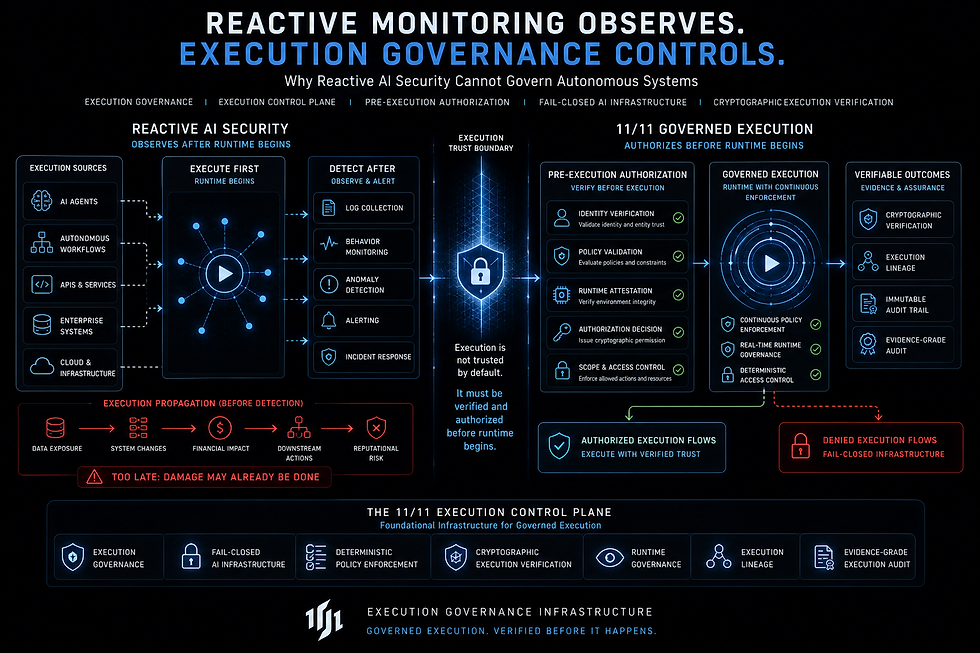
Modern AI systems, autonomous agents, orchestration platforms, and regulated compute environments increasingly execute actions without deterministic governance enforcement occurring before runtime execution.
Execution Governance Compatible (EGC) introduces a standardized governance interoperability model designed to establish verifiable execution controls before runtime activity is permitted to occur.
The objective of EGC is to normalize a new infrastructure expectation:
No execution without prior authorization.
Execution Governance Compatibility defines the operational requirements for systems that support:
pre-execution authorization
fail-closed execution enforcement
runtime verification
authorization artifact validation
execution lineage persistence
cryptographic auditability
governed runtime controls
The initiative positions execution governance as a foundational infrastructure layer for autonomous and regulated compute systems.
Similar to how:
OAuth standardized delegated authorization,
Kubernetes standardized orchestration behavior,
OpenAPI standardized API interoperability,
and Zero Trust standardized identity-centric security,
Execution Governance Compatibility aims to standardize governance-before-execution infrastructure behavior.
The specification introduces a vendor-neutral governance framework that enables interoperability between:
AI runtimes
autonomous agents
orchestration systems
cloud execution infrastructure
robotics platforms
defense systems
regulated financial infrastructure
healthcare execution environments
industrial automation systems
At the center of the model is the concept of the Governed Runtime.
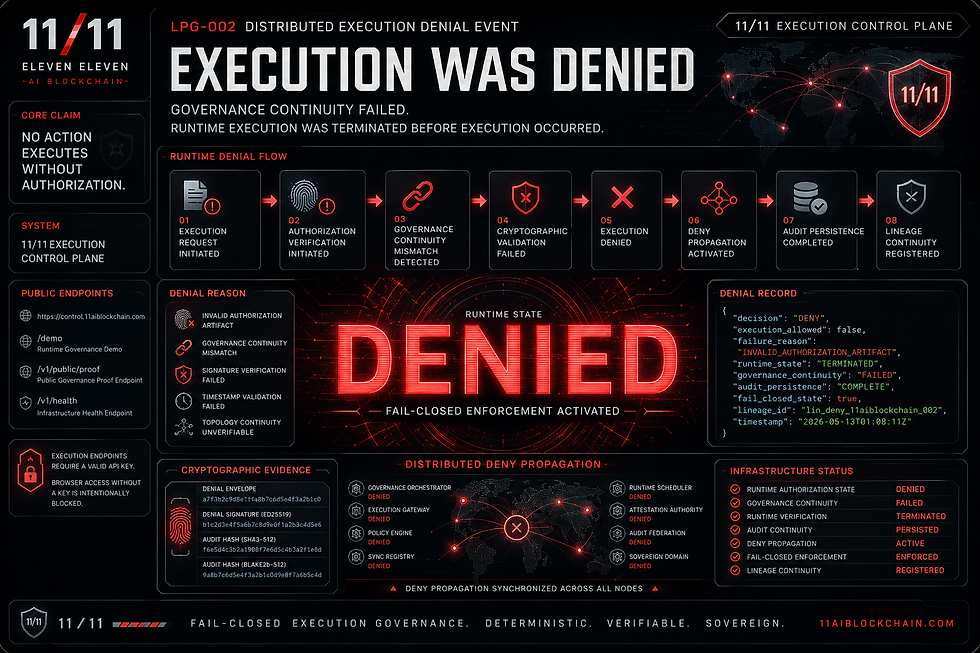
A Governed Runtime is defined as a runtime environment that verifies authorization validity prior to execution and refuses execution when governance requirements fail.
Execution Governance Compatible systems MUST support fail-closed semantics.
This means execution cannot proceed when:
authorization is missing,
policy verification fails,
runtime context integrity diverges,
cryptographic validation fails,
or lineage persistence cannot be established.
The specification also establishes foundational terminology for the emerging execution governance ecosystem, including:
Runtime Authorization
Authorization Artifact
Runtime Trust Boundary
Execution Lineage
Verified Execution Chain
Governed Execution Layer
Cryptographic Runtime Governance
Pre-Execution Enforcement
Execution Governance Compatibility is intended to serve as the baseline interoperability definition for future governed runtime certification and conformance programs.
Future standards-track specifications will expand the ecosystem through:
Runtime Authorization Standards (RAS)
Execution Lineage Format (ELF)
Governed AI Runtime Profiles (GARP)
Execution Governance Conformance Frameworks (EGCF)
The long-term objective is to establish governance-before-execution as a globally recognized infrastructure requirement for autonomous compute systems.
Suggested Category
Execution Governance Standards
Suggested CTA
Explore the emerging standards architecture for governed runtimes, execution lineage infrastructure, fail-closed AI systems, and runtime authorization interoperability through the 11/11 Execution Governance Standards Track Initiative.

Comments