
Execution Governance Control Plane Stack Canonical Stack Architecture for Governed Runtime Infrastructure
- 11/11 AI

- May 11
- 4 min read

Infrastructure architecture is entering a new control-layer era.
Historically, infrastructure stacks focused primarily on:
networking
compute orchestration
identity management
observability
application runtime coordination
These systems controlled infrastructure behavior.
They did not govern execution trust itself.
Modern autonomous systems change this entirely.
AI systems increasingly generate:
autonomous runtime execution
machine-to-machine orchestration
dynamic infrastructure modification
continuously evolving execution behavior
distributed runtime decision systems
Execution itself becomes the operational trust boundary.
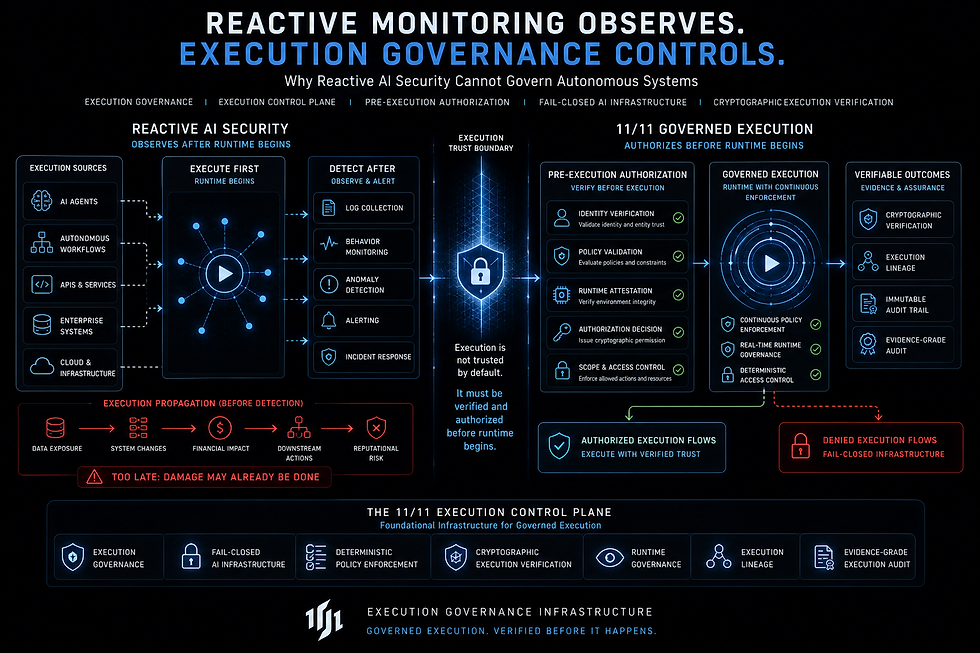
The Execution Governance Control Plane Stack defines the canonical layered architecture for governing execution before and during runtime activity.
Purpose of the Stack
The Execution Governance Control Plane Stack establishes a canonical infrastructure stack for:
governed execution
runtime trust continuity
authorization enforcement
execution lineage persistence
cryptographic runtime verification
fail-closed governance enforcement
operational proof continuity
The stack defines how infrastructure evolves from:
reactive runtime security
to:
deterministic governed execution control systems
Execution governance becomes a foundational control plane layer.
Canonical Definition
Execution Governance Control Plane Stack is defined as:
a layered governance architecture in which execution authorization, runtime trust, operational continuity and governance enforcement are continuously validated before and during runtime execution.
The stack establishes:
deterministic runtime authorization
governed execution continuity
cryptographic trust validation
fail-closed runtime governance
execution lineage continuity
independently verifiable operational proof
Execution becomes governance-controlled infrastructure.
The Fundamental Infrastructure Shift
Traditional infrastructure stacks assumed:
execution was inherently trusted once runtime systems became operational.
This model increasingly fails in:
AI infrastructure
distributed orchestration systems
autonomous runtime environments
machine-generated execution systems
continuously adaptive workloads
Reactive visibility is no longer sufficient.
Execution itself must become continuously governed.
The control plane evolves from:operational orchestration
to:execution governance.
Foundational Stack Principles
The stack architecture is built around several foundational governance principles.
1. Governance Exists Before Runtime
Execution governance must occur before runtime activity begins.
Execution requests must pass through:
policy validation
authorization verification
runtime trust establishment
governance continuity enforcement
before execution proceeds.
Governance becomes part of the execution path itself.
2. Runtime Trust Must Remain Continuous
Execution trust cannot remain static.
Runtime trust must remain continuously verified throughout execution lifecycles.
This includes:
execution integrity validation
trust synchronization
authorization continuity
runtime verification
governance continuity enforcement
Trust becomes continuously governed infrastructure.
3. Execution Must Be Cryptographically Verifiable
Execution governance systems must establish cryptographically verifiable trust continuity.
This includes:
authorization artifacts
integrity attestations
cryptographic execution proof
tamper-evident lineage continuity
independently verifiable governance evidence
Execution trust becomes measurable.
4. Execution Must Fail Closed
Execution governance systems must fail closed.
Execution must be denied or halted if:
authorization integrity breaks
runtime trust becomes unverifiable
governance continuity fails
policy boundaries are violated
operational trust degrades
Execution governance becomes enforceable infrastructure behavior.
Canonical Control Plane Stack Layers
The Execution Governance Control Plane Stack defines several foundational infrastructure layers.
Layer 1 — Identity and Attestation Layer
This layer establishes foundational execution identity and trust attestation.
Capabilities may include:
workload identity
service identity
runtime attestation
cryptographic trust establishment
execution identity continuity
environment verification
Identity becomes execution-aware.
Layer 2 — Governance Policy Layer
This layer establishes deterministic governance policy.
Capabilities may include:
policy evaluation
runtime boundary enforcement
governance rule validation
risk classification
execution scope management
trust continuity constraints
Governance becomes deterministic infrastructure logic.
Layer 3 — Authorization and Verification Layer
This layer establishes deterministic execution authorization.
Capabilities may include:
authorization artifact generation
cryptographic validation
runtime trust establishment
authorization continuity enforcement
fail-closed authorization verification
Execution becomes independently verifiable.
Layer 4 — Runtime Enforcement Layer
This layer governs execution during runtime activity.
Capabilities may include:
runtime integrity enforcement
trust continuity synchronization
execution interruption controls
policy continuity validation
fail-closed runtime governance
operational constraint enforcement
Runtime governance remains continuously active.
Layer 5 — Execution Lineage Layer
This layer establishes execution continuity and traceability.
Capabilities may include:
execution lineage persistence
governance continuity tracking
runtime event chaining
authorization continuity
cryptographic audit linkage
operational traceability
Execution continuity becomes verifiable infrastructure.
Layer 6 — Operational Proof Layer
This layer establishes independently verifiable operational proof systems.
Capabilities may include:
execution verification proof
authorization validation proof
runtime trust continuity proof
governance enforcement proof
cryptographic operational evidence
immutable audit continuity
Operational trust becomes measurable infrastructure.
Layer 7 — Enterprise Integration Layer
This layer integrates execution governance infrastructure into enterprise ecosystems.
Capabilities may include:
SIEM integration
GRC systems
audit systems
observability platforms
data governance systems
regulatory compliance systems
Execution governance becomes ecosystem-aware infrastructure.
Execution Governance Lifecycle
The control plane stack commonly follows a deterministic governance lifecycle.
Phase 1 — Execution Intent Generated
A runtime action request is initiated.
Phase 2 — Governance Policy Evaluated
Execution governance systems determine whether execution is permitted.
Phase 3 — Authorization Artifact Issued
A cryptographically verifiable authorization object is generated.
Phase 4 — Runtime Trust Established
Execution environment integrity becomes trusted.
Phase 5 — Governed Execution Begins
Execution proceeds under continuous governance enforcement.
Phase 6 — Runtime Verification Continues
Trust continuity remains continuously validated.
Phase 7 — Operational Proof Persisted
Execution evidence becomes permanently auditable and independently verifiable.
Security Improvements
The control plane stack significantly improves runtime governance integrity.
Organizations establish:
deterministic execution authorization
continuous runtime trust validation
fail-closed governance enforcement
cryptographic execution continuity
independently verifiable operational proof
execution lineage accountability
reduced implicit runtime trust exposure
Execution becomes governed infrastructure.
AI Infrastructure Applicability
AI systems dramatically increase the need for execution governance control planes.
Autonomous systems increasingly generate:
distributed runtime execution
machine-generated orchestration
adaptive infrastructure behavior
autonomous execution chains
continuously evolving runtime conditions
Without governance control planes:
AI infrastructure remains operationally fragile.
The stack introduces deterministic runtime governance into autonomous systems.
This allows AI infrastructure to become:
continuously governable
cryptographically verifiable
operationally auditable
fail-closed enforceable
independently trustworthy
before and during runtime execution.
The Strategic Transition
The Execution Governance Control Plane Stack represents a broader infrastructure transition.
Historically:
control planes orchestrated infrastructure.
Modern infrastructure increasingly requires:
control planes that govern execution trust itself.
This changes infrastructure from:
operational orchestration
to:
governed execution infrastructure
from:
runtime trust assumptions
to:
continuously validated execution trust
from:
reactive security
to:
deterministic execution governance
Execution itself becomes the operational trust boundary.
The Future of Runtime Infrastructure
Infrastructure increasingly requires:
governed execution
continuous runtime trust validation
authorization continuity
fail-closed governance enforcement
cryptographic operational proof
execution lineage continuity
independently verifiable runtime trust
Execution governance becomes foundational runtime infrastructure.
11/11 Execution Governance Control Plane
11/11 is developing execution governance control plane infrastructure focused on:
governed execution
runtime trust continuity
authorization artifact validation
cryptographic governance enforcement
execution lineage continuity
operational proof systems
independently verifiable execution trust
Execution governance becomes foundational infrastructure architecture.
Operational Proof Surfaces
Primary Proof Environment:
Runtime Health:
Public Verification Proof:
Execution Governance Briefings:


Comments