
Execution Governance Is Emerging as the Sovereign Enforcement Standard for Autonomous Infrastructure


Artificial intelligence infrastructure is rapidly evolving into sovereign operational infrastructure capable of executing machine-speed decisions across national systems, public infrastructure, and interconnected autonomous ecosystems.
The next generation of autonomous AI systems will increasingly:
coordinate sovereign infrastructure
support national operational systems
manage logistics and transportation environments
orchestrate communications networks
execute operational workflows continuously
operate across distributed runtime ecosystems
As autonomous systems gain operational authority, enforcement itself becomes sovereign infrastructure.
11/11 introduces Execution Governance™ infrastructure designed to establish deterministic sovereign enforcement for autonomous infrastructure systems.
Sovereign Infrastructure Requires Runtime Enforcement
Modern nations already depend on operational enforcement across:
energy infrastructure
transportation systems
communications networks
financial ecosystems
emergency response operations
healthcare systems
public safety infrastructure
Autonomous AI systems are rapidly becoming integrated into these same operational environments.
This creates a new operational requirement:governance before execution.
Without deterministic governance:
operational trust fragments across systems
machine-speed failures propagate rapidly
policy enforcement becomes inconsistent
accountability weakens across domains
runtime assumptions drift continuously
sovereign continuity becomes vulnerable
Civilization-scale infrastructure requires deterministic sovereign enforcement.
The Problem With Reactive Enforcement Models
Many current AI systems still operate within architectures where:
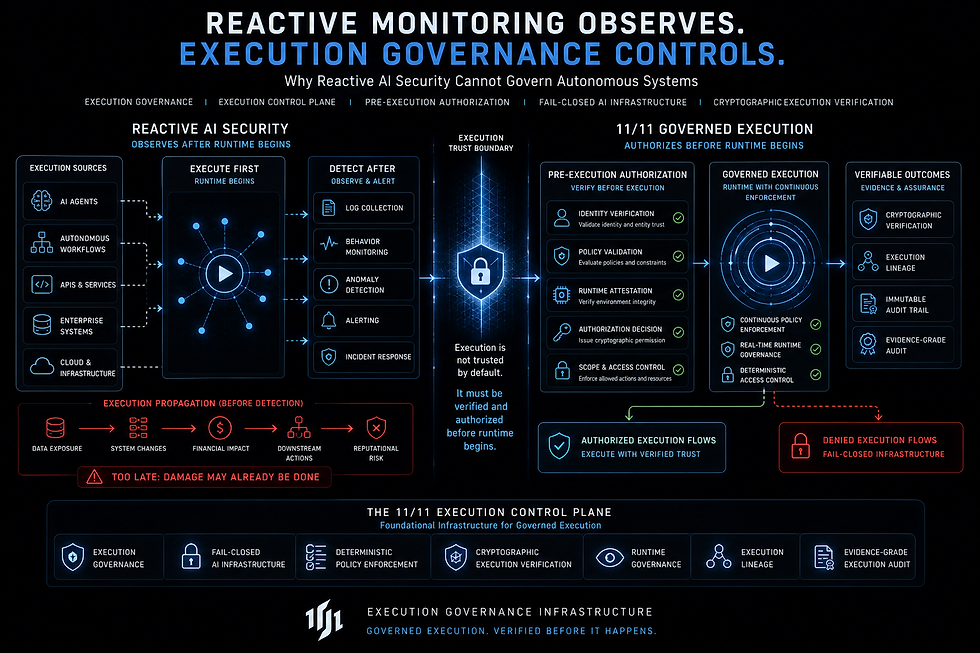
execution occurs before validation
intervention occurs after operational impact
governance remains reactive
runtime trust depends on assumptions
policy enforcement drifts over time
accountability becomes fragmented
Reactive governance cannot reliably enforce:
sovereign operational continuity
machine-speed infrastructure coordination
distributed runtime ecosystems
public-sector operational systems
continuously operating autonomous networks
Autonomous systems require governance before execution occurs.
Governance Before Execution
Execution Governance™ introduces a governance-first runtime architecture.
Instead of:execute → observe → investigate
The operational flow becomes:authorize → verify → enforce → execute → audit → persist lineage
Under this architecture:
execution intent becomes attributable
authorization becomes continuously enforceable
runtime verification becomes deterministic
operational enforcement remains synchronized
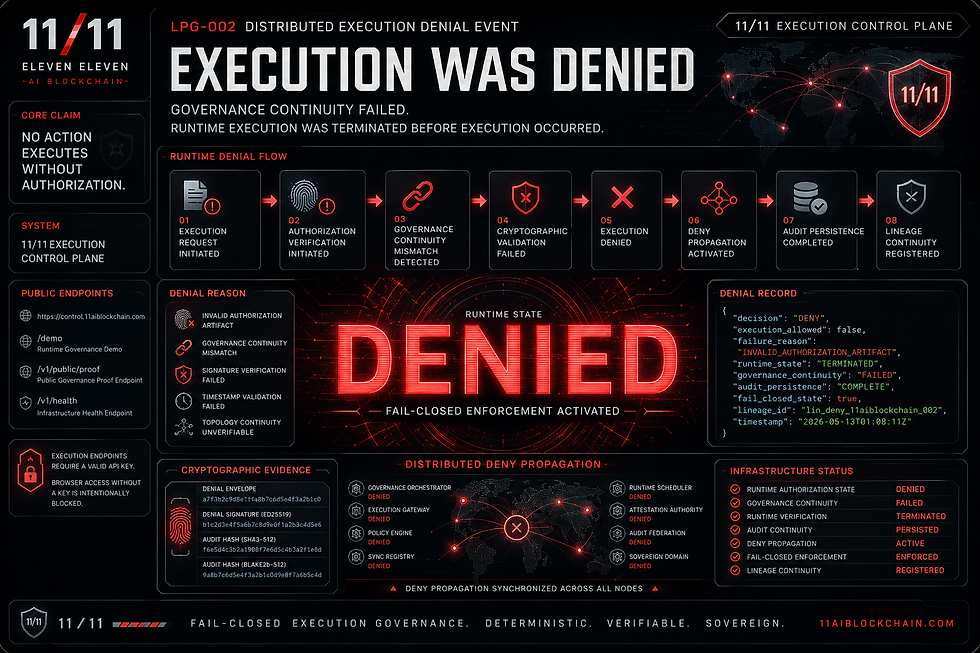
unauthorized activity fails closed
lineage preserves immutable accountability
Governance becomes sovereign enforcement infrastructure.
Enforcement Requires Deterministic Runtime Trust
Civilization-scale operational enforcement requires:
deterministic runtime enforcement
continuous operational verification
synchronized sovereign policy governance
immutable execution lineage
fail-safe operational boundaries
attributable execution chains
continuously verifiable operational trust
Execution Governance™ transforms enforcement from institutional assumption into runtime-enforced infrastructure.
Governance as Enforcement Infrastructure
Execution Governance™ transforms governance from:
passive observation
retrospective investigation
monitoring overlays
advisory operational policy
…into sovereign operational enforcement infrastructure.
Under this architecture:
authorization becomes enforceable
verification becomes continuous
enforcement becomes deterministic
accountability becomes immutable
operational trust becomes runtime-native
governance becomes machine-speed enforcement infrastructure
This creates infrastructure designed specifically for continuously operating sovereign autonomous ecosystems.
The Future Sovereign Enforcement Stack
The next generation of sovereign infrastructure will increasingly require:
governance before execution
deterministic runtime enforcement
continuous authorization validation
synchronized operational policy
fail-closed operational control
immutable execution lineage
cryptographic accountability
governed autonomous execution
Execution Governance becomes the sovereign enforcement standard between autonomous intelligence and sovereign operational infrastructure.
The Sovereign Enforcement Era
The future of autonomous infrastructure will not be defined solely by automation capability or execution speed.
It will increasingly be defined by whether autonomous systems can maintain deterministic sovereign enforcement under civilization-scale machine-speed conditions.
Execution Governance is emerging as the sovereign enforcement standard for autonomous infrastructure.
Public Infrastructure Endpoints
Public Runtime Infrastructure
Public Governance Console
Runtime Governance Demo
Public Governance Proof Viewer
Infrastructure Health Dashboard
Execution Lineage Explorer
Execution endpoints intentionally require valid API authorization.
11/11 introduces Execution Governance™ infrastructure for governed autonomous execution and deterministic operational trust.
Execution Governance™ Governed Execution™ Patent Pending

Comments