
Execution Governance Maturity Model (EGMM)

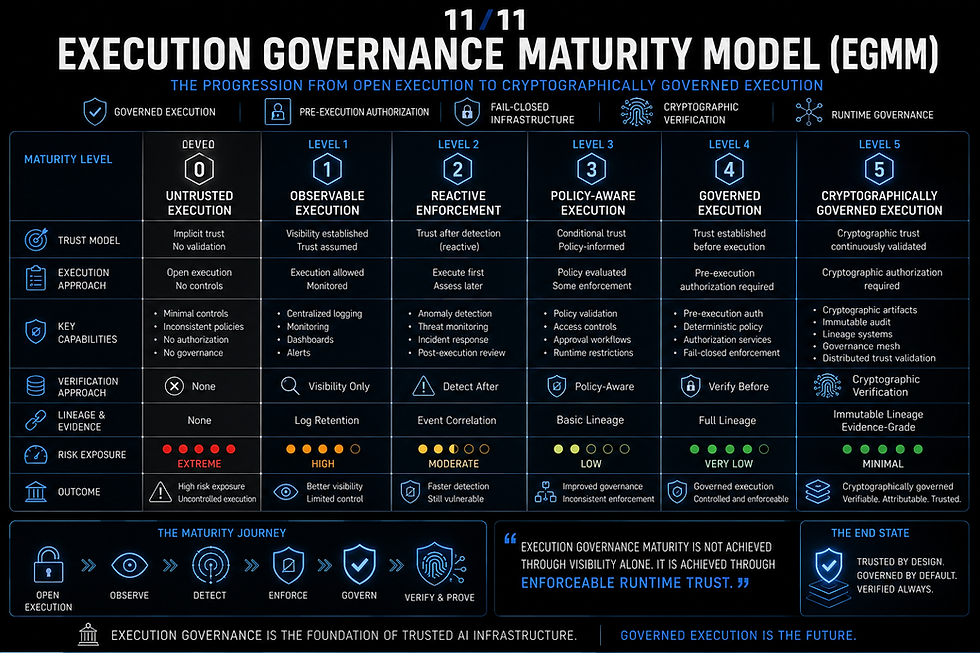
Establishing the Progression Toward Governed Infrastructure
Modern infrastructure is undergoing a fundamental trust transition.
Historically, execution environments largely operated under implicit trust assumptions.
Execution occurred automatically once requests reached runtime systems.
Verification often happened after execution through:
monitoring
logging
anomaly detection
reactive controls
audit review
incident response
That operational model becomes increasingly insufficient as AI systems, autonomous agents and distributed orchestration environments scale.
Execution governance introduces a fundamentally different infrastructure model.
Execution must first become governed.
The Execution Governance Maturity Model (EGMM) establishes a framework for measuring this progression.
Why Execution Governance Maturity Matters
Organizations increasingly deploy AI systems into environments involving:
enterprise automation
financial infrastructure
autonomous coordination
healthcare systems
machine-level orchestration
critical infrastructure operations
distributed runtime execution
As runtime autonomy increases, execution itself becomes the trust boundary.
Infrastructure maturity can no longer be measured solely through visibility or monitoring.
Infrastructure must increasingly demonstrate:
runtime governance
deterministic policy enforcement
fail-closed execution
cryptographic verification
authorization control
immutable audit capability
execution lineage traceability
EGMM establishes the progression toward these operational capabilities.
The Purpose of EGMM
The Execution Governance Maturity Model provides:
infrastructure benchmarking
governance assessment
operational maturity classification
runtime trust evaluation
execution governance standardization
enterprise governance planning
autonomous system readiness assessment
The framework establishes how infrastructure evolves from:
open execution
to:
cryptographically governed execution.
Level 0 — Untrusted Execution
At Level 0, infrastructure operates without meaningful runtime governance.
Characteristics may include:
implicit execution trust
minimal policy enforcement
limited execution visibility
reactive operational models
unrestricted runtime activity
inconsistent authorization controls
Execution largely occurs automatically once requested.
This environment creates significant operational risk for autonomous systems.
Level 1 — Observable Execution
Level 1 introduces operational visibility.
Organizations begin implementing:
centralized logging
runtime monitoring
telemetry systems
alerting frameworks
execution analytics
operational dashboards
Infrastructure becomes observable.
However, execution still largely occurs before governance validation.
Visibility improves. Trust does not.
Level 2 — Reactive Enforcement
Level 2 introduces reactive security controls.
Organizations begin deploying:
anomaly detection
behavioral monitoring
threat detection
post-execution review
runtime observation systems
incident response automation
Execution may now be analyzed after runtime activity occurs.
However, governance still primarily remains reactive.
Execution is still trusted before verification.
Level 3 — Policy-Aware Execution
At Level 3, policy enforcement becomes operationally integrated.
Infrastructure begins implementing:
runtime policy validation
execution restrictions
authorization workflows
policy-aware orchestration
conditional runtime controls
governance enforcement systems
Execution becomes partially governed.
However, governance may still remain inconsistent across distributed runtime environments.
Level 4 — Governed Execution
Level 4 establishes governed execution as infrastructure policy.
Execution now requires:
pre-execution authorization
runtime identity validation
deterministic policy enforcement
authorization services
verification systems
fail-closed enforcement
governance-aware runtime architecture
Execution no longer proceeds automatically.
Trust must first be established before runtime activity begins.
This marks the transition toward operational execution governance.
Level 5 — Cryptographically Governed Execution
Level 5 establishes cryptographically governed infrastructure.
Execution now requires:
cryptographic authorization artifacts
evidence-grade verification
immutable audit persistence
execution lineage systems
runtime trust architecture
governance mesh enforcement
cryptographic runtime attribution
distributed trust validation
Execution becomes:
verifiable
attributable
traceable
enforceable
cryptographically governed
Infrastructure no longer relies upon implicit trust assumptions.
Trust becomes continuously validated across the execution lifecycle.
The Shift From Visibility to Governance
Historically, many organizations equated visibility with security.
EGMM establishes a different principle.
Visibility alone is insufficient.
Infrastructure maturity increasingly depends upon:
enforceable governance
runtime trust validation
deterministic execution control
authorization enforcement
cryptographic verification
fail-closed runtime architecture
This fundamentally changes how infrastructure maturity is measured.
Autonomous Systems Increase the Need for EGMM
Autonomous systems dramatically increase the importance of execution governance maturity.
As AI systems begin independently coordinating:
infrastructure operations
financial execution
distributed orchestration
machine-level automation
cross-domain runtime activity
runtime trust becomes operationally critical.
Autonomous environments cannot safely operate within low-maturity execution models.
They require governed runtime infrastructure.
EGMM provides the roadmap toward that operational state.
Runtime Governance as Infrastructure
The EGMM framework reflects a broader infrastructure transition.
Historically, infrastructure normalized:
encrypted transport
identity verification
Zero Trust networking
hardware trust anchors
Execution governance now emerges as the next foundational infrastructure layer.
Execution itself must become governed.
Infrastructure Is Evolving
Execution governance maturity increasingly becomes:
an enterprise requirement
a regulatory necessity
an operational trust standard
a runtime security expectation
an autonomous systems prerequisite
Organizations operating critical AI infrastructure will increasingly require formal governance maturity assessment.
EGMM establishes that progression framework.
Conclusion
The Execution Governance Maturity Model establishes the roadmap from open execution toward cryptographically governed infrastructure.
Under this framework:
trust becomes operationally enforced
authorization becomes mandatory
governance becomes runtime-native
infrastructure fails closed
verification becomes cryptographic
execution becomes attributable
lineage becomes foundational
Execution governance maturity is no longer theoretical.
It is becoming a defining infrastructure requirement for the autonomous era.
“Execution governance maturity is not achieved through visibility alone. It is achieved through enforceable runtime trust.”

Comments