
Execution Governance Is the Missing Layer in AI Infrastructure


Modern infrastructure evolved through foundational layers.
Networking created connectivity.
Virtualization created abstraction.
Cloud infrastructure created elasticity.
Container orchestration created scalable runtime operations.
Observability created operational visibility.
AI infrastructure now introduces a new requirement:
execution governance.
The industry increasingly recognizes:execution itself has become the trust boundary.
Yet most systems still lack a dedicated governance layer responsible for:
runtime trust continuity
execution authorization
deterministic enforcement
cryptographic verification
governed runtime validation
execution lineage continuity
Execution governance becomes the missing infrastructure layer.
SECTION 1 — HOW INFRASTRUCTURE EVOLVES
Infrastructure historically evolves through:foundational control layers.
Examples include:
networking layers
operating systems
hypervisors
virtualization platforms
orchestration systems
identity systems
encryption infrastructure
observability platforms
Each layer solved a structural operational problem.
AI infrastructure introduces a new structural problem:
governing execution itself.
SECTION 2 — WHY EXISTING SECURITY MODELS ARE INSUFFICIENT
Most infrastructure security architectures were designed for:human-driven systems.
Modern AI systems increasingly operate:
autonomously
continuously
dynamically
across distributed runtime environments
through machine-generated orchestration
with expanding operational authority
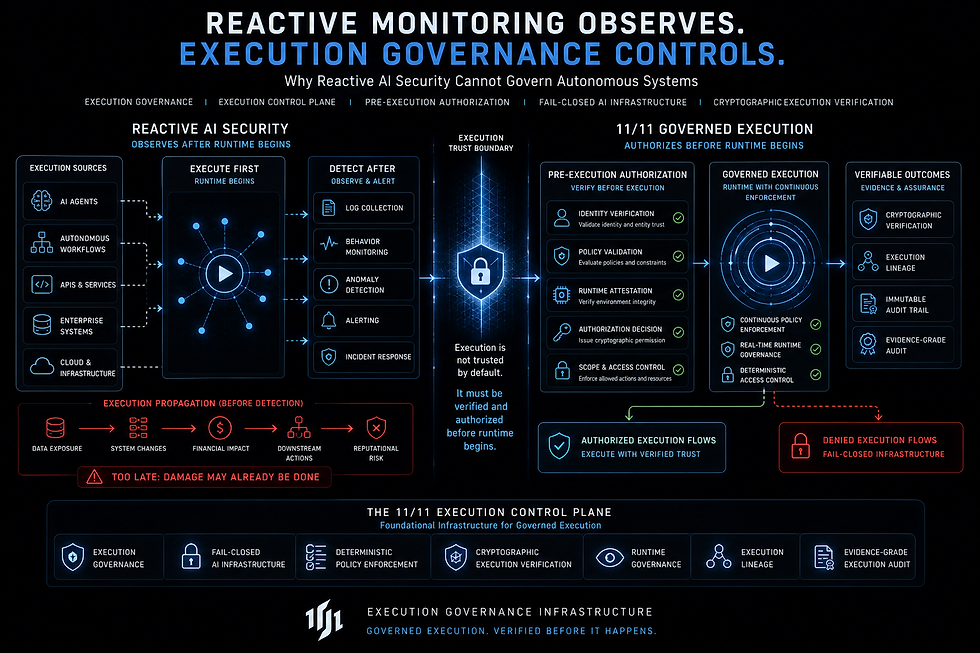
Traditional systems focus heavily on:monitoring after execution occurs.
But autonomous systems require:continuous runtime governance before and during execution itself.
This creates a governance gap across modern AI infrastructure.
SECTION 3 — WHAT THE MISSING LAYER DOES
11/11 Execution Governance Layer establishes:runtime execution governance infrastructure.
This layer continuously governs:
authorization continuity
runtime trust validation
execution scope enforcement
governance state integrity
cryptographic runtime verification
execution lineage continuity
Execution becomes:continuously governed infrastructure behavior.
Not implicitly trusted runtime activity.
SECTION 4 — FROM OBSERVABILITY TO GOVERNANCE
Observability systems explain:what happened.
Execution governance determines:what execution remains permitted.
This distinction becomes foundational.
Infrastructure can no longer rely solely on:reactive visibility.
Execution itself must become:actively governed.
11/11 Runtime Governance Layer embeds governance directly into runtime execution flow.
SECTION 5 — FAIL-CLOSED EXECUTION INFRASTRUCTURE
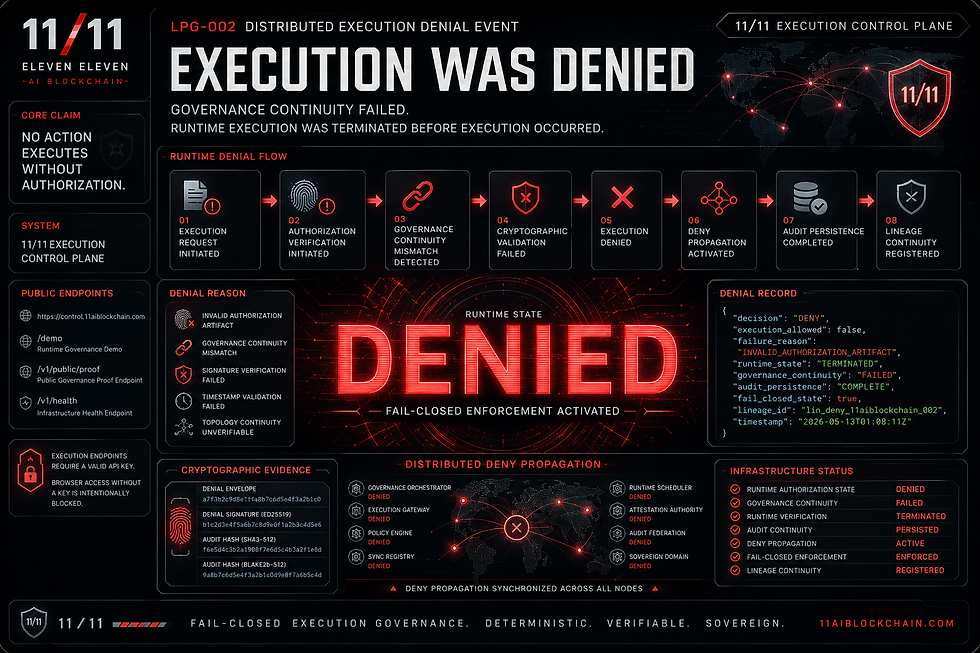
11/11 Execution Control Plane establishes:fail-closed execution continuity.
If authorization becomes invalid:execution stops.
If governance continuity breaks:execution stops.
If runtime trust degrades:execution stops.
If cryptographic verification fails:execution stops.
Execution continuity becomes dependent on governance continuity.
This creates:deterministic runtime trust enforcement.
SECTION 6 — WHY THIS LAYER BECOMES NECESSARY
AI systems increasingly operate across:
enterprise infrastructure
healthcare systems
financial operations
logistics coordination
autonomous agent ecosystems
defense environments
regulated compute systems
Organizations require:
runtime trust continuity
deterministic execution validation
governed authorization enforcement
cryptographic runtime proof
execution accountability
evidence-grade audit continuity
Without execution governance, runtime trust remains incomplete.
SECTION 7 — THE NEXT INFRASTRUCTURE PRIMITIVE
The industry already standardized layers for:
compute
networking
orchestration
virtualization
encryption
identity
AI infrastructure now requires:execution governance infrastructure.
This layer establishes:
runtime trust boundaries
deterministic governance enforcement
governed execution continuity
cryptographic verification systems
execution lineage infrastructure
fail-closed runtime validation
Execution governance becomes a foundational infrastructure primitive.
SECTION 8 — THE FUTURE OF TRUSTED AI INFRASTRUCTURE
11/11 Runtime Trust Architecture establishes:execution governance as the missing operational layer for trusted AI systems.
This introduces:
deterministic runtime trust
governed execution continuity
cryptographic runtime verification
fail-closed execution enforcement
execution lineage continuity
evidence-grade governance proof
Execution itself becomes:continuously governed infrastructure behavior.
CLOSING
AI infrastructure evolved: networking, virtualization, orchestration, and observability layers.
The next required infrastructure layer is:execution governance.
Execution itself must become:
continuously validated
runtime governed
cryptographically verified
deterministically enforced
permanently auditable
before and during runtime execution.
Execution governance is the missing layer in AI infrastructure.
11/11 is building the execution governance layer for AI infrastructure.

Comments