
Establishing Governed Execution as Foundational Infrastructure


Execution governance defines the infrastructure systems, verification models and policy enforcement mechanisms required to authorize execution before runtime operations occur.
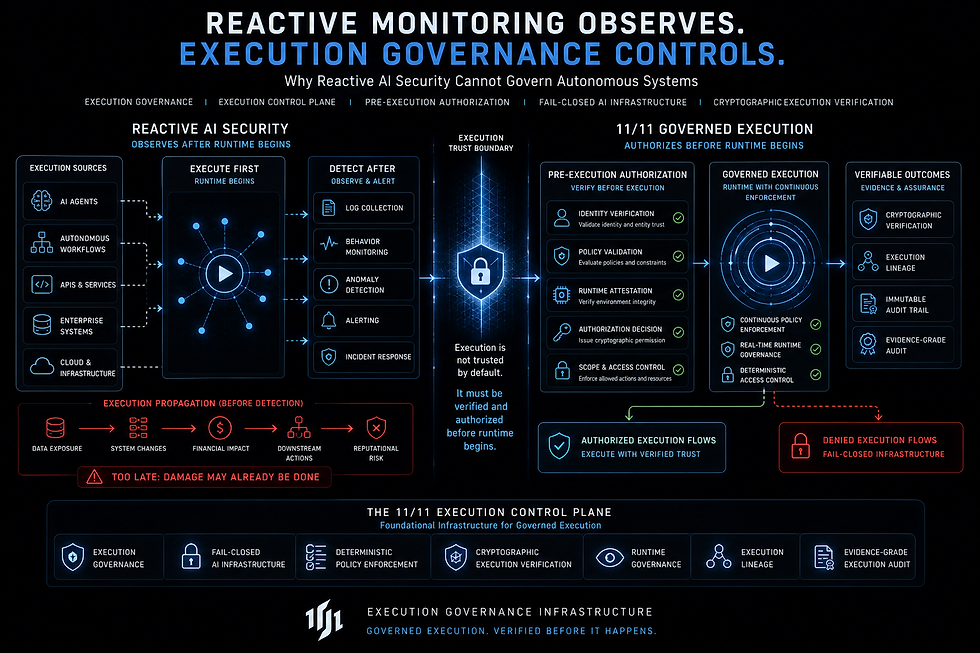
Traditional security models observe execution after runtime activity has already begun.
Execution governance changes the trust model entirely.
Execution is no longer trusted by default.
Execution must first be:
verified
authorized
policy compliant
cryptographically validated
operationally attributable
evidence-capable
before runtime activity is permitted.
This establishes:governed execution.
The Failure of Reactive Security
Modern infrastructure largely operates using reactive trust assumptions.
Systems execute first.
Validation occurs later.
Audit occurs after compromise risk already exists.
This creates structural weaknesses across:
enterprise AI
autonomous systems
financial infrastructure
regulated healthcare systems
multi-agent orchestration
distributed runtime environments
critical infrastructure operations
Reactive detection cannot sufficiently secure systems that already executed untrusted operations.
Execution governance addresses this failure directly.
Governed Execution
Governed execution is a runtime model requiring mandatory authorization before execution is permitted.
Under governed execution:
every action requires verification
every execution request is policy evaluated
every authorization is cryptographically attributable
every runtime operation is evidence-capable
every execution path is lineage traceable
every denial event is operationally auditable
Execution therefore becomes:
verifiable
attributable
deterministic
enforceable
fail-closed
cryptographically governed
Core Execution Governance Principles
1. Pre-Execution Authorization
Execution authorization must occur before runtime activity begins.
No system should execute solely because execution was requested.
Execution must first be verified against:
policy authority
execution permissions
runtime trust state
cryptographic authorization validity
environmental integrity
operational governance requirements
2. Fail-Closed Infrastructure
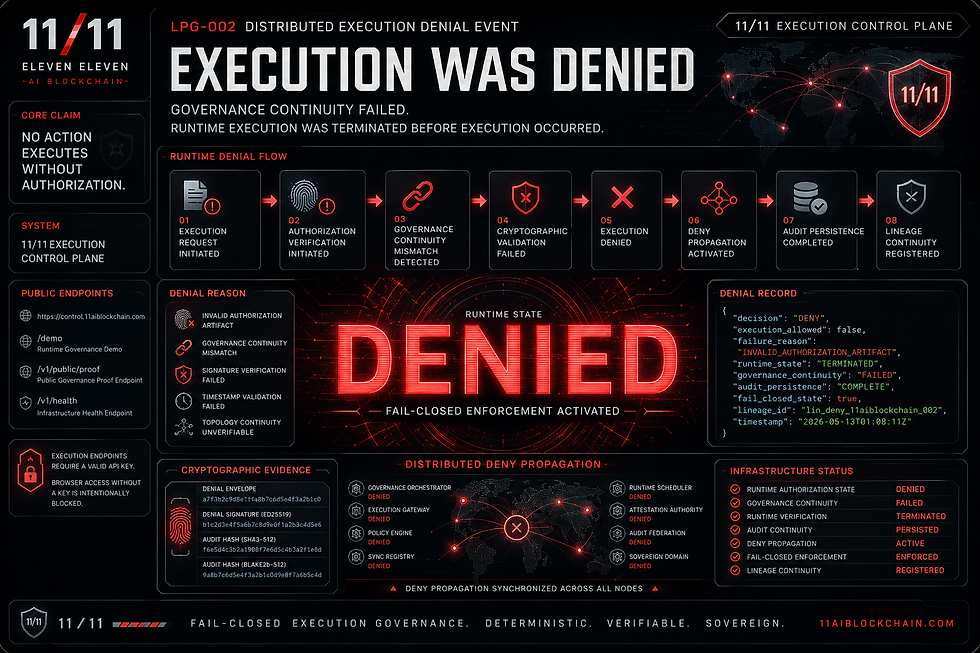
Infrastructure must deny execution when authorization requirements fail.
Execution denial conditions include:
missing authorization artifact
expired authorization
invalid signature verification
policy mismatch
replay detection
runtime integrity failure
environment mismatch
revoked authorization state
Failure to verify must result in denial.
Not warning.Not retry.Not deferred audit.
Denial.
3. Cryptographic Execution Verification
Execution authorization must be cryptographically verifiable.
Authorization systems should support:
signed authorization artifacts
execution-bound verification
environmental binding
policy hash validation
temporal validity windows
immutable verification evidence
cryptographic audit persistence
This establishes evidence-grade verification.
4. Deterministic Policy Enforcement
Execution policy must be enforced deterministically.
Execution decisions must not depend upon:
advisory interpretation
probabilistic runtime assumptions
post-execution correction
non-authoritative monitoring
Execution policy must remain authoritative.
5. Immutable Execution Audit
Execution governance requires immutable operational evidence.
All authorization and denial events should produce:
audit records
lineage relationships
verification states
cryptographic evidence chains
runtime attribution records
Execution governance therefore creates evidence-capable infrastructure.
Authorization Artifacts
Execution governance introduces authorization artifacts as runtime trust objects.
Authorization artifacts represent:
approved execution scope
authorized initiator identity
runtime environment binding
policy validation state
temporal authorization validity
cryptographic authorization proof
Execution should not occur without valid authorization artifacts.
Authorization artifacts become:runtime trust anchors.
Execution Lineage
Execution lineage establishes traceable ancestry for runtime operations.
Lineage systems track:
execution origin
authorization source
policy authority
runtime dependency relationships
verification states
execution inheritance chains
Execution lineage enables:
attribution
forensic validation
governance verification
operational traceability
regulatory evidence production
Runtime Governance
Runtime governance establishes active execution enforcement during operational execution lifecycles.
Runtime governance systems may include:
execution gateways
policy authorities
verification services
authorization systems
governance meshes
audit persistence systems
execution lineage engines
Together these components form:the execution control plane.
Execution Governance Maturity
Execution governance adoption may evolve through maturity stages.
Level 0 — Untrusted Execution
Execution occurs without governance.
Level 1 — Observable Execution
Systems log execution activity.
Level 2 — Reactive Enforcement
Detection occurs after runtime execution.
Level 3 — Policy-Aware Execution
Execution includes policy checks.
Level 4 — Governed Execution
Execution requires pre-execution authorization.
Level 5 — Cryptographically Governed Execution
Execution requires cryptographically verifiable authorization with immutable lineage and evidence-grade verification.
The Infrastructure Shift
Execution governance represents a foundational infrastructure transition.
Historically:
network trust became mandatory.
Identity trust became mandatory.
Transport encryption became mandatory.
Runtime governance now emerges as the next mandatory infrastructure layer.
As AI systems, autonomous agents and distributed execution environments expand, execution itself becomes the trust boundary.
This changes infrastructure assumptions permanently.
Execution can no longer be trusted implicitly.
Execution must become governed.
Conclusion
Execution governance establishes a new operational trust model for modern infrastructure.
Under this model:
execution is verified before runtime
authorization becomes mandatory
infrastructure fails closed
runtime activity becomes attributable
cryptographic verification becomes foundational
evidence-grade audit becomes operationally necessary
Governed execution therefore becomes:the next infrastructure trust layer.
Execution governance is no longer theoretical.
It is becoming operational infrastructure.

Comments