
Execution Governance Will Become a Regulatory Requirement for Autonomous AI

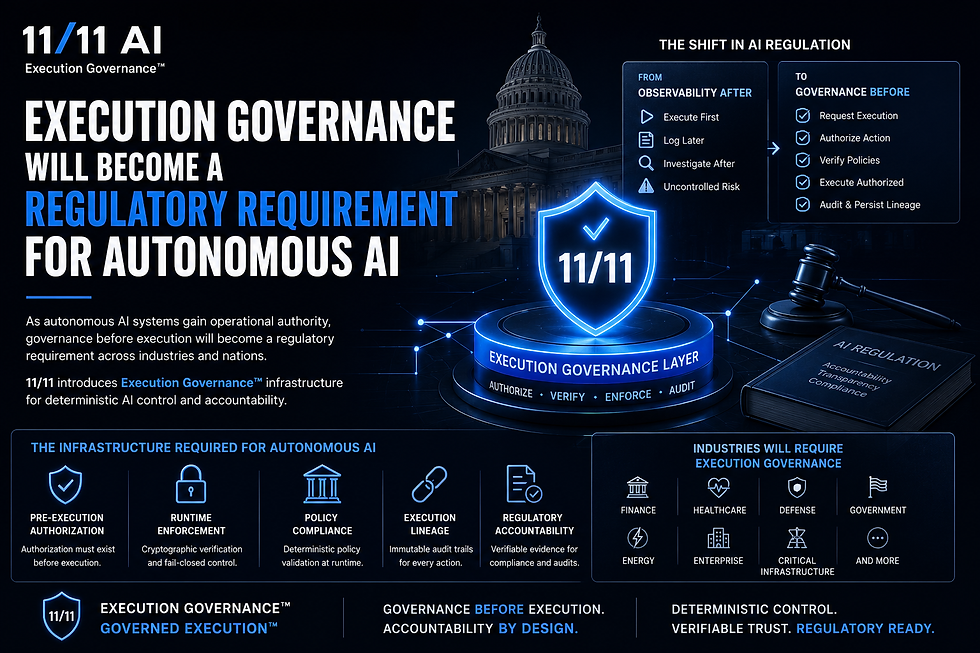
Artificial intelligence is entering a new operational phase.
AI systems are no longer limited to generating information, recommendations, or conversational outputs.
Modern AI infrastructure is rapidly evolving toward autonomous execution systems capable of:
orchestrating infrastructure
initiating transactions
modifying operational environments
coordinating software systems
interacting with sensitive enterprise resources
executing actions without continuous human approval
As autonomous operational authority increases, governance requirements fundamentally change.
The global conversation surrounding artificial intelligence regulation has largely focused on:
model bias
content moderation
training data
safety evaluations
transparency reporting
These issues remain important.
However, they do not address the core infrastructure problem emerging inside autonomous execution systems.
The most important governance question is no longer:“What information did the AI generate?”
The question becomes:“What actions was the AI permitted to execute?”
This transition introduces a new infrastructure requirement:governance before execution.
11/11 introduces Execution Governance™ infrastructure designed to enforce deterministic authorization before autonomous runtime activity occurs.
Autonomous AI Changes the Regulatory Landscape
Traditional software systems generally operate under explicit human control.
Autonomous AI systems increasingly operate under delegated authority.
This distinction is critical.
As organizations deploy AI systems capable of:
triggering workflows
accessing enterprise systems
initiating infrastructure actions
managing financial operations
coordinating operational environments
…the risk profile changes dramatically.
Regulatory frameworks will inevitably evolve toward requiring:
execution accountability
runtime authorization
operational verification
audit persistence
deterministic governance enforcement
Autonomous execution cannot remain ungoverned infrastructure.
Observability Alone Is Not Governance
Many current AI governance approaches focus primarily on:
monitoring
telemetry
post-event analysis
logging
behavioral observation
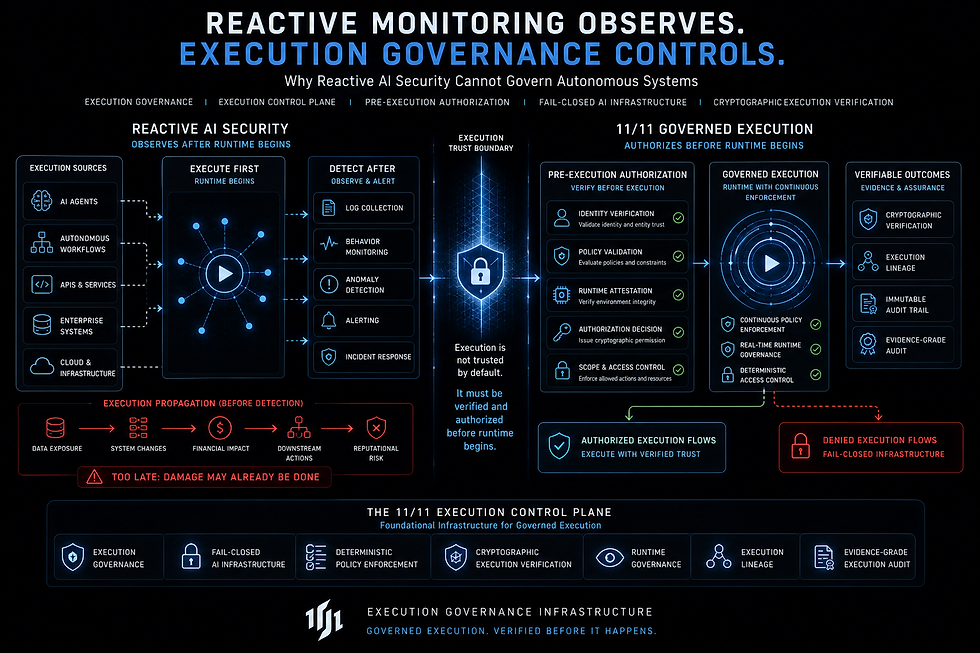
These systems operate after execution has already occurred.
This creates an “execute first, investigate later” model.
For autonomous systems operating inside:
healthcare
finance
defense
energy
government
critical infrastructure
…that architecture becomes increasingly insufficient.
Monitoring unauthorized execution after the fact does not prevent operational damage.
Governance infrastructure must exist before runtime execution occurs.
Governance Before Execution
Execution Governance™ introduces a fundamentally different infrastructure model.
Instead of:execute → observe → investigate
The architecture becomes:request → authorize → verify → execute → audit → persist lineage
Under this model:
authorization becomes mandatory before execution
runtime systems verify authorization artifacts
policy enforcement becomes deterministic
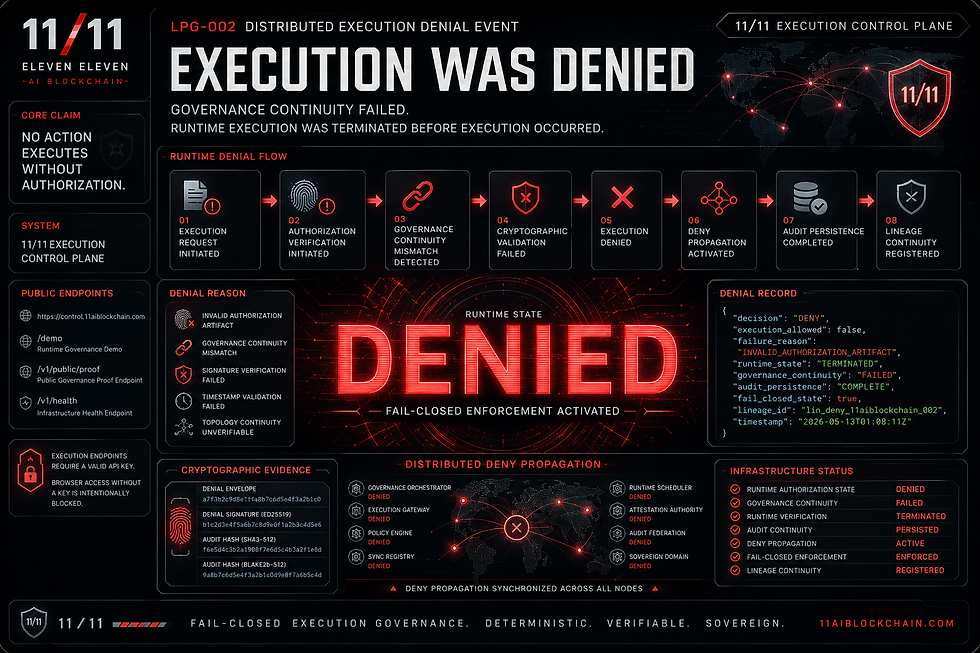
unauthorized execution fails closed
execution lineage becomes persistent and verifiable
This creates operational accountability for autonomous systems.
Execution Governance as Infrastructure
As autonomous AI systems continue scaling across enterprise and government environments, governance will increasingly become foundational infrastructure rather than optional oversight tooling.
This infrastructure layer introduces:
deterministic execution control
cryptographic authorization
runtime enforcement
immutable audit persistence
execution lineage verification
fail-closed operational boundaries
These capabilities become essential as organizations attempt to safely operationalize autonomous systems.
The Future of Autonomous AI Compliance
Future AI governance frameworks will likely require organizations to demonstrate:
who authorized execution
what policies governed execution
what systems verified authorization
what runtime conditions existed
what actions were executed
what lineage was produced
This creates a new compliance architecture category centered around governed execution rather than post-event observation.
Execution Governance infrastructure enables organizations to establish verifiable operational trust boundaries for autonomous systems.
The Next Infrastructure Layer
The next generation of AI infrastructure will not be defined solely by model capability.
It will increasingly be defined by:
whether execution was authorized
whether runtime behavior was governed
whether actions were verifiable
whether autonomous systems operated within deterministic boundaries
As autonomous AI systems continue expanding into operational environments, governance before execution becomes mandatory infrastructure.
Public Infrastructure Endpoints
Public Runtime Infrastructure
Public Governance Console
Runtime Governance Demo
Public Governance Proof Viewer
Infrastructure Health Dashboard
Execution Lineage Explorer
Execution endpoints intentionally require valid API authorization.
11/11 introduces Execution Governance™ infrastructure for the autonomous AI era.
Execution Governance™Governed Execution™Patent Pending

Comments