
Why Execution Lineage Becomes Mandatory In Autonomous Infrastructure


Autonomous infrastructure creates a new operational requirement: infrastructure must be able to prove why execution occurred.
In traditional systems, operational history was often treated as logging.
Events were stored.
Actions were timestamped.
Records were archived.
But autonomous systems fundamentally change the importance of execution history.
When infrastructure operates at machine speed, the question is no longer simply whether an action happened.
The question becomes:
Was the action authorized, governed, validated, and policy-compliant before execution occurred?
That answer requires execution lineage.
Execution lineage is the immutable operational chain proving how execution decisions were made.
It establishes a verifiable record of:
who initiated the action
what was requested
what policies were evaluated
what runtime conditions existed
what authorization proof was validated
what decision was reached
what execution path occurred
what lineage evidence was recorded
Without lineage, autonomous infrastructure operates on assumption.
With lineage, infrastructure operates on provable operational trust.
This distinction becomes critical as governments, enterprises, financial systems, healthcare systems, defense systems, and public infrastructure increasingly depend on autonomous execution.
Machine-speed systems require machine-speed accountability.
That accountability cannot depend entirely on human memory, scattered logs, fragmented observability tooling, or after-the-fact interpretation.
Infrastructure itself must preserve execution truth.
Execution lineage therefore becomes operational infrastructure, not merely audit infrastructure.
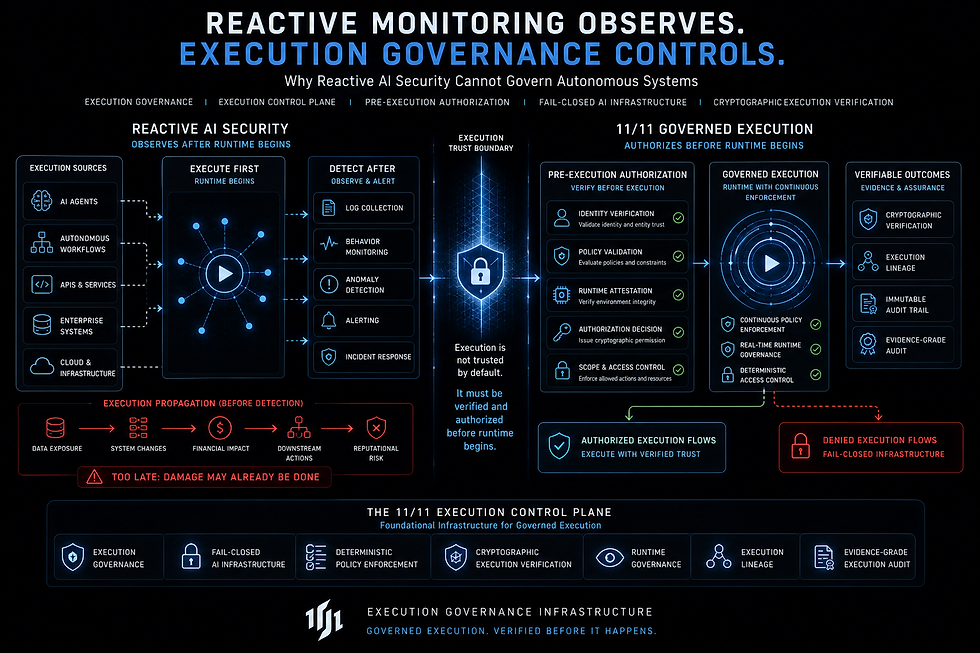
It provides deterministic evidence that governance existed before execution occurred.
It allows systems to prove that authorization was valid.
It proves that policy was enforced.
It proves that runtime context matched operational requirements.
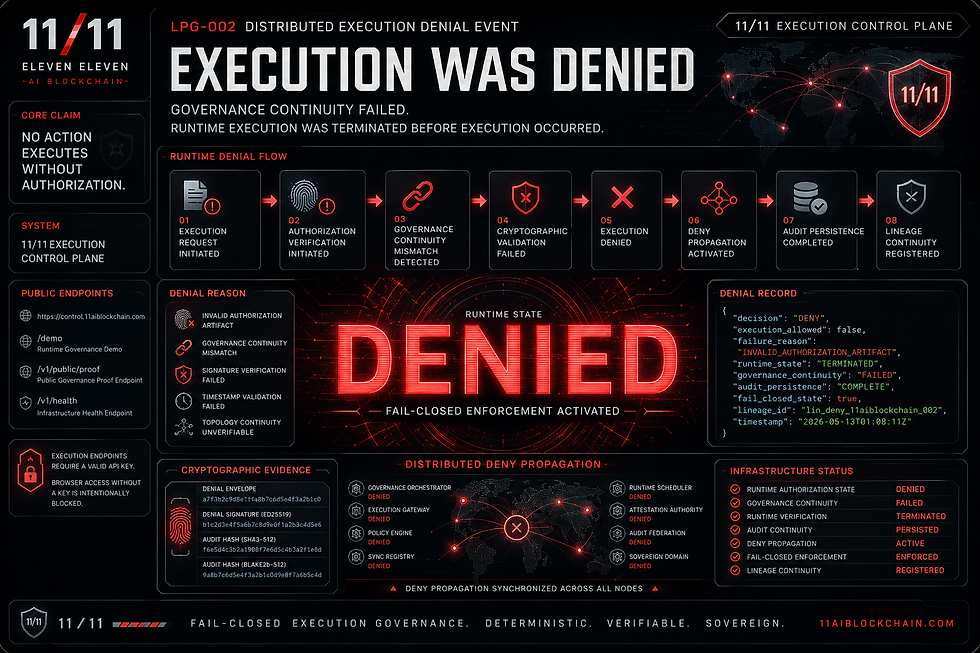
It proves whether execution was admitted or denied.
This creates enforceable operational trust boundaries for autonomous environments.
Without lineage, organizations cannot reliably distinguish between:
authorized execution
unauthorized execution
policy drift
runtime manipulation
operational inconsistency
governance failure
unverified automation
As autonomous systems scale, that uncertainty becomes unacceptable.
This is why immutable execution lineage becomes foundational to governed autonomous infrastructure.
Execution Governance™ introduces lineage as a runtime governance primitive.
Not simply a reporting layer.
Not merely a compliance archive.
But an active operational proof system tied directly to execution authorization itself.
A governed execution architecture where lineage is generated as part of the operational decision boundary.
A deterministic infrastructure layer where proof exists before trust is assumed.
A fail-closed governance model where execution cannot silently bypass operational accountability.
This matters because future infrastructure will increasingly depend on autonomous coordination between systems operating faster than humans can manually supervise.
The infrastructure that succeeds will not be the infrastructure that executes the fastest.
It will be the infrastructure that can prove execution was governed correctly.
That proof requires lineage.
That lineage requires governed execution.
That is why execution lineage is becoming mandatory infrastructure for autonomous systems.
Public Infrastructure Endpoints
Public Runtime Infrastructure
Public Governance Console
Runtime Governance Demo
Public Governance Proof Viewer
Infrastructure Health Dashboard
Execution Lineage Explorer
Execution endpoints intentionally require valid API authorization.
Browser access without a valid authorization key is fail-closed by design.
11/11 introduces Execution Governance™ infrastructure for governed autonomous execution and deterministic operational trust.
Execution Governance™
Governed Execution™
Patent Pending

Comments