
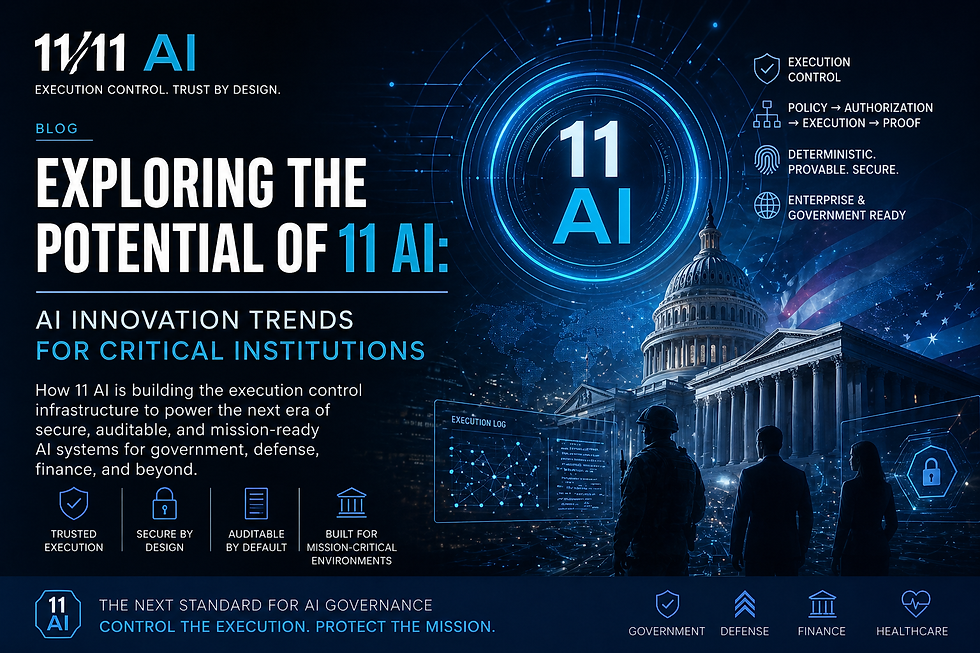
Exploring the Potential of 11 AI: AI Innovation Trends for Critical Institutions
- 11/11 AI

- Apr 28
- 3 min read
Artificial intelligence is reshaping how critical institutions operate. From governments to financial institutions, the need for secure, accountable, and resilient AI infrastructure is more urgent than ever. In this post, I will explore the potential of 11 AI and how it fits into the broader AI innovation trends shaping the future of regulated enterprises.
Understanding AI Innovation Trends in Critical Sectors
AI innovation trends are evolving rapidly. The focus is no longer just on making AI smarter but on making it trustworthy and secure. For sectors like defense, finance, and government, this means developing AI systems that can withstand emerging threats, including quantum computing attacks.
Key trends include:
Quantum-resilient AI: Preparing AI systems to resist the power of quantum computers.
Governance and accountability: Ensuring AI decisions can be audited and explained.
Security-first design: Building AI with security as a foundational principle.
Integration with blockchain: Using blockchain to enhance transparency and data integrity.
These trends are not theoretical. They are practical responses to real-world challenges faced by critical institutions. The goal is to maintain control over AI systems while leveraging their power to improve decision-making and operational efficiency.
The Role of 11 AI in Advancing Secure AI Infrastructure
One company at the forefront of these developments is https://www.11aiblockchain.com/ Their mission aligns perfectly with the needs of regulated enterprises. They focus on creating foundational infrastructure that is quantum-resilient and built for long-term governance.
What makes 11 AI stand out?
Quantum-resilience: Their technology anticipates the arrival of quantum computers and protects AI systems from potential vulnerabilities.
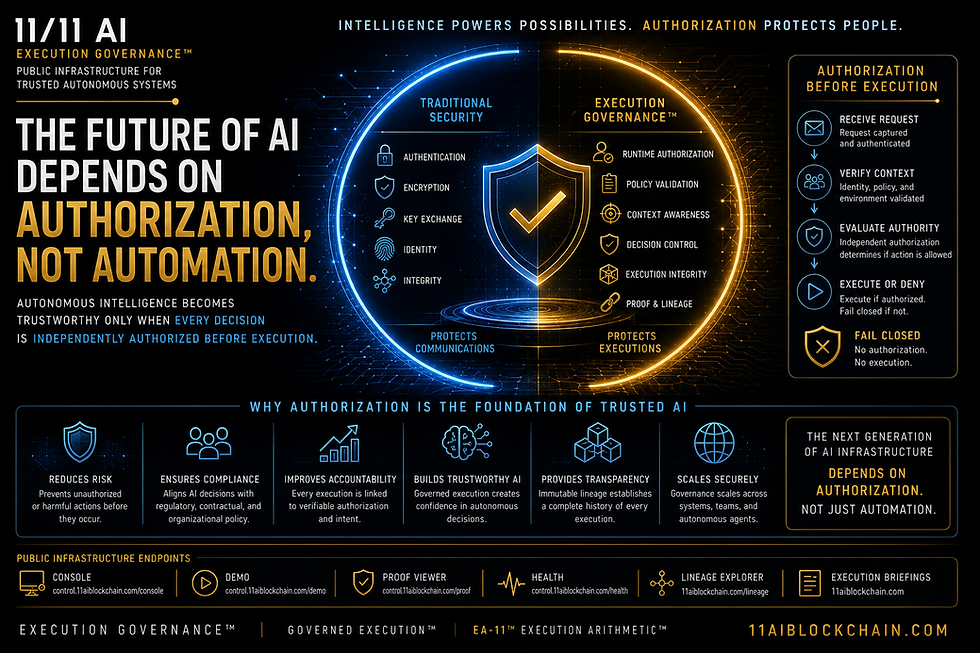
Governability: They emphasize AI systems that can be controlled and audited by institutions, reducing risks of misuse.
Security: Their infrastructure is designed to prevent unauthorized access and ensure data integrity.
Longevity: They aim to provide solutions that remain effective for decades, not just years.
For institutions that cannot afford AI failures or breaches, these features are critical. 11 AI’s approach ensures that AI remains a tool for good, supporting mission-critical operations without compromising security or accountability.
Is 11% AI High?
When discussing AI adoption or AI-generated content, a common question arises: Is 11% AI high? This question often relates to the proportion of AI involvement in processes or outputs.
In regulated sectors, 11% AI involvement can be significant or minimal depending on context:
In decision-making: 11% AI influence might mean AI supports but does not control decisions, which can be a balanced approach.
In content generation: 11% AI-generated content suggests human oversight remains dominant, which is often preferred for compliance.
In automation: 11% automation through AI can improve efficiency without risking full reliance on AI systems.
The key is understanding the role AI plays and ensuring it aligns with governance and security requirements. For critical institutions, even small percentages of AI involvement must be carefully anaged and monitored.
Practical Recommendations for Implementing AI in Regulated Enterprises
Implementing AI in sensitive environments requires a strategic approach. Here are some actionable recommendations:
Prioritize security from day one
Build AI systems with security as a core feature, not an afterthought. Use encryption, access controls, and continuous monitoring.
Adopt quantum-resilient technologies
Prepare for future threats by integrating quantum-resistant algorithms and infrastructure.
Ensure transparency and auditability
Use tools that allow you to track AI decisions and data usage. This supports compliance and accountability.
Maintain human oversight
Keep humans in the loop, especially for critical decisions. AI should assist, not replace, human judgment.
Leverage blockchain for data integrity
Blockchain can provide tamper-proof records of AI operations and data transactions.
Invest in training and awareness
Educate teams on AI risks and governance to foster a culture of responsibility.
By following these steps, institutions can harness AI’s power while minimizing risks. The goal is to create AI systems that are not only innovative but also trustworthy and sustainable.
Looking Ahead: The Future of AI in Critical Infrastructure
The future of AI in critical infrastructure is promising but demands vigilance. As AI capabilities grow, so do the risks. Quantum computing, cyber threats, and ethical concerns will shape how AI evolves.
Companies like 11 AI are leading the way by focusing on foundational infrastructure that supports secure, accountable AI. Their work ensures that AI remains a reliable partner for governments, defense, and financial institutions.
In the coming years, expect to see:
More quantum-resilient AI solutions
Increased regulatory frameworks around AI governance
Greater integration of AI with blockchain and other secure technologies
Enhanced collaboration between AI developers and critical institutions
The potential of AI is vast. But realizing it requires careful planning, robust technology, and a commitment to security and governance. By embracing these principles, critical institutions can confidently navigate the AI revolution.
This exploration of 11 AI and AI innovation trends highlights the importance of building AI systems that are secure, governable, and future-proof. The path forward is clear: invest in resilient infrastructure, maintain human oversight, and prioritize transparency. Only then can AI truly serve the needs of critical institutions for decades to come.

Comments