
Why AI Requires a Fail-Closed Execution Control Plane

Updated: May 13
Why AI Requires a Fail-Closed Execution Control Plane

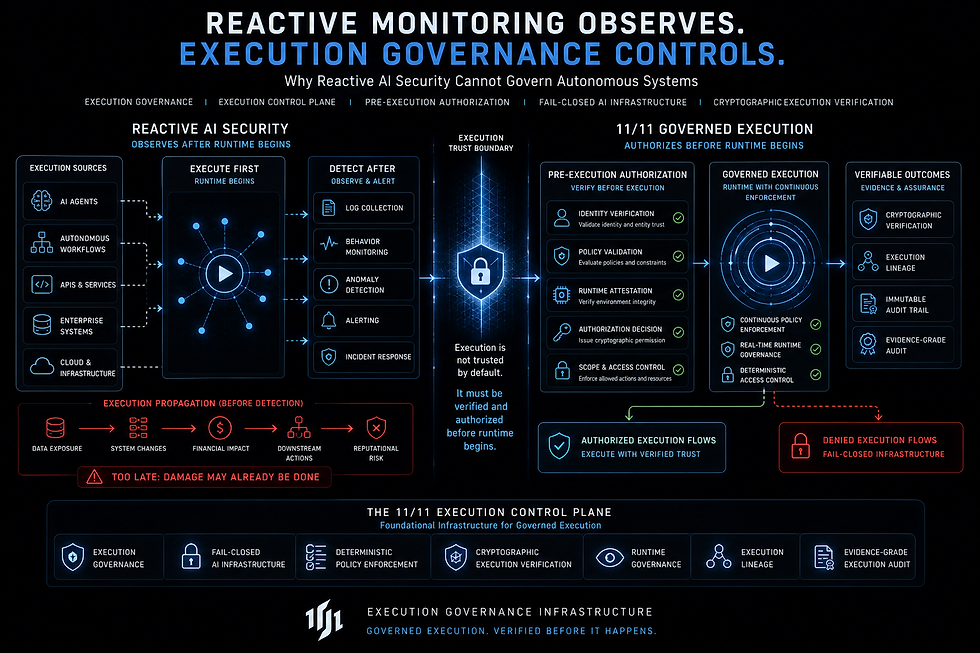
The current architecture of most AI systems assumes execution is permissible by default. Models execute. Agents act. Workflows trigger. Data moves. External systems are called.
Verification typically occurs afterward.
Monitoring systems inspect logs after execution. Security systems attempt detection after runtime activity has already occurred. Audit systems reconstruct events after actions complete.
This model does not scale into high-risk infrastructure environments.
As AI systems gain authority over financial systems, healthcare systems, operational infrastructure, defense workflows, and autonomous decision environments, post-execution inspection becomes structurally insufficient.
The infrastructure layer itself must evolve.
Execution can no longer be trusted implicitly.
Execution must first be governed.
This is the emerging category of execution governance.
And it introduces a new architectural requirement:
Fail-closed AI infrastructure.
The Problem With Execute-Then-Inspect Architectures
Modern AI stacks were largely built around acceleration and orchestration.
Not execution trust.
Inference systems optimize throughput. Agent frameworks optimize autonomy. Runtime stacks optimize scale. Multi-agent systems optimize coordination.
But very few systems answer the foundational infrastructure question:
Who authorized execution in the first place?
Today, most infrastructure assumes execution is allowed unless explicitly interrupted.
That creates an open execution model.
In an open execution model:
execution begins before verification
authorization is often implicit
runtime policy enforcement is inconsistent
audit trails are reconstructed after the fact
trust depends on monitoring rather than enforcement
This creates systemic risk.
Because once execution begins, the environment has already changed.
Transactions may already be committed.
Data may already be exposed.
External systems may already be called.
Autonomous chains may already propagate.
At scale, retrospective analysis is not governance.
It is incident reconstruction.
The Shift Toward Governed Execution
Governed execution changes the execution model entirely.
Instead of assuming execution is allowed, governed execution assumes execution is denied until authorization conditions are satisfied.
This is the foundation of a fail-closed execution architecture.
Under a governed execution model:
execution requests are intercepted before runtime
policies are evaluated before authorization
identity and trust assertions are verified
cryptographic execution permissions are issued
runtime actions are continuously enforced
immutable execution evidence is produced afterward
This changes AI infrastructure from reactive monitoring into deterministic enforcement.
The distinction is critical.
Monitoring observes.
Governance controls.
What “Fail-Closed” Actually Means
Fail-closed infrastructure is frequently misunderstood.
Fail-closed does not mean “secure by default” in a generic sense.
It means execution becomes categorically impossible when authorization conditions cannot be verified.
Under a fail-closed execution control plane:
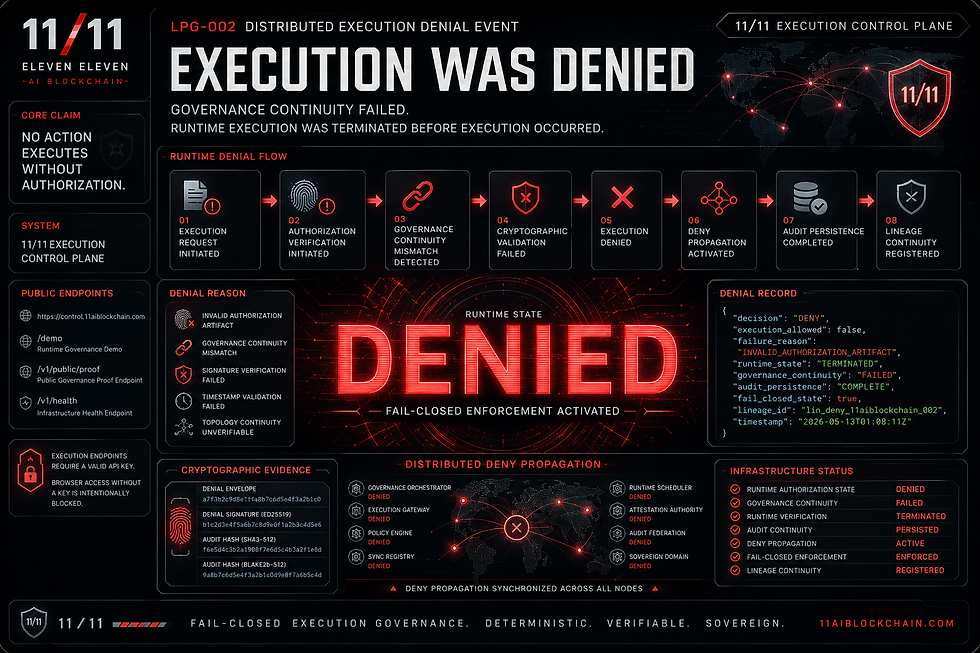
missing policy validation results in denial
invalid cryptographic assertions result in denial
expired execution permissions result in denial
unverifiable identities result in denial
broken attestation chains result in denial
unavailable governance systems result in denial
Execution does not continue under uncertainty.
It halts.
This is how high-trust infrastructure operates in aviation systems, nuclear systems, military systems, and critical industrial control environments.
AI infrastructure is now approaching the same requirement boundary.
The Rise of the Execution Control Plane
As AI systems become operational infrastructure, a new architectural layer is emerging:
The execution control plane.
The execution control plane sits beneath models, agents, APIs, and orchestration systems.
Its role is not intelligence generation.
Its role is execution governance.
An execution control plane governs:
whether execution is allowed
under what policies execution is allowed
what identities are authorized
what runtime conditions are required
what external systems may be accessed
what evidence must be produced
whether execution remains compliant during runtime
This creates a deterministic trust boundary around execution itself.
Not merely around users.
Not merely around networks.
Not merely around data.
Around execution.
That distinction defines the category.
Why Cryptographic Execution Verification Matters
Traditional audit systems depend heavily on trust assumptions.
Logs can be altered.
Events can be omitted.
Monitoring systems can fail silently.
Governed execution introduces cryptographic execution verification.
Under this model:
execution authorization artifacts are cryptographically signed
execution lineage becomes tamper-evident
runtime attestations become independently verifiable
policy decisions become provable
execution chains become immutable evidence structures
This transforms infrastructure trust from observational trust into mathematical trust.
The implications are significant.
In regulated environments, organizations increasingly require evidence-grade execution assurance.
Not screenshots.
Not dashboards.
Not reconstructed logs.
Provable execution governance.
This is particularly relevant for:
healthcare infrastructure
financial systems
AI-assisted defense environments
autonomous operational systems
regulated enterprise AI
critical infrastructure automation
Execution governance becomes the operational trust layer beneath AI deployment.
Why This Category Will Expand Rapidly
The current AI industry is heavily focused on capability expansion.
But infrastructure markets historically mature around control layers.
The internet matured around network governance layers.
Cloud matured around orchestration and isolation layers.
Enterprise computing matured around identity and access governance layers.
AI infrastructure is now entering the execution governance phase.
The next generation of enterprise AI deployment will increasingly require:
governed execution
deterministic runtime enforcement
fail-closed execution infrastructure
cryptographic execution verification
execution lineage systems
runtime authorization architectures
infrastructure-grade audit systems
These are not optional enterprise enhancements.
They become necessary once AI systems operate inside consequential environments.
The market transition has already started.
The terminology simply has not stabilized yet.
11/11 is defining that category boundary now.
The Infrastructure Layer Beneath AI
11/11 is not positioned as a generic AI company.
11/11 is building execution governance infrastructure.
The objective is not to compete at the model layer.
The objective is to govern execution itself.
11/11 introduces a governed execution architecture built around:
execution control planes
pre-execution authorization
fail-closed infrastructure enforcement
cryptographic execution verification
deterministic policy enforcement
immutable execution evidence
This creates an infrastructure trust layer beneath AI systems.
A runtime governance architecture.
A foundational execution authorization system.
A future operational standard for governed AI execution.
As AI systems continue expanding into regulated and mission-critical environments, execution governance increasingly becomes unavoidable infrastructure.
The systems that verify execution before runtime will ultimately matter more than the systems that merely observe execution afterward.
Because in high-trust environments, execution itself must become governable.
And governable execution requires infrastructure designed to fail closed.
Execution Governance™, Governed Execution™, and related execution control plane terminology are used by 11/11 to describe emerging infrastructure models centered on pre-execution authorization, deterministic policy enforcement, and cryptographic runtime verification for AI systems and autonomous infrastructure.
Patent Pending. Certain systems, architectures, infrastructure models, execution governance methods, and runtime authorization mechanisms described herein are subject to ongoing U.S. and international patent filings and related intellectual property protections by 11/11.
Public Governance Console
Runtime Governance Demo
Public Governance Proof Viewer
Infrastructure Health Dashboard
Execution Lineage Explorer

Comments