
Why Fail-Closed AI Infrastructure Changes Runtime Security Entirely
- 11/11 AI

- May 9
- 3 min read

Most modern AI infrastructure still operates on fail-open assumptions.
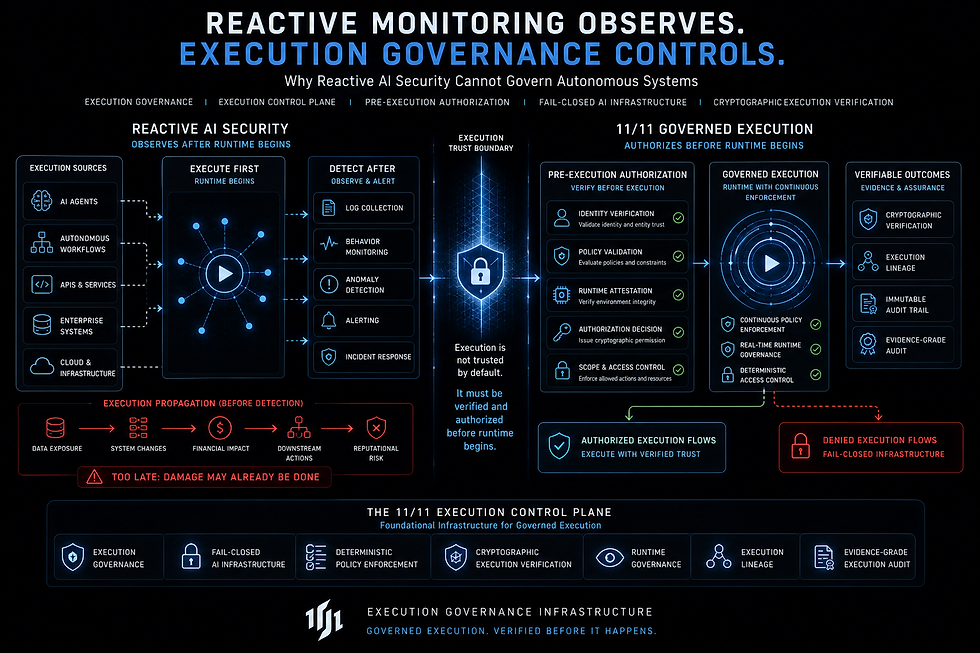
Execution begins first.
Monitoring occurs afterward.
Detection systems attempt to identify runtime violations after execution already propagates.
This architecture evolved during earlier generations of enterprise software where:
execution paths remained constrained
runtime propagation moved relatively slowly
infrastructure trust assumptions remained stable
human intervention remained operationally central
Autonomous systems fundamentally change these assumptions.
Execution now propagates dynamically across:
orchestration layers
distributed runtime environments
APIs
infrastructure services
autonomous workflows
external systems
machine-driven operational infrastructure
Under these conditions, runtime trust can no longer depend on reactive visibility alone.
This creates the operational need for fail-closed AI infrastructure.
What Fail-Closed Actually Means
Fail-closed infrastructure means runtime execution stops automatically when trust conditions fail.
Execution is not trusted implicitly.
Execution must continuously remain:
authorized
policy-compliant
cryptographically verifiable
operationally trusted
runtime validated
throughout execution itself.
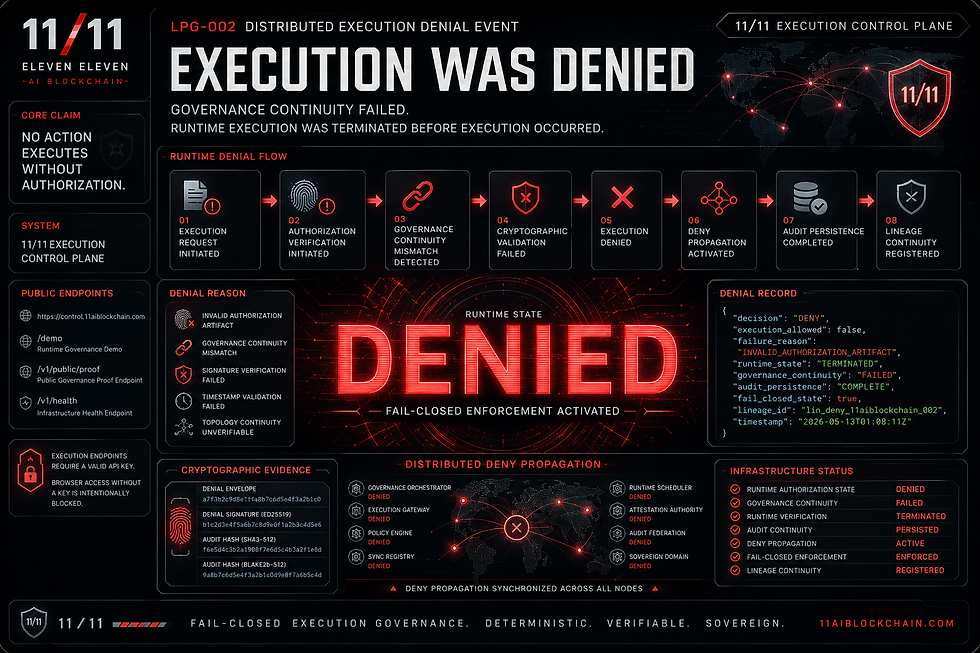
If trust conditions fail:
execution stops
authorization becomes invalid
downstream propagation halts
fail-closed enforcement activates automatically
This creates governed execution infrastructure rather than reactive runtime infrastructure.
Why Traditional Runtime Security Fails
Traditional runtime security architectures remain largely observational.
They observe execution after runtime activity already begins.
This creates unavoidable operational delay.
By the time runtime monitoring systems respond:
downstream systems may already execute
infrastructure states may already change
operational impact may already propagate
runtime integrity may already degrade
execution lineage continuity may already fragment
Reactive monitoring explains what happened.
Fail-closed infrastructure determines whether execution should continue at all.
That distinction fundamentally changes runtime governance architecture.
Why Autonomous Infrastructure Requires Fail-Closed Enforcement
Autonomous systems increasingly operate at machine speed across operational infrastructure.
Execution paths evolve dynamically.
Dependencies change continuously.
Machine-generated workflows propagate independently.
Under these conditions, infrastructure trust can no longer depend solely on detection and remediation afterward.
Execution itself increasingly becomes the operational trust boundary.
This changes the infrastructure requirement fundamentally.
Execution must become:
continuously governed
policy-enforced
cryptographically verified
runtime validated
fail-closed by design
before runtime propagation occurs.
The 11/11 Fail-Closed Model
The 11/11 execution control plane was designed around fail-closed operational behavior.
Meaning:
If trust fails, execution stops.
Examples include:
invalid authorization
runtime integrity drift
policy violation
invalid execution context
cryptographic verification failure
broken execution lineage
unauthorized downstream propagation
Under these conditions:
authorization artifacts become invalid
runtime execution halts
fail-closed enforcement activates
execution lineage stops
immutable audit records capture denial state
Execution therefore remains continuously governed throughout runtime activity itself.
The Runtime Trust Boundary
One of the defining architectural principles behind fail-closed AI infrastructure is the runtime trust boundary.
Traditional systems frequently trust runtime execution implicitly after authorization occurs.
The 11/11 architecture was designed differently.
Runtime trust must remain continuously proven.
This means:
authorization continuity must remain valid
policy enforcement must remain active
runtime integrity must remain verified
execution lineage must remain continuous
cryptographic execution verification must remain intact
If runtime trust degrades, execution stops automatically.
This creates continuously governed runtime infrastructure.
The Role of Pre-Execution Authorization
Fail-closed infrastructure begins before runtime execution itself.
Execution requests must first pass through:
policy evaluation
identity validation
runtime condition verification
deterministic policy enforcement
authorization artifact issuance
cryptographic verification
Only then can runtime execution begin.
This creates:
governed execution
deterministic runtime trust
execution governance
fail-closed enforcement
evidence-grade execution verification
Execution does not become trusted automatically once execution begins.
Trust must remain continuously maintained.
Why Immutable Audit and Execution Lineage Matter
Fail-closed infrastructure also depends on immutable runtime accountability.
The execution control plane continuously records:
execution lineage
authorization continuity
runtime events
integrity verification signals
policy enforcement state
downstream execution propagation
This creates:
immutable execution audit
cryptographic execution verification
evidence-grade execution verification
continuously traceable execution lineage
Execution therefore becomes continuously verifiable operational infrastructure.
Not merely observable infrastructure.
Public Runtime Proof Infrastructure
Public demo:
Health endpoint:
Public proof endpoint:
These endpoints demonstrate operational proof of:
execution governance
governed execution
pre-execution authorization
deterministic policy enforcement
fail-closed AI infrastructure
cryptographic execution verification
immutable execution audit
runtime governance
The architecture is no longer presented only conceptually.
The runtime proof infrastructure is now operational publicly.
Why This Defines a Different Infrastructure Category
Most AI infrastructure vendors still optimize primarily for:
runtime acceleration
orchestration scale
observability
workflow automation
reactive monitoring
11/11 is positioned differently.
11/11 governs whether execution is operationally permitted before runtime propagation occurs.
This defines a separate infrastructure category centered around:
execution governance
execution control planes
governed execution
fail-closed AI infrastructure
pre-execution authorization
deterministic policy enforcement
runtime governance
execution lineage
immutable execution audit
evidence-grade execution verification
cryptographic execution verification
Execution itself becomes governed infrastructure.
That distinction defines the category.
Execution governance systems, execution control plane architectures, governed execution models, and related runtime authorization technologies described herein are patent pending under ongoing intellectual property filings associated with 11/11.

Comments